


Dog sunscreen can help protect some exposed areas of a dog’s skin during time outdoors, but it is only one part of a sun-safety routine. The right product must be suitable for dogs, applied according to its label, and kept away from areas the dog can lick. Shade, timing, and a veterinarian’s advice matter too, especially for dogs with thin coats or exposed skin.
Shop interactive dog toys for indoor play
When might a dog need sunscreen?
Consider sun protection when your dog will spend time in direct sunlight and has areas with little fur or pigment. Sunscreen does not replace shade, breaks, or veterinary advice.
Dogs can be exposed to ultraviolet light during walks, hikes, play, and long periods in a yard or near a sunny window. Fur offers some coverage, but the amount varies by coat and body area. Thinly haired or hairless dogs, dogs with pale or pink skin, and dogs with sparse hair on the nose, ears, belly, or around a recent clip may have more exposed skin. Individual risk varies, so ask your veterinarian what protection makes sense for your dog.
Think about the setting as well as your dog’s coat. Sun can reach a dog on an open trail, a beach, a boat, or a patio with little shade. Light may also reflect from bright surfaces such as sand or concrete. A short trip outside does not mean every dog needs sunscreen, but repeated or extended exposure is a reason to plan ahead.
Sun protection is not just a warm-weather issue. UV exposure can occur on bright or cool days, and altitude and reflected light may affect exposure. Use common sense: choose shaded routes where possible, avoid the brightest part of the day when you can, and provide a way for your dog to rest out of direct sun.
It can help to check the dog before deciding what to bring. Part the coat gently and look at places where fur is naturally sparse. Note any areas that are newly clipped, pink, or already irritated. This is not a diagnosis, and a skin change that is new or concerning is a reason to call your veterinarian rather than simply covering it with sunscreen.
Consider the whole outing, not only the number of minutes outdoors. A dog walking under tree cover may have a different exposure than a dog resting on an open beach or riding in a boat without shade. Ask whether the dog can move into shelter, whether the route offers shaded rest stops, and whether the activity can be shifted to a cooler or less sunny time. Those practical details may reduce exposure before you reach for a product.
How do you choose a dog sunscreen?
Choose a product whose packaging and directions clearly state that it is intended for dogs. Read the full label, including active and inactive ingredients, application directions, warnings, and instructions for reapplication. If the label is unclear, the product is intended only for people, or your dog has a health condition or takes medication, check with your veterinarian before use.
Do not assume that a human sunscreen is safe for a dog. Dogs groom themselves and may lick a product from their coat or skin. Some sunscreen ingredients can be harmful if swallowed, and the risk depends on the ingredient and amount. In particular, ask a veterinarian before using any product containing zinc oxide or salicylates. Do not rely on a product being described as natural, mineral, or gentle as proof that it is safe to lick.
Look for clear directions and a label that fits the intended use. The product should tell you where it can be applied, how much to use, how often to reapply, and what to do if it gets into the eyes or mouth. Avoid formulas with unclear ingredients or directions, and do not use a product past its expiration date or if its packaging has been damaged.
When comparing two dog-labeled products, use the same checklist for each. Confirm the intended species, permitted application areas, precautions around licking, directions for use, and any stated limitations. Compare the full ingredient information rather than relying on front-of-package wording. If a product gives no clear answer about an issue that matters for your dog, treat that uncertainty as a reason to pause and ask a veterinary professional.
Also consider the practical format. A balm, lotion, or spray may be easier or harder to apply depending on your dog’s temperament and the location that needs coverage. A spray can be startling, and it should never be directed toward the face. A thicker product may be difficult to spread through a coat. The label, your ability to apply it calmly, and your dog’s tolerance matter more than a convenient-looking container.
A sunscreen label is not a substitute for veterinary guidance. Ask your veterinarian to review the product if your dog has had a skin reaction, has a skin disorder, is recovering from a procedure, or needs sun protection because of a medical concern. The American Veterinary Medical Association is a professional veterinary resource; your own veterinarian can give advice tailored to your dog.
Shop This Post

Where should you apply it?
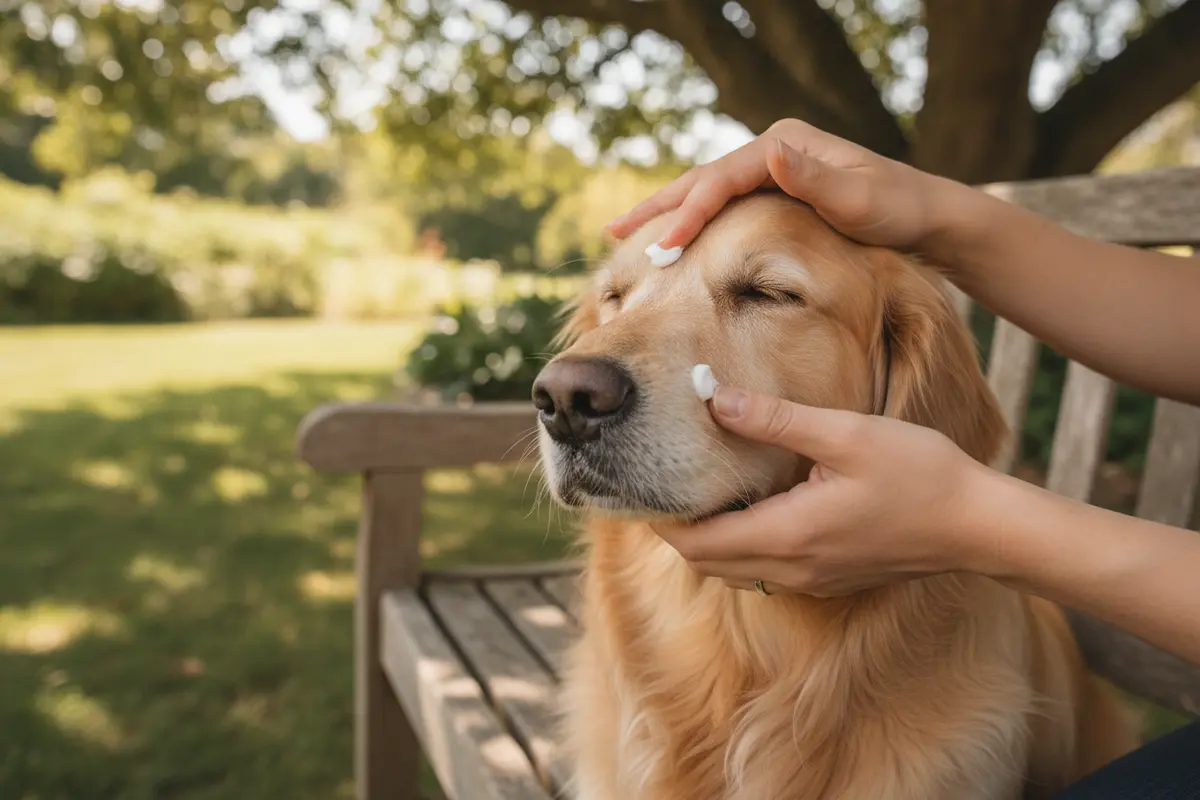
Only apply sunscreen to areas allowed by the product label. Commonly exposed spots can include the bridge of the nose, ear tips, and sparsely haired areas of the belly, but your dog’s coat, skin, and product instructions determine what is appropriate. Apply a small amount first if the label permits, and watch for irritation. Do not put sunscreen in or close to the eyes, inside the nose or mouth, on the genitals, or on broken or irritated skin unless your veterinarian specifically directs you to do so.
Prepare the dog before opening the container. Choose a quiet, shaded place and have the label, product, and any treats or calm rewards ready. If your dog is unfamiliar with the product, let them sniff the closed container first. You can practice briefly touching the intended area before application, then stop and try again later if the dog pulls away or becomes tense. A calm, gradual introduction is safer and more manageable than trying to apply a product while the dog struggles.
- Read the label before you go outside, not after you arrive.
- Keep your dog calm and work in a shaded, familiar spot.
- Apply only to the permitted skin areas, using the amount and method on the package.
- Prevent licking until the product has dried or the label says it is safe to resume normal activity.
- Follow the label’s reapplication instructions, including after swimming or heavy rubbing when directed.
- Wash your hands and store the product where your dog cannot reach it.
Never spray toward your dog’s face. If the label allows a spray, apply it to your hands first and then gently spread it over the approved area, taking care not to contaminate the eyes or nose. Stop if your dog becomes distressed. Do not force an application if your dog is struggling; ask your veterinarian about another approach.
After applying, give the product the amount of time specified on its label before heading into direct sun or letting the dog groom. Do not guess at drying time. Keep the dog occupied with a calm activity and supervise closely so the product is not licked off. If the dog gets the product in an eye or mouth, follow the package instructions and contact your veterinarian for advice if you are unsure what to do.
Dog sunscreen and other ways to limit sun exposure
The simplest protection is often reducing direct exposure. Combine a dog-safe sunscreen, when appropriate, with shade, a water break, and a shorter outing during intense sun.
Think of sunscreen as one tool, not a pass to stay in the sun longer. Plan a route with shade, take breaks, and let your dog move to a cooler, sheltered place. Bring water and watch your dog’s behavior. If the ground is too hot for comfortable paw contact, choose another route or time; sunscreen does not protect paws from hot pavement.
Clothing may provide another physical barrier when it is designed for that purpose and fits comfortably. A dog garment is not automatically UV protective, so check its product details rather than assuming coverage. If you consider clothing as an added barrier, confirm that the specific garment is designed for sun protection, fits comfortably, and does not cause overheating. Clothing should not restrict movement, cause overheating, or replace shade.
Before relying on a garment, check how much of the exposed area it actually covers. Observe your dog walking, sitting, and lying down in it. Look for rubbing at the legs, chest, or neck, and make sure the dog can move freely and settle comfortably. A garment that shifts, bunches, or causes the dog to pant heavily is not a practical sun barrier for that outing. Remove it and use shade or a different plan.
Use the same practical thinking when planning exercise. Walk early or later when conditions are more comfortable, make outings shorter on especially sunny days, and choose indoor rest or play instead of prolonged exposure. For a change of pace at home, explore interactive dog toys for supervised play. Keep activity appropriate for your dog and stop if they seem uncomfortable.
For multi-pet households, make a sun plan for each animal rather than assuming one routine works for all. A dog’s coat and habits differ from a horse’s or cat’s. Keep products labeled for each species separate, and ask your veterinarian before using a product intended for another animal.
When planning an outing with more than one animal, pack and label each pet’s supplies separately. A product chosen for one animal should not be treated as suitable for another just because both may spend time outdoors. Keep every animal’s shade, water, and rest needs in view, and make sure no pet is left in a place where direct sun or heat builds up while the others are active.
A comparison checklist before you buy
Compare labels and directions rather than choosing by packaging alone. The table below is a checklist for evaluating options, not an endorsement of a particular formula. If you cannot answer a question from the label, contact the manufacturer or ask your veterinarian before applying the product.
| What to check | Dog-specific sunscreen | Human sunscreen | Shade or protective clothing |
|---|---|---|---|
| Intended user | Label states it is for dogs | Made for people, not automatically suitable for dogs | Check that the item is made for dogs and designed for the intended use |
| Ingredient information | Review full ingredients and warnings; ask your vet about concerns | Ingredients may pose a risk if licked; do not assume it is safe | Check material, fit, and any stated UV-protection details |
| Application details | Follow label for approved areas, amount, and reapplication | Human directions do not establish safe dog use | Use shade naturally; check garment coverage and comfort |
| Best role | May be one part of a sun-safety plan when appropriate | Use only if your veterinarian specifically approves | Can reduce direct exposure but does not replace supervision or breaks |
| When to seek advice | Unclear label, health concern, reaction, or accidental ingestion | Before use, and promptly if your dog licks or reacts to it | If the dog overheats, is uncomfortable, or the fit limits movement |
This comparison is deliberately cautious. Sunscreens differ, and product formulations can change. Read the actual package in hand, not just a short product description or an old review. When in doubt, use shade and avoid applying an uncertain product while you check with a veterinary professional.
Use the table as a decision aid, not a ranking. For example, if a dog will be outside briefly on a shaded path and has no exposed skin, changing the route may be all that is needed. If the dog has exposed areas and the outing cannot be shifted, ask the veterinarian whether a particular dog-labeled product is suitable and how to use it. If the label does not answer your questions, it is reasonable to choose the non-product options while you obtain advice.
Recognize when to stop and get help
Stop using a product if you notice redness, swelling, itching, a rash, unusual licking, or other skin changes after application. Prevent further licking if you can do so safely, and contact your veterinarian for advice. If your dog swallows sunscreen, check the label and call your veterinarian or an animal poison-control service for guidance. Keep the package available so you can report the product name and ingredients. Do not try to make your dog vomit unless a veterinary professional instructs you to.
Sunburn may cause red, tender, or irritated skin. Blistering, significant pain, or a worsening skin change needs prompt veterinary attention. Do not apply more sunscreen, human ointments, or home remedies to an injured area unless your veterinarian recommends them. Skin irritation can have causes other than sun exposure, and a professional can help determine the next step.
Sun protection and heat safety are related but different. Sunscreen does not prevent overheating. Heavy panting, weakness, confusion, vomiting, collapse, or other sudden distress after heat exposure may be an emergency. Move the dog to a cooler place and contact a veterinarian immediately for instructions. Do not wait to see whether sunscreen resolves a heat-related problem.
If you contact a veterinary professional, be ready to share when the product was applied, where it was used, whether the dog may have licked or swallowed any, and what signs you noticed. Keep the original container nearby so the ingredient list and directions are available. Avoid applying another product while you wait for instructions unless the veterinary professional tells you to do so.
Build a simple sun-safe routine
A repeatable routine makes it easier to protect your dog without turning every outing into a complicated process. Before leaving, check the weather and route, pack water, and decide where your dog can rest in shade. If sunscreen is appropriate, confirm that it is dog-specific, within date, and applied only as directed. Take breaks and turn back if your dog is uncomfortable.
- Before the outing: Check for exposed skin, read the sunscreen directions, and choose a route with shade.
- During the outing: Offer water, take breaks, and watch for changes in comfort or energy.
- After the outing: Check the skin and coat for irritation, and follow label directions about washing or reapplication.
- For repeat exposure: Ask your veterinarian to help tailor a plan to your dog’s coat, skin, health, and activities.
A little preparation can also prevent rushed decisions. Keep the product in its original container, check its expiration date before the season starts, and replace it if the package is damaged or the directions are no longer readable. Add water and a collapsible bowl to your outing kit, and identify a shaded rest option before you leave. If the plan changes and shade is not available, shorten the outing rather than assuming sunscreen alone makes the conditions suitable.
Match the plan to the kind of day. For a quick neighborhood walk, choose a shaded side of the street when available and keep the route flexible. For a longer hike or time near water, plan several rest points, bring enough water, and think through how swimming or rubbing could affect any applied product. For yard time, give the dog access to shade and a way to come indoors. Recheck the dog rather than leaving them outside unattended for long stretches.
Keep sunscreen and other supplies out of reach between outings. If you use a clothing layer, review its fit and product details, and verify any sun-protection claims before use. For a quieter indoor break, browse interactive fetch toys for supervised play away from direct sunlight.
Shop interactive dog toys today
Frequently Asked Questions
Can I use regular human sunscreen on my dog?
Do not use human sunscreen unless your veterinarian specifically approves that product for your dog. Dogs can lick applied products, and some ingredients may be harmful if swallowed. Ask your veterinarian to review the exact product and ingredient list.
Which dogs may benefit from sunscreen?
Dogs with sparse or thin fur, hairless areas, or pale and exposed skin may need extra sun protection. Exposure, coat, skin, and health all matter. Your veterinarian can help assess your dog’s individual needs.
Can I apply sunscreen to my dog’s nose?
Only if the product label permits use there and you can keep it out of the eyes, nostrils, and mouth. Dogs may lick the nose, so ask your veterinarian which product and method are appropriate for your dog.
How often should I reapply dog sunscreen?
Follow the directions on the specific product. Reapplication instructions vary, including after swimming or rubbing. Do not guess at timing or apply more often than directed.
Does dog sunscreen prevent heatstroke?
No. Sunscreen is for skin protection and does not prevent overheating. Provide shade, water, and breaks, and contact a veterinarian promptly if your dog shows signs of heat distress.
What should I do if my dog licks sunscreen?
Check the product label, note the ingredients and possible amount, and contact your veterinarian or an animal poison-control service for advice. Do not induce vomiting unless a veterinary professional tells you to.
Is sunscreen enough for a long day outdoors?
No. It may be one part of a plan when appropriate, but shade, water, rest, and limiting exposure remain important. Reassess the conditions during the day and leave if your dog seems uncomfortable or the planned shade is unavailable.
A careful label check, sensible time in the sun, and a conversation with your veterinarian can help you choose an approach that fits your dog.


