


A cat harness and leash can give a curious cat a chance to explore outside while staying connected to its person. The right setup starts with fit, calm indoor practice, and a plan for what to do if your cat freezes or tries to back out. A leash does not make every cat comfortable outdoors, so let your cat's response guide each step.
What should you look for in a cat harness and leash?
Start with the harness, not the leash. A harness should sit securely around the cat's body without rubbing, pinching, or restricting normal movement. The leash then connects to the harness to give you a way to guide your cat at close range. A collar alone is not a substitute for a harness when you are attaching a leash, since pulling on a collar can put pressure on the neck.
Key Takeaway
Choose a harness that adjusts to your cat's body and stays secure during gentle movement. You should be able to check the fit and attachment before every outing.
Common harness designs include vest-style and strap-style options. A vest can cover more of the torso, while a strap style uses narrower bands. Neither design is automatically right for every cat. Look for adjustable points, smooth edges, secure fasteners, and a leash attachment intended for the harness. The best choice is the one your cat can wear comfortably and that you can fit consistently.
| Option | What to consider | Best next step |
|---|---|---|
| Vest-style harness | More fabric contacts the body. Check for heat, rubbing, and freedom of movement. | Adjust it carefully and observe your cat walking indoors. |
| Strap-style harness | Several bands and buckles need to be positioned correctly. | Check each strap and fastener, then test for slipping with gentle movement. |
| Collar with leash | Does not distribute leash pressure across the body like a harness. | Do not use a collar as a replacement for a cat harness. |
| Harness and leash set | Confirm the leash attaches to the harness and is an appropriate length for close supervision. | Inspect the connection and keep the cat within easy reach. |
Do not select a size based on age or breed alone. Use the brand's sizing directions and measure the cat as instructed. If measurements fall between sizes, or your cat has a body shape that makes the fit unclear, ask the seller or your veterinarian how to evaluate the options. Avoid relying on a description such as "escape-proof" as a guarantee. A determined cat may still twist or back out, so fit checks and supervision matter.
Think through the whole connection, not just the fabric
A useful setup is a chain of several parts: the harness, its intended leash attachment, the leash clip, and the leash itself. Each part should work with the others. Before buying, check whether the harness maker gives a clear sizing chart and directions for putting it on. Look at how the leash attaches and whether the clip can be operated easily while you keep the cat close. A small or awkward clip can be difficult to fasten with one hand, especially if your cat is moving.
Consider how the equipment will be used. A cat who will only practice inside needs a different level of planning than one who may visit a garden or enclosed patio. For indoor sessions, a manageable leash that stays under your control is more useful than extra length that can wrap around furniture. Outdoors, the goal is still close supervision, not allowing the cat to range at the end of a long line. Choose manageable gear, not gear that encourages distance.
Try the fastening sequence before the first real session. Lay the harness out, locate each buckle, adjustment, and attachment point, then rehearse opening and closing them. Make sure the leash clip fits the designated ring without forcing it. When gear is unfamiliar to the person using it, fumbling can prolong the time the cat must tolerate handling. A calm, practiced routine helps make each fitting session brief and predictable.
How do you check harness fit?
Try the harness in a quiet room when your cat is relaxed. Follow the maker's fitting directions. The harness should be snug enough that it does not slide freely or rotate when the cat moves, while still allowing comfortable breathing and ordinary steps. Check around the chest, shoulders, and any area where a strap or edge touches the body. Look for pinched fur, rubbing, or pressure points.
Fasten every buckle and inspect each adjustment point. Gently move the harness as the instructions allow, without yanking or pulling hard. Watch whether it shifts toward the head or loosens when the cat turns. Attach the leash only to the harness's designated connector. Before going outside, verify that the leash clip closes fully and that the harness has not loosened since your last check.
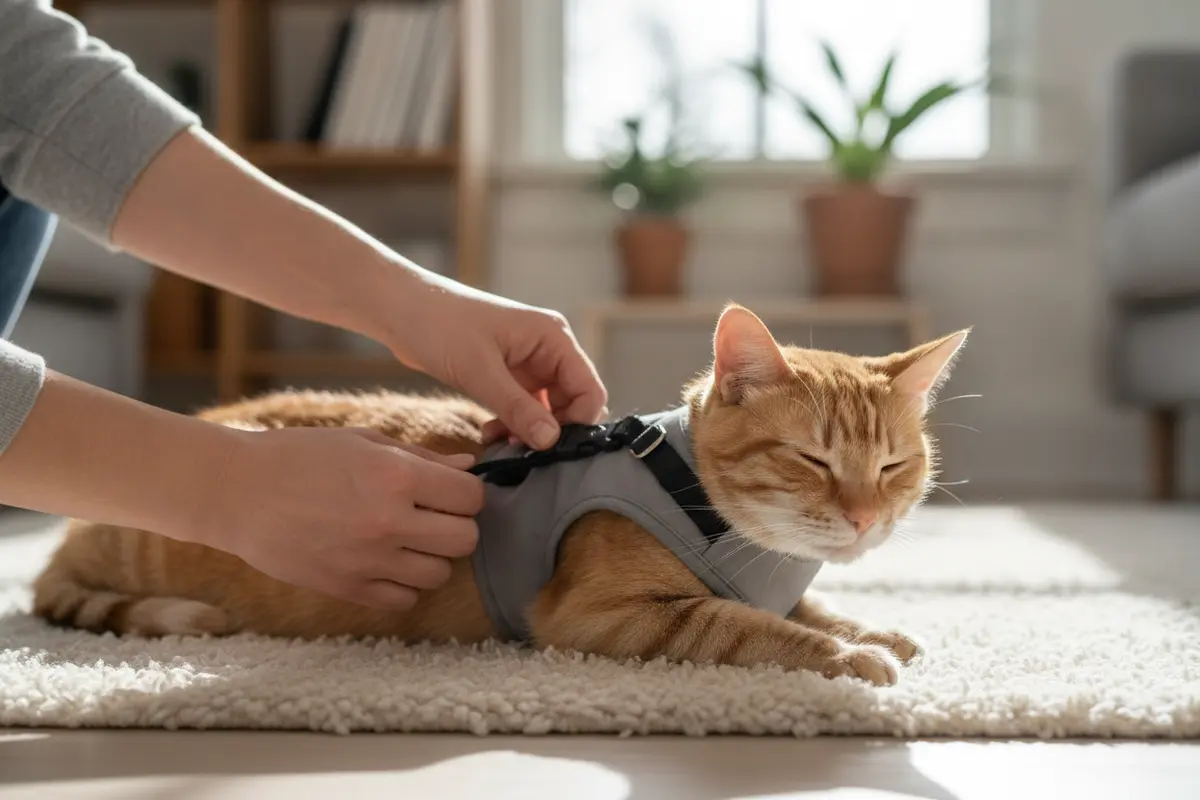
A fit check is not a one-time task. Cats can change size, coat condition, or tolerance for gear, and straps can shift with use. Inspect before each practice session and outing. Stop if you notice rubbing, restricted movement, a damaged buckle, a frayed leash, or a connector that does not close securely. Replace damaged gear rather than trying to compensate with a tighter fit.
A practical fit check from first fastening to movement
First, place the harness according to its instructions and check that the front and body sections are not reversed or twisted. Fasten the closures without pulling the cat's legs or shoulders into an unnatural position. Then look at the fit from above and from each side. Does the harness lie flat? Are the straps sitting where the design intends them to sit? Are any edges pressing into the armpit area or shifting toward the throat?
Next, observe ordinary movement. Let the cat stand, turn, sit, and take a few steps in a familiar room. A harness that appears correctly positioned while the cat is still may shift as the body bends. If it moves, pause and readjust according to the manufacturer's guidance. Do not solve slipping by tightening every strap indiscriminately. If adjustments cannot make it stable and comfortable, the size or design may not suit that cat.
Finally, check the connection again. Hold the leash close and gently test the clip in the way the maker recommends. Do not use a forceful tug test on the cat. The purpose is to see that the clip is closed, the ring is intact, and the harness remains in place during normal movement. Make this same visual check each time, even if the cat wore the harness the day before.
How can you introduce a harness without rushing?
Most cats need time to get used to wearing equipment. Begin with the harness in the cat's familiar space. Let your cat investigate it voluntarily. You can place it near a favorite resting area, but do not trap, chase, or force the cat to approach. Once the cat is relaxed near the harness, briefly touch it to the body, then put it away and continue another time.
Build up in small steps. Place the harness on the cat for a short period, reward calm behavior if your cat enjoys food or play rewards, then remove it. Increase the time gradually only when the cat remains at ease. Next, let the cat move around indoors while wearing it. Keep the first sessions brief and end before the cat becomes distressed. Attach the leash indoors only after the harness itself is tolerated, and hold it loosely so it does not drag or catch.
- Let the cat see and investigate the harness at its own pace.
- Practice brief, gentle contact with the harness, then pause.
- Put it on for a short indoor session and reward relaxed behavior.
- Gradually allow more time and normal movement while supervised.
- Attach the leash indoors and practice following without pulling.
- Move to a quiet, enclosed outdoor space only if indoor practice is calm.
A cat that lies down, walks low, or moves awkwardly at first may simply be unfamiliar with the sensation. But do not assume every response is harmless or that the cat will adjust if you keep going. Pause, remove the harness if the cat is distressed, and try a shorter or easier step another day. If your cat repeatedly resists, harness walking may not be a good activity for that individual.
Quick Summary
Progress from looking at the harness to wearing it, moving indoors, and then connecting the leash. Do not move to the next stage until your cat is comfortable at the current one.
A qualitative research paper discussing cat walking notes that using a harness and leash is suggested in the limited literature about walking cats. This is not a promise that every cat will enjoy it. Treat the activity as an individual choice and keep your cat's comfort at the center of the decision. Read the paper on cat walking and related experiences.
Use a gradual practice ladder
Think of the introduction as a sequence rather than a deadline. Stage one is simply having the harness nearby while the cat remains free to leave. Stage two is brief contact, such as letting the harness rest against the cat's side for a moment. Stage three is fastening it briefly, then taking it off before the cat becomes frustrated. Only after the cat accepts that should you lengthen the wearing time or invite normal walking indoors.
At the next stage, attach the leash while indoors, but keep it in your hand and close to the cat. Let the cat move naturally; avoid steering by pulling. Practice turning toward you with a gentle voice or a familiar reward rather than using leash tension. A session can end after a calm minute or two. The goal is an uneventful experience that can be repeated, not a long training session.
If a step goes poorly, go back one stage or pause for the day. For example, if the cat accepts a harness resting on its back but becomes tense when it is fastened, return to brief contact and stop there. If the leash itself is startling, leave it in view during another session before clipping it on. Small adjustments make it easier to identify what is bothering the cat, while repeating an overwhelming step can create more reluctance.
Use rewards only if they help your individual cat. Some cats are motivated by a small food reward, while others respond better to play, a quiet voice, or simply having the equipment removed promptly. Keep treats modest and account for them within the cat's normal feeding routine. Do not hold food just out of reach to lure a frightened cat into a harness. Participation should remain voluntary and calm.
Where and when should you take a cat outdoors?
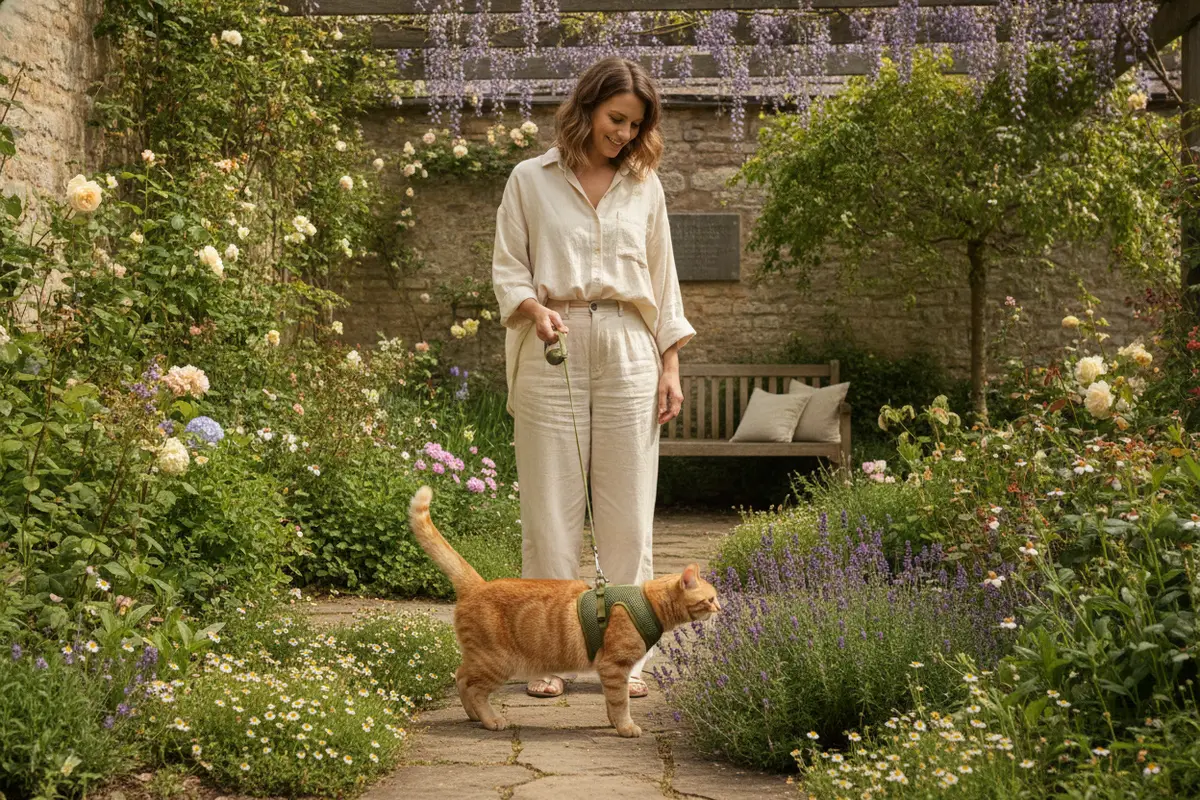
Choose a quiet place with a secure boundary and few sudden noises or moving hazards. A busy sidewalk, crowded event, or area with loose dogs can be overwhelming and difficult to manage. Keep the first outdoor visit short. Stay close, keep the leash slack, and let the cat decide whether to look around or remain near you. Never tie the leash to an object or leave a harnessed cat unattended.
Before you leave home, consider how you will carry your cat back inside if it becomes frightened. A carrier can provide a familiar retreat and a secure way to return. Keep doors and gates closed, and do not assume a fence alone will contain a cat. If the cat startles, avoid dragging it toward you. Move calmly, reduce pressure on the leash, and use the carrier or another safe route to end the outing.
Weather and surroundings also matter. Avoid conditions that could make the ground or air uncomfortable, and check the area for sharp debris, toxic substances, traffic, and other animals. Do not let outdoor exploration replace ordinary supervision or a secure home environment. A harness and leash offer limited control, not a guarantee against escape or injury.
Plan the first trip before opening the door
Choose the destination and route before the cat is harnessed. A quiet enclosed area close to home is easier to leave than a busy public space or a long walk away. Check that doors, gates, and access points can be closed. Look at the ground for hazards and note where you can retreat if people, dogs, vehicles, or sudden sounds appear. If conditions are unsettled, postpone rather than trying to make the outing work.
Keep the carrier ready and accessible. A carrier can help you transport the cat safely in both directions, and it offers a planned way to end an outing without pulling on the leash. If your cat already uses a carrier comfortably, that familiar object may make departure and return less complicated. Do not rely on carrying a frightened cat loose in your arms near a door or other escape route.
At the destination, give the cat time to observe before expecting movement. Some cats may prefer to remain beside the carrier or close to their person. That still counts as useful information about how the environment feels. Do not coax the cat farther just to cover ground. End the visit while you can still manage it calmly, and make the next decision based on what the cat showed you.
What signs mean it is time to stop?
Watch your cat rather than focusing only on the harness. If your cat tries repeatedly to escape, crouches and will not move, struggles, pants, vocalizes in distress, or appears overwhelmed, end the practice or outing. Do not punish or pull the cat into motion. Move to a quiet place and let the cat settle. If behavior or physical signs concern you, contact a veterinarian for individual advice.
Also stop if the gear shifts, catches, or seems to limit movement. A cat can become frightened quickly, and a loose harness may make escape more likely. Keep your phone and the carrier accessible, and choose a location where you can leave easily. If every outing is stressful despite gradual indoor practice, use indoor enrichment instead. Window perches, play, and food-search activities can offer stimulation without requiring a leash walk.
How to respond when a cat freezes or backs away
If your cat freezes, first stop moving and loosen any pressure on the leash. Give the cat a moment to look and settle, while staying alert to nearby hazards. Do not tug the leash to make the cat walk. If the cat relaxes, you can wait briefly or calmly return to the carrier. If distress continues, finish the outing. A quiet retreat is a better outcome than extending a session the cat cannot handle.
If the cat twists or begins to back out, avoid grabbing the leash and pulling against the movement, which may worsen the struggle. Keep the cat close, reduce pressure, and use the carrier if possible. Once safely indoors, examine how the harness shifted and whether a strap was incorrectly placed or adjusted. Do not immediately retry outdoors. Reassess the fit and go back to supervised indoor practice, or stop using that setup if it cannot be made secure.
After an outing, consider the whole experience rather than only whether the cat reached the garden. Did the cat tolerate getting dressed? Was the environment quiet? Could you return easily? Those observations help decide what to change next time. A shorter visit, a calmer location, or staying indoors may be the right adjustment. Some cats are more content with indoor activities, and that preference does not need to be corrected.
Care for the harness and leash
Follow the manufacturer's cleaning and storage directions. After use, check fabric, stitching, buckles, adjustment slides, clips, and leash material for wear or damage. Remove dirt and allow gear to dry fully before storing it. Keep the harness and leash in a place where a cat cannot chew or play with them unsupervised. Recheck the fit after cleaning, since straps can shift during handling.
Do not modify a harness by cutting straps, adding unapproved clips, or tying extensions to it. Changes can affect how it fits or how the leash connects. If a part breaks or the harness no longer adjusts securely, stop using it and find a replacement that meets your cat's needs.
Make inspection part of putting the equipment away, not just a task for the next outing. Run your eyes along the seams and straps, and work each buckle and clip as intended. Look for loose stitching, cracked or bent fasteners, fraying, and areas that have become stiff or rough. If the harness is damp, let it dry fully in a suitable place before storing it. Follow its care label rather than using a cleaning method that could weaken or distort the material.
Store the set together so a leash from a different product is not accidentally paired with a harness it does not fit. Keep the gear away from chewing and entanglement. If several people in the household use it, show everyone the correct fitting position and leash attachment. Consistent use of the maker's instructions makes it easier to notice changes in fit and condition from one session to the next.
Make outdoor practice work in a multi-pet home
When cats and dogs share a home, give each animal separate equipment and a calm space for practice. A dog leash is not a substitute for a cat harness. For example, the Weaver Leather Terrain D.O.G. Rope Leash is designed for dog walking, not for a cat harness or cat leash. If a dog becomes excited, let the cat practice behind a closed door or in another quiet area.
It can help to keep another pet occupied while you focus on a brief cat session. Dog toys, such as the Petlou squeaky plush dog toys, should stay with the dog they are intended for and should be used with supervision. For a different way to plan supervised outdoor transport, review the harness-compatible cat stroller guide. Keep that option separate from the equipment used for walking on a leash. For a broader comparison of handling choices, see the leash length and style guide as a general reference, while still following cat-specific fit instructions.
Before each session, check the harness fit, leash connection, carrier, route, and household setup. Keep the first outings short and turn back if your cat freezes, struggles, or seems overwhelmed. Progress means your cat can explore at a comfortable pace, not that you reach a certain distance.
Set up the room and household first
Choose a quiet room, close exterior doors and windows, and remove objects that could catch the leash. Keep other pets out if they change the cat's behavior. Everyone handling the cat should know where the harness is stored, how it goes on, where the leash attaches, and which signs mean stop. Children should not manage a harnessed cat or carry the leash without an adult.
For the first outdoor attempts, one person can focus on the cat while another manages the carrier or door. There is no need to combine the cat's activity with the dog's walk. Store each animal's equipment in a clearly labeled place so nobody mistakes a dog collar or leash for cat walking gear.
A short pre-outing checklist
- Confirm the harness is correctly positioned, comfortable, and undamaged.
- Check that the leash clip closes and connects to the designated point.
- Have the carrier ready and know how you will return indoors.
- Check the route for noise, open gates, other animals, and hazards.
- Make sure other pets will not interrupt the session.
- Choose an easy stopping point and be ready to end early.
Learn More About Cat Outdoor Gear
Frequently Asked Questions
Can I attach a leash to my cat's collar?
Use a properly fitted harness designed for leash attachment rather than relying on a collar. A harness distributes contact around the body and provides a more suitable attachment point. Follow the manufacturer's instructions and check the fit before each use.
How tight should a cat harness be?
Follow the specific sizing and fitting directions for the harness. It should stay in place without restricting comfortable movement, breathing, or normal steps. Check for shifting, pinching, and rubbing while your cat moves indoors.
How long does it take a cat to get used to a harness?
There is no fixed timeline. Some cats may accept brief sessions sooner than others, while some may never enjoy wearing a harness. Move in small steps and let your cat's comfort determine the pace.
Should I take my cat outside on the first day it wears a harness?
No. First practice wearing the harness and moving indoors. Add the leash indoors, then consider a quiet, secure outdoor spot only if your cat remains relaxed through those steps.
What should I do if my cat backs out of the harness?
Stay calm, avoid pulling hard, and safely end the session. Recheck the fit and adjustment directions before trying again indoors. If the harness repeatedly shifts or your cat remains distressed, stop using that setup and seek advice from the seller or your veterinarian.
Can every cat learn to walk on a leash?
No. Cats differ in comfort and temperament. Some may tolerate brief, supervised exploration, while others prefer indoor activities. Do not force a cat to continue if it shows persistent fear or resistance.
How do I know whether to try a vest-style or strap-style harness?
Compare how each design fits your cat, how easily it adjusts, and whether it stays in place during gentle indoor movement. Follow each product's sizing and fitting directions. If either option rubs, shifts, or restricts movement, it is not a good fit just because its style is popular.
Can I leave my cat alone while it wears a harness?
No. Supervise the cat whenever the harness and leash are in use. A leash or strap can catch, and an unattended cat may become tangled or frightened. Remove the equipment after practice or an outing and store it safely.
A cat harness and leash can be useful for some cats when the equipment fits well and the introduction is gradual. Keep sessions supervised, respond to your cat's signals, and choose indoor enrichment instead if outdoor walking does not suit your cat.


