


A cat stroller can give an indoor cat a controlled way to enjoy fresh air, accompany you on a walk, or travel through a busy event without walking on a leash. The best cat stroller is not simply the one with the largest canopy or the most wheels. It should fit your cat's body, keep the carrier area secure and well ventilated, roll predictably, and make it easy for your cat to rest comfortably.
Shop cat comfort and enrichment essentials
What should you look for in a cat stroller?
A safe cat stroller has enough interior room for your cat to stand, turn around, and lie down, plus breathable mesh, a sturdy frame, reliable brakes, secure closures, and a harness-compatible restraint point.
Start with your cat's needs rather than a stroller's marketing language. A model for occasional neighborhood walks may be different from one used for veterinary visits, outdoor markets, or travel between a car and a destination. Look for a defined interior weight limit, a base that stays level when the stroller turns, and a cabin that cannot be opened by a curious paw.
- Correct interior size: Your cat should be able to stand, change position, and settle naturally.
- Cross-ventilation: Mesh openings on more than one side improve airflow and visibility.
- Stable construction: The frame should remain steady when parked and when the stroller is turned slowly.
- Secure restraint points: Use a short tether with a well-fitted harness, never a collar alone.
- Useful wheel hardware: Swivel control, smooth rolling, and a dependable parking brake matter more than decorative features.
- Weather protection: A canopy or rain cover should shield your cat without sealing in heat.
Always read the manufacturer's instructions before using a tether, cover, car-seat adapter, or removable carrier. A stroller is for supervised transport. It is not a safe place to leave a cat unattended, and it is not a replacement for a properly secured vehicle carrier during a car trip.
How do you choose the right stroller size for your cat?
Measure your cat before shopping, then compare those measurements with the usable interior floor area, cabin height, and weight rating. A cat stroller should provide room to reposition without allowing enough empty space for your cat to slide dangerously during a turn.
Measure your cat while they are standing naturally. Record the length from the nose to the base of the tail, the height from the floor to the top of the head or ears, and the widest part of the body. Then compare those measurements with the stroller's actual interior dimensions, not its exterior footprint. The cabin should allow your cat to turn around and lie down without pressing against the sides.
Do not choose a stroller by weight capacity alone. A large cat may be under the stated weight limit but still feel cramped in a narrow cabin. Conversely, a very open cabin may give a small cat too much room to slide when the stroller crosses a curb. A washable pad with a slightly raised edge can improve comfort and help create a more secure resting area.
| What to check | Why it matters | Questions to ask |
|---|---|---|
| Interior length and width | Gives your cat room to change position | Can my cat turn around and lie down? |
| Cabin height | Prevents a crouched, uncomfortable posture | Can my cat sit or stand without touching the canopy? |
| Weight rating | Protects frame and wheel performance | Does the rating include bedding and a second cat? |
| Entry opening | Makes loading less stressful | Can I place my cat inside without forcing them through a small door? |
If you plan to transport two cats, check whether the manufacturer permits that use. Two cats need enough separate resting space, and their combined weight can affect balance. Separate carriers or compartments may be safer for cats that do not travel well together.
Shop This Post

Featured in this article
Ducky World Yeowww! 7" Organic Catnip Kicker for Barn Cats
$12.11
Shop Now →

Ventilation and visibility are safety features
Choose breathable mesh on multiple sides, keep airflow open in warm weather, and give your cat a visual retreat. A covered stroller should protect from sun and distractions without trapping heat or reducing ventilation.
A calm, well-ventilated stroller setup should let your cat rest while you keep the cabin secure and within reach.
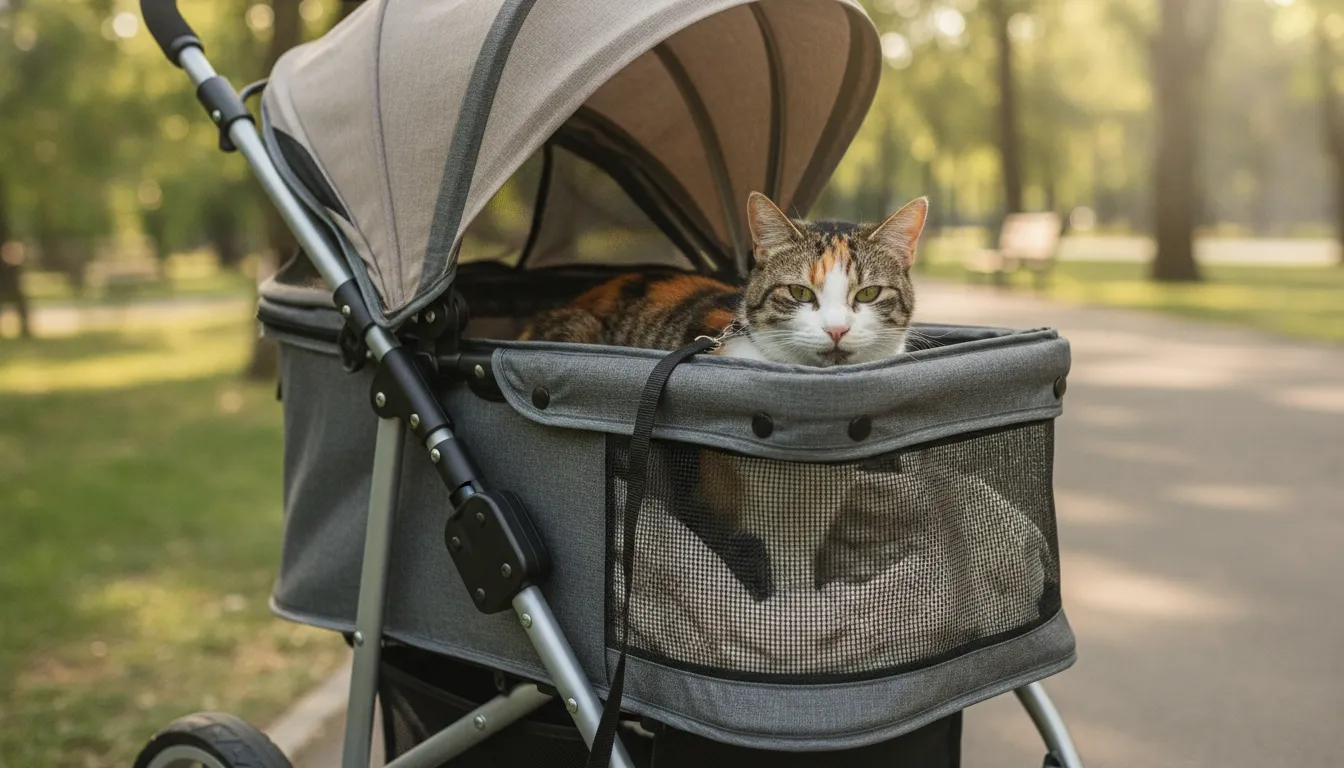
Mesh panels serve several purposes: they allow air exchange, let you monitor your cat, and give your cat a view of the surroundings. Look for openings at the front and sides rather than a single small window. Mesh should be tightly woven, securely sewn, and free from gaps that could catch claws.
Visibility is a preference, not a requirement. Some cats relax when they can watch the path, while others settle better behind a partial cover. A stroller with a canopy that can be adjusted in stages gives you more control. Keep the cabin out of direct sun, and never cover the mesh with a blanket in warm weather. Cats can overheat quickly in an enclosed space.
For cold or wet conditions, use only the cover supplied or approved for that stroller. The cover should not block every ventilation panel. Check your cat frequently for signs of distress, including rapid breathing, excessive vocalization, drooling, frantic escape attempts, weakness, or unusual stillness. End the outing and contact a veterinarian if concerning signs do not resolve promptly.
Frame stability, wheels, and brakes
A stable cat stroller should track smoothly and remain balanced when you walk at a controlled pace. Before buying, inspect how the frame supports the cabin, whether the base flexes, and whether the stroller stays upright when parked. A low center of gravity and a broad wheel stance can make a stroller feel steadier, but the finished design matters more than any single feature.
- Front wheels: Swivel wheels can improve maneuverability, while a lockable setting can help on straight paths.
- Rear wheels: Look for solid attachment points and a brake that engages easily on both sides when applicable.
- Wheel size: Larger wheels may roll more smoothly over small surface changes, but no stroller should be pushed quickly over rough terrain.
- Handle height: An adjustable handle can reduce strain and help you maintain control.
- Parking brake: Test the brake before loading your cat and use it whenever you stop.
Do not use a standard pet stroller for jogging, stairs, or steep trails unless the manufacturer specifically rates it for that purpose. Lift the stroller over steps rather than dragging the front wheels up them. Slow down before curbs, keep both hands available when the path is uneven, and never hang a heavy bag from the handle if it could tip the stroller backward.
What restraint and closure features does a cat stroller need?
Use every zipper, latch, and closure as designed, and connect a stroller tether to a properly fitted harness when the product instructions allow it. A tether should prevent a dash through an open panel, not forcefully restrain a cat or replace supervision.
A cat stroller should have closures that stay shut when the stroller moves. Check zippers for smooth operation, inspect seams around doors and mesh, and look for locking clips or interior safety straps. Before each outing, run your hand around the cabin and confirm that there are no openings large enough for your cat's head or paws to reach through.
If the stroller includes an interior tether, connect it to a harness rather than a collar. The tether should be short enough to prevent an escape but long enough for your cat to lie down and reposition. Never attach a tether to a collar, and do not use a tether if the manufacturer prohibits it. A cat can injure their neck or become tangled when a restraint is used incorrectly.
Safety does not end when the canopy is closed. Keep the stroller within reach, avoid crowded contact with unfamiliar dogs, and do not allow anyone to unzip the cabin without your permission. In a parking lot or near traffic, use the stroller's brake before opening any panel.
Weather protection, storage, and everyday usability
A good stroller solves practical problems without creating new ones. A canopy can reduce glare and light rain, while a removable, washable liner makes accidents easier to handle. Check whether the fabric is water resistant or truly waterproof, and remember that a rain cover may reduce airflow. Carry a towel, waste bags, water for the person, and any cat-specific supplies you need, but keep heavy items low and centered.
Storage baskets are useful for lightweight items, but do not overload them. An organizer on the handle can change the stroller's balance, especially when the cat is small. Look for a fold mechanism that does not pinch fingers and confirm that the folded stroller fits your vehicle or storage area. If the stroller has a removable carrier, test that the carrier locks securely into the frame before placing your cat inside.
For a veterinary visit, a stroller with a removable carrier can be convenient, but the clinic may still require a separate carrier or a specific setup. Ask ahead of time. For a neighborhood walk, choose a model you can control on the routes you actually use. For an event, prioritize ventilation, secure closures, and a way to limit visual stimulation.
Shop cat essentials for calmer outings today
How can you acclimate a cat to a stroller?
Acclimation is often more important than the stroller's feature list. Cats are territorial animals, and unfamiliar movement, smells, people, and noise can feel threatening. International Cat Care recommends secure transport and careful management of unfamiliar environments, while the ASPCApro carrier-training resource emphasizes changing a cat's association with the carrier through gradual, positive experiences.
- Set it up indoors: Keep the stroller stationary with the entry open. Let your cat investigate without being placed inside.
- Add familiar scent: Put in a washable blanket or bed that already smells like home.
- Reward voluntary entry: Use praise, a favorite toy, or a small treat when your cat approaches or rests inside.
- Practice brief closure: Close the panel for a few seconds, then open it before your cat becomes distressed.
- Introduce movement slowly: Roll the stroller a short distance indoors, then pause and reward calm behavior.
- Try a quiet outdoor location: Begin with a few minutes in a low-traffic area and return home while the experience is still positive.
Never force a frightened cat into a stroller and assume they will adapt on the move. Watch body language such as flattened ears, crouching, rapid breathing, growling, repeated escape attempts, or a frozen posture. Short, successful sessions are more useful than a long outing that teaches your cat the stroller is frightening. A veterinarian can help if travel anxiety is severe or a medical condition makes outdoor transport risky.
Which cat stroller fits your travel situation?
Match the stroller to the route and the cat, not just the product photo. Quiet walks call for comfort and smooth handling, while busy locations require stronger containment, more ventilation, and better control of visual stimulation.
| Travel situation | Prioritize | Use extra caution with |
|---|---|---|
| Short neighborhood walk | Comfortable cabin, smooth wheels, parking brake | Heat, traffic, loose dogs, and sudden noises |
| Veterinary visit | Secure entry, washable liner, removable carrier if approved | Opening the stroller in a parking lot or waiting room |
| Outdoor market or event | Breathable mesh, partial visual cover, reliable closures | Crowds, touching, loud sounds, and unfamiliar animals |
| Car-to-destination transfer | Compact fold and a separate, vehicle-approved carrier | Using the stroller as a substitute for vehicle restraint |
A stroller should expand safe choices for a cat that tolerates the experience. It should not be used to force outdoor activity on a cat that consistently shows fear. If your cat prefers staying home, enrichment indoors can be a better fit. Hooves and Paws also offers cat enrichment ideas for indoor cats, along with guides to automatic toys for cats when you are away.
Frequently Asked Questions
Are cat strollers safe?
Cat strollers can be safe when they fit the cat, provide ventilation, stay closed, and are used under direct supervision. Use the parking brake when stopped, avoid extreme heat, and use a harness-compatible tether only as directed by the manufacturer.
Can a cat sleep in a stroller?
A cat may rest or nap during a supervised outing if the cabin is comfortable and well ventilated. Do not leave a cat unattended in a stroller, parked vehicle, direct sun, or any enclosed area that can heat up quickly.
What size stroller does my cat need?
Choose a cabin that lets your cat stand, turn around, and lie down naturally, then confirm the weight rating includes bedding and any other cat. Compare usable interior dimensions instead of relying on the stroller's outside measurements.
Should I use a leash inside a cat stroller?
Use an interior tether only if the stroller is designed for one and the instructions permit it. Attach it to a properly fitted harness, never a collar, and leave enough length for your cat to lie down without becoming tangled.
Can I use a cat stroller in hot weather?
Use extra caution in warm weather. Choose open mesh on multiple sides, keep the stroller out of direct sun, do not cover the vents with fabric, and end the outing if your cat shows rapid breathing, weakness, drooling, or distress.
Is a cat stroller a replacement for a carrier in the car?
No. A stroller is not a substitute for a vehicle-approved carrier or restraint system. Follow your vehicle and carrier manufacturer's instructions, and ask your veterinarian about the safest setup for your cat's journey.
Shop Now for cat comfort and enrichment essentials
Sources for safe cat travel: ASPCApro carrier training guidance, International Cat Care travel advice, Feline Veterinary Medical Association transportation guidance, and American Veterinary Medical Association vehicle safety guidance.


