


A horse grazing muzzle can help limit how much pasture a horse takes in during turnout, but it is only one part of a thoughtful management plan. The right choice depends on the horse’s health and behavior, the muzzle’s fit, the pasture, and how often someone can check the horse. This guide explains what to compare, how to introduce a muzzle gradually, and what to monitor before and during use.
What does a horse grazing muzzle do?
A grazing muzzle limits access to pasture grass without necessarily stopping grazing altogether. It does not establish an individual feeding plan or replace veterinary advice.
A grazing muzzle is designed to restrict the amount of grass a horse can grasp at one time. The horse may still be able to nibble through an opening, depending on the product’s design and fit. Owners may consider one when pasture access needs to be managed, including as one tool in a weight-management plan. It should not be treated as a guaranteed amount of intake reduction.
The University of Minnesota Extension article Using grazing muzzles to reduce forage intakes in horses reports an approximate reduction in pasture intake of 30 percent in the research it summarizes. That is a reported finding, not a promise for every horse or pasture. Grass growth, muzzle design, fit, grazing behavior, and time at pasture can all affect an individual result. Discuss use with your veterinarian, especially if your horse has a diagnosed condition, a history of metabolic concerns, or a prescribed diet.
A muzzle does not remove the need to plan for forage, water, movement, social contact, and observation. Nor does it make every paddock safe. Think of it as a management aid to assess with your equine care team, not a shortcut around the horse’s broader needs.
Which grazing muzzle features should you compare?
Start with the features that affect function and day-to-day checks. Products may differ in material, shape, base opening, attachment, and sizing. A good-looking or inexpensive option is not necessarily a suitable fit for a particular horse. Read the maker’s directions and compare the product with the horse and turnout setup you actually have.
| Feature | What to inspect | Questions to ask |
|---|---|---|
| Size and shape | Manufacturer’s measuring points, nose and jaw clearance, and where the muzzle sits | Does the maker’s sizing guide match this horse’s measurements and head shape? |
| Grazing opening | Opening size and whether grass, mud, or debris can obstruct it | Can the horse use it as intended, and can it be checked and cleaned easily? |
| Attachment | Straps, closures, halter compatibility, and adjustment range | Can it stay in the intended position without being tightened uncomfortably? |
| Edges and materials | Contact surfaces, seams, hardware, and signs of wear | Are edges smooth, and can you inspect the parts that touch the horse? |
| Daily care | Cleaning instructions, drainage, and access for routine inspection | Can you check the muzzle and the horse reliably after turnout? |
| Turnout suitability | Fencing, feeders, water source, pasture footing, and horse interactions | Could the equipment catch on something or make the setup difficult to navigate? |
Some styles attach to a separate halter, while others have integrated headgear. Follow the specific maker’s guidance for measuring, fitting, adjustment, cleaning, and intended use. Do not cut, bend, or otherwise alter equipment unless the manufacturer explicitly instructs you to do so. An improvised change can affect how the muzzle sits or stays in place.
Compare the whole routine, not just the item. Consider whether the horse will be supervised, whether you can inspect the muzzle promptly, and whether the enclosure has features that could snag it. If the horse shares turnout, also consider whether equipment could affect normal movement or interactions. Ask the manufacturer or an equine professional about a fit question you cannot resolve from the instructions.
How should a grazing muzzle fit?
Use the product’s sizing directions, check the muzzle in its intended position, and look for pressure, rubbing, or shifting. A muzzle that stays on only when pulled tight is not a sound fit.
Measure the horse where and how the manufacturer directs. Compare the measurement with the maker’s size chart rather than guessing from the horse’s breed or usual halter size. Fit the muzzle according to its instructions, then check that it sits as intended and does not press sharply against the nose, slip toward the eyes, or interfere with normal movement.
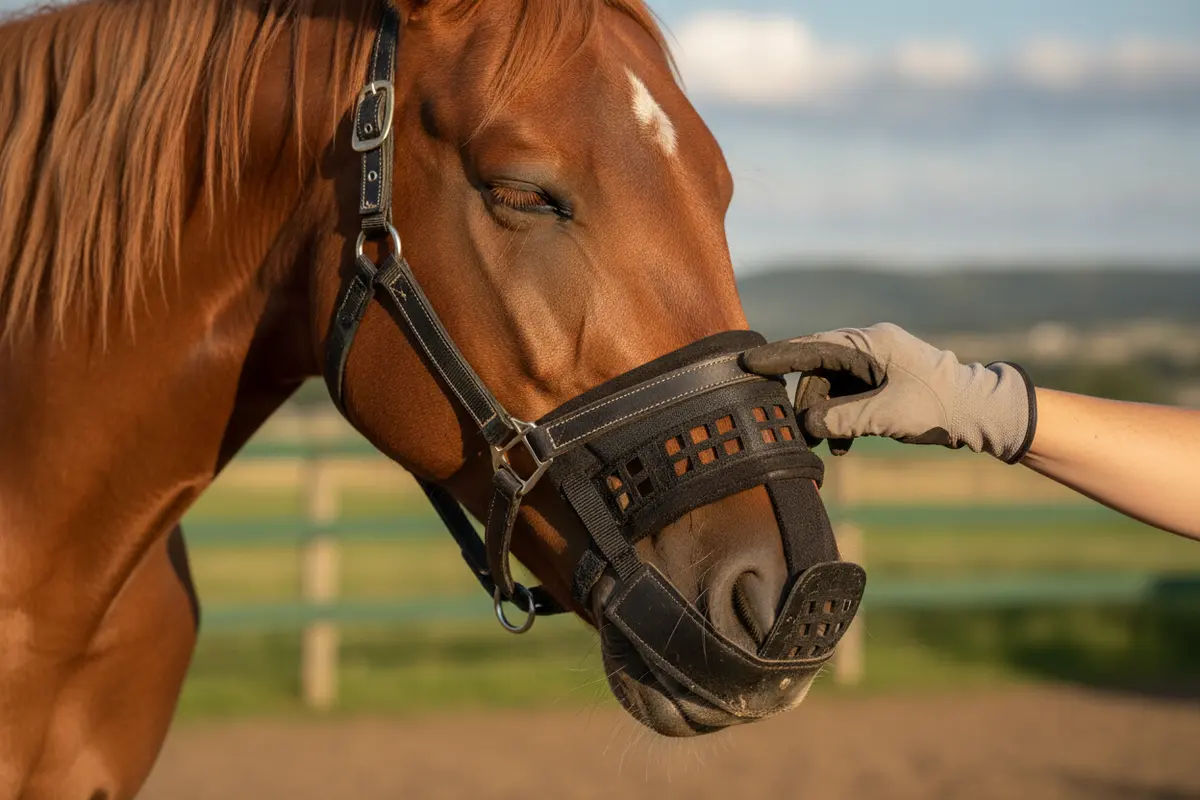
Inspect contact areas, including the nose, jaw, and any places where straps rest. Look for pinching, pressure marks, damp or trapped debris, hair wear, tenderness, or swelling. Check the equipment itself for rough edges, cracked material, loose stitching, or hardware that could irritate the horse. If the horse resists being touched in a particular area, do not dismiss that response as ordinary adjustment without investigating.
Observe the horse standing and moving in a familiar area. Confirm that the muzzle remains in place without obstructing breathing or normal movement. Follow the product’s directions for water access and observe the horse using the actual water setup. Do not assume a horse can drink simply because the water source looks accessible. If you cannot confirm comfortable drinking or normal function, remove the muzzle and seek qualified advice before trying again.
Recheck fit when equipment is adjusted, the horse’s condition changes, or the muzzle becomes wet, dirty, or damaged. Fit is not a one-time task. A strap can shift, a part can wear, and an arrangement that seemed secure in the barn may behave differently during turnout.
How can you introduce one gradually?
Let the horse investigate the equipment in a calm, familiar setting before expecting it to wear the muzzle during turnout. Follow the maker’s introduction instructions, and keep the first supervised session brief. The aim is to observe how the horse responds and confirm that the equipment is correctly positioned, not to push through signs of distress.
- Inspect it before use. Check the opening, edges, straps, closures, and materials. Make sure it is clean and undamaged.
- Let the horse see and smell it. Work in a quiet place and handle the muzzle calmly. Avoid rushing or restraining the horse in a way that adds unnecessary stress.
- Fit it using the directions. Use the stated measurements and adjustments. Ask for help if the fit is uncertain rather than improvising.
- Observe a short, supervised session. Watch the horse’s movement, breathing, comfort, and response to the equipment.
- Check function and water access. Observe whether the horse can use the muzzle as designed and reach water in the intended setup.
- Remove and inspect. Look at the horse’s skin and the muzzle for rubbing, debris, pressure, or damage.
Repeated pawing, panic, persistent attempts to remove the muzzle, or signs of pain are reasons to stop and reassess. Do not leave a newly introduced muzzle on unattended until you have established that the horse tolerates it and the setup is suitable. Follow the product’s guidance and your veterinarian’s recommendations for use. There is no single introduction schedule or wear time that fits every horse.
Keep the routine consistent as you learn how the horse responds. Note when the muzzle is put on and removed, where the horse is turned out, and any change in comfort, behavior, or equipment condition. These observations help you spot a pattern and give your veterinarian useful context if you need advice.
What should you check during daily use?
Check the horse, the equipment, and the turnout environment every time. A muzzle that was comfortable yesterday still needs inspection today.
Before turnout, inspect the horse’s face and the muzzle. Make sure straps and closures are in their intended condition, the opening is clear, and the equipment is free of damage. After use, remove the muzzle as appropriate and look for rub marks, unusual sensitivity, trapped grass, dirt, or wear. Clean it according to the manufacturer’s instructions, then allow it to dry as directed.
- Check skin contact for redness, hair wear, soreness, swelling, or a new mark.
- Inspect straps, seams, closures, and material for looseness, breaks, or rough areas.
- Confirm the grazing opening is clear and the equipment is positioned correctly.
- Observe whether the horse moves normally, remains settled, and can access water as intended.
- Look over gates, feeders, fencing, and other turnout features for potential snag points.
- Remove damaged equipment and stop use if the horse shows distress or injury.
Include the whole turnout environment in your check. A muzzle can be exposed to mud, vegetation, rough surfaces, and objects that may catch on straps. Consider the horse’s companions and whether the area allows normal movement. If weather or pasture conditions change, take another look at the setup instead of assuming yesterday’s routine still works.
Watch for changes beyond the equipment itself. If the horse’s behavior, appetite, body condition, or comfort changes, record what you notice and contact your veterinarian for guidance. A muzzle should not be used to postpone assessment of a health concern. Seek prompt veterinary advice for a wound, swelling, breathing difficulty, pronounced distress, or inability to drink.
What alternatives or other tools might fit the plan?
A grazing muzzle is one possible way to manage access to pasture, but it is not the only option. Depending on the individual horse, property, and care plan, a veterinarian or equine nutrition professional may discuss turnout timing, controlled pasture access, forage management, exercise, or a dry lot. These approaches have different practical demands. No single choice is right for every horse, and a change in pasture access should not mean overlooking appropriate forage, water, and observation.
For some setups, owners also consider how forage is presented when the horse is not grazing. A slow-feed hay bag or a folding combo feeder may be relevant equipment to evaluate for a feeding area. These items are not substitutes for a grazing muzzle and do not determine how much an individual horse should eat. Check the product instructions and consider placement, safety, and your horse’s feeding plan before choosing any equipment.
To compare approaches, write down the specific problem you are trying to solve, the hours and location involved, and who will monitor the horse. For example, if the challenge is unrestricted pasture access during a particular turnout period, ask whether a muzzle is suitable for that horse and setting. If the challenge is managing forage in a stall or dry lot, discuss that feeding routine separately. Keeping the question precise makes it easier for your care team to compare practical options without assuming that one device solves every part of the plan.
When reviewing equipment, think through the everyday details: where it will be used, how it will be cleaned, how you will check for wear, and what you will do if the horse removes or damages it. A plan that cannot be monitored consistently may need a different approach. If you are shopping for complementary feeding equipment, compare relevant options and instructions rather than relying on a product name alone.
When should you ask a veterinarian?
Ask your veterinarian before changing grazing access if your horse has a diagnosed medical condition, a history of metabolic concerns, unexplained weight changes, or an existing feeding plan. Also ask if you are unsure whether a muzzle is appropriate, how it may fit into the horse’s overall routine, or what changes should prompt you to stop using it. A professional who knows the horse can account for factors a general guide cannot assess.
Contact a veterinarian promptly if the horse has an injury, swelling, breathing difficulty, marked distress, or cannot access water as intended. Remove the equipment if it appears to be causing harm, and do not make a potentially unsafe adjustment to keep it in place. Bring the product instructions and your notes about use and behavior to the conversation. These details can help clarify whether the issue is fit, tolerance, the environment, or a broader care concern.
Frequently Asked Questions
Can a horse graze while wearing a grazing muzzle?
Many grazing muzzles are designed to allow restricted grazing through an opening. How easily a horse can graze depends on the specific design, fit, pasture, and the individual horse. Follow the instructions and observe the horse rather than assuming every model functions the same way.
Can a horse drink with a grazing muzzle on?
Water access is essential. Check the maker’s guidance and observe the horse using the actual water source before relying on the setup during turnout. If you cannot confirm that the horse can drink comfortably, remove the muzzle and ask a veterinarian or the manufacturer for guidance.
How long should a horse wear a grazing muzzle?
There is no universal wear time for every horse and product. Follow the manufacturer’s directions and your veterinarian’s advice, and plan checks that let you observe the horse and inspect the equipment. Do not treat a general duration as a substitute for individual guidance.
Does a grazing muzzle guarantee a specific reduction in grass intake?
No. Research summarized by University of Minnesota Extension reports an approximate reduction in pasture intake, but that result should not be treated as a guarantee for an individual horse. Design, fit, pasture, behavior, and management all matter.
What should I do if the muzzle rubs or shifts?
Remove it and inspect the horse’s skin and the equipment. Do not continue using a muzzle that causes injury, persistent irritation, or an unstable fit. Ask a veterinarian or knowledgeable equine professional to help assess the fit and next steps.
Is a grazing muzzle appropriate for every horse?
No. Health, behavior, fit, water access, turnout conditions, and the horse’s ability to tolerate the equipment all matter. Ask your veterinarian if you are uncertain, particularly when the horse has a medical history or an established feeding plan.
Choose a horse grazing muzzle only after considering the individual horse, the product instructions, and the daily monitoring the setup requires. Careful introduction and regular checks help you make a more informed decision with your equine care team.


