


Finding the right spray for flies on horses starts with more than picking the strongest-smelling bottle. The best choice matches the insects, your horse's skin and coat, the setting, and the product label. Use fly spray as one part of a practical plan that also includes manure and moisture management, shade, turnout decisions, and physical barriers such as fly masks and boots.
What is the best spray for flies on horses?
The best spray is an equine-labeled repellent or insecticide that addresses the fly pressure you are seeing and can be applied safely according to its directions. A product that works well in a dry pasture may not be the right option for a horse with sensitive skin, a wet coat, or a stall environment. Read the full label before buying, and do not assume that a dog, livestock, household, or garden spray is appropriate for a horse.
Horse fly products commonly fall into two practical groups:
- Repellent formulas: These are intended to discourage insects from landing or biting. They may be useful before turnout, riding, or other predictable exposure.
- Insecticidal formulas: These contain active ingredients intended to kill or control particular insects. They require especially careful label reading, including where the product may be applied and how often.
Marketing language such as “natural,” “long lasting,” or “all season” does not replace the label. The U.S. Environmental Protection Agency explains that registered repellent labels provide directions for use and safety information. See the EPA guidance on using insect repellents safely and effectively before applying any repellent around animals or people.
How do you choose an equine fly spray?
Start by observing when and where the problem occurs. Stable flies, face flies, horn flies, horse flies, deer flies, mosquitoes, and tiny biting midges do not behave exactly alike. A spray may offer only temporary relief if the product does not fit the pest or if the horse remains in an environment with heavy fly pressure.
| What to compare | Why it matters | What to check |
|---|---|---|
| Target pests | Different insects feed and rest in different places. | Look for the pests named on the label, not only a general “fly” claim. |
| Application area | Some products are intended for the coat, while others have more limited directions. | Confirm whether the label allows use on the horse and which areas must be avoided. |
| Horse sensitivity | Some horses react to fragrance, preservatives, or active ingredients. | Patch test only as directed and stop if redness, hives, rubbing, or other reactions appear. |
| Weather and activity | Sweat, rain, bathing, and rubbing can change how long protection lasts. | Follow the label rather than assuming a fixed number of hours. |
| Stable and pasture use | Spraying a horse is different from treating a building or manure area. | Use a premise product only for the surfaces and setting named on its label. |
Keep the horse's age, health, pregnancy or nursing status, and any veterinary treatment in mind. Ask your veterinarian before using a new product on a horse with a skin condition, open wounds, eye problems, or a history of chemical sensitivity.
When should you use fly spray on a horse?
Use fly spray when your horse is likely to encounter the named pests and the product label permits application for that setting. Many owners apply a product before turnout, grooming, or a ride, but the correct timing depends on the formula. A spray used before a short ride may need a different approach from a product used for a horse spending several hours in a pasture.
Consider the horse's daily routine rather than spraying automatically. If flies are light in the morning and heavy near dusk, adjust turnout or use shade and fans where practical. If your horse is sweating, wet from rain, or covered by a blanket, check the label before applying. Do not spray through a blanket or onto a damp coat unless the product directions specifically allow it.
Keep a simple record of when you apply the product, weather conditions, and how your horse responds. This can help you see whether the spray is providing useful relief or whether you need to change the broader fly-control plan. Persistent problems deserve an evaluation of the environment and the insect species, not simply more frequent applications.
How should you apply spray for flies on horses?
Good application is as important as the formula. Apply only to a clean, dry coat when the label allows it. Work in a calm, ventilated area away from feed, water, and open flames. Protect your own skin and eyes if the label calls for gloves or other personal protective equipment.
- Read the label first. Check the active ingredients, target pests, application rate, reapplication interval, age restrictions, and first-aid information.
- Test a small area if permitted. Wait and inspect for irritation before treating more of the horse. Do not improvise a patch test if the label gives different directions.
- Use a controlled spray pattern. Spray onto a cloth for sensitive areas only when the label permits it. Never spray directly toward the face, eyes, nostrils, mouth, genitals, or broken skin.
- Keep the bottle moving. Apply an even, light coverage instead of soaking the coat. Avoid runoff that could reach the horse's eyes or contaminate soil and water.
- Let the coat dry as directed. Do not immediately cover, saddle, bathe, or turn out the horse unless the product instructions allow it.
- Observe after application. Watch for rubbing, sweating, redness, hives, unusual behavior, breathing changes, or eye discomfort. Contact a veterinarian promptly if a concerning reaction develops.
Do not mix two fly products, add essential oils, or dilute a concentrate unless the label specifically instructs you to do so. Homemade fly spray recipes can also be risky because the final concentration, stability, and animal safety may not be established. If you are considering a nonstandard ingredient, ask your veterinarian first.
Can you use horse fly spray on dogs or other pets?
Not automatically. A product labeled for horses is not necessarily labeled for dogs, cats, people, poultry, or other animals. Species differ in metabolism, grooming behavior, skin sensitivity, and safe exposure levels. Use a product only on the species and application area listed on its label. This is especially important in a multi-pet barn where a dog may lick a recently treated horse or rub against the coat.
Store concentrates and ready-to-use sprays securely. Keep pets away during application and until the label's reentry guidance allows contact. Never use a horse product on a cat unless the label explicitly says it is approved for cats. If an animal licks or is accidentally sprayed with a product not intended for it, call your veterinarian or an animal poison resource and have the product label available.
Why is fly spray only one part of fly control?
Spraying the horse can reduce contact for a period, but it does not remove breeding sites or stop every insect from returning. Penn State Extension describes fly control on horse farms as an integrated pest management process: identify the pests, monitor their numbers, set a reasonable tolerance level, choose control methods, and evaluate the result. Its filth fly control guide for horse farms also cautions that spraying alone is not a complete solution.
Use a layered plan:
- Manage manure and wet organic material. Remove manure regularly, keep feed areas clean, repair leaking waterers, and address wet bedding or muddy drainage.
- Reduce exposure during peak activity. Use turnout timing, fans, shade, and well-ventilated shelter according to your horse's needs and local conditions.
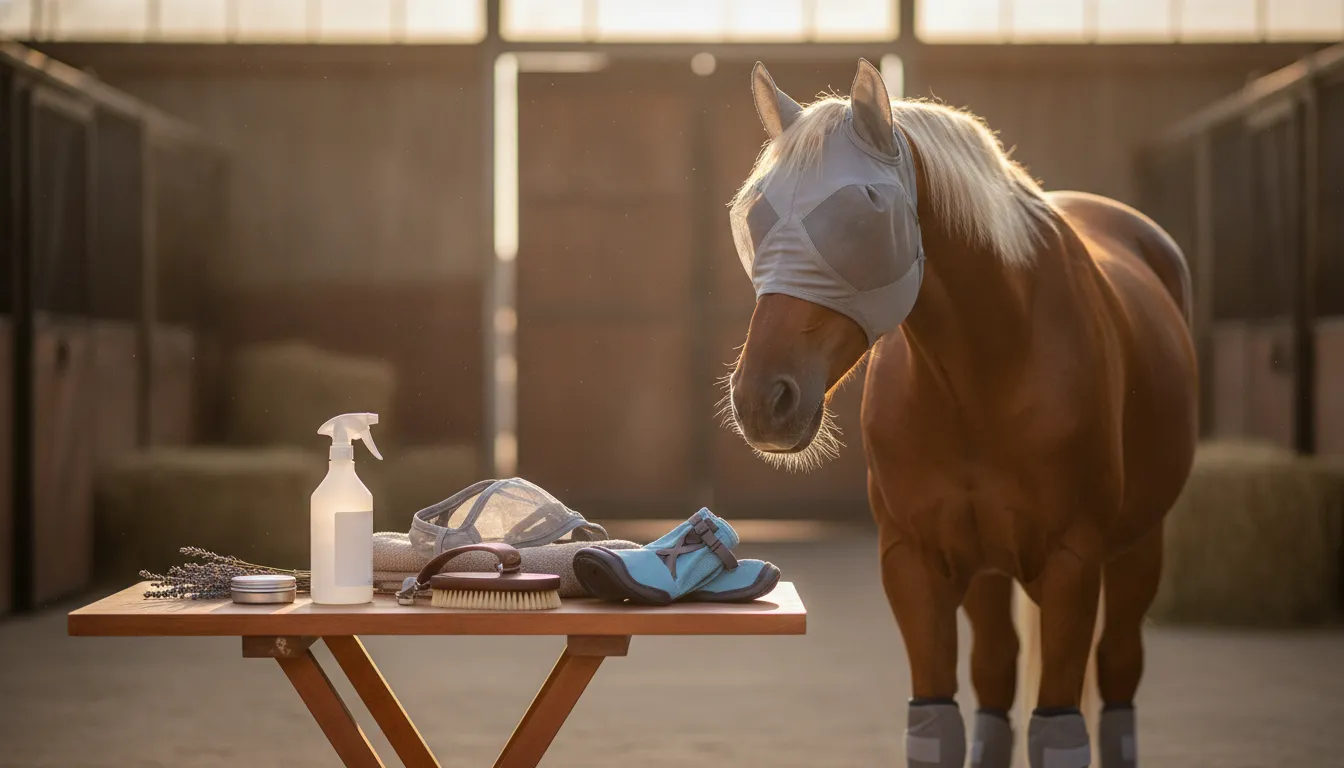
- Add physical barriers. A properly fitted fly mask can protect the eyes and face, while fly boots can limit insects around the lower legs.
- Monitor the horse. Look for persistent rubbing, skin sores, head shaking, tail swishing, stomping, or changes in eating and resting behavior.
- Reassess the plan. If flies remain severe, identify the species and ask your veterinarian or an equine pest-control professional for advice.
University of Minnesota Extension similarly recommends combining sanitation, monitoring, non-chemical controls, and carefully labeled insecticides rather than relying on one method. Its fly control guidance for horses notes that insecticides become less effective when debris and moisture are not managed.
When should you add a fly mask or fly boots?
Add physical protection when flies concentrate around a body area that spray cannot reliably protect, when your horse rubs off a product quickly, or when you want to reduce the amount of chemical used. Fit and inspection matter. A mask should sit clear of the eyes, allow normal vision and breathing, and remain free of dirt or damaged mesh. Fly boots should fit without twisting, slipping, trapping heat, or rubbing the pasterns.
Hooves and Paws' Fly Season Protection collection includes multiple coverage options. For facial protection, compare the Cashel Crusader Sun Fly Mask and the Shires FlyGuard Pro Fine Mesh Fly Mask based on your horse's face shape and tolerance for ear or nose coverage. For lower-leg coverage, the Professional's Choice Deluxe Fly Boots and Cashel Fly Leg Guards offer additional options to review.
Product pages and labels are the final authority for current materials, sizing, included pieces, and care instructions. Inspect any barrier daily, especially after turnout, rolling, rain, or heavy sweating.
What are common fly spray mistakes?
Several habits can make a fly-control plan less safe or less effective:
- Using a household insecticide on the horse: A premise spray is not automatically an animal spray.
- Spraying the face directly: Use only the label-approved method for facial areas, and keep product out of the eyes and airways.
- Reapplying by the clock alone: Rain, sweat, grooming, and rubbing may change the product's performance, but they do not authorize extra applications beyond the label.
- Ignoring the environment: Manure, wet bedding, spilled feed, and standing water can maintain high fly pressure.
- Assuming a reaction is normal: Redness, hives, intense rubbing, or eye discomfort deserves attention and may require veterinary guidance.
- Using a mask or boot without inspection: A dirty, torn, or poorly fitted barrier can create its own welfare problem.
Shop Horse Fly Protection Today
Frequently Asked Questions
How often should I apply fly spray to my horse?
Use the reapplication interval printed on the product label. Weather, sweat, bathing, grooming, and rubbing can affect performance, but do not justify applying more often than directed. If protection seems inadequate, identify the fly pressure and add non-chemical controls or ask a veterinarian for advice.
Can I make homemade fly spray for my horse?
Homemade mixtures can have uncertain concentration, shelf life, and safety, especially when essential oils or household products are involved. A labeled equine product gives you directions and precautions to follow. Ask your veterinarian before trying a nonstandard formula.
Should I spray my horse's face?
Only if the label specifically permits facial use, and never spray toward the eyes, nostrils, or mouth. Follow the label's approved method, such as applying to a cloth for a limited area when allowed. A fitted fly mask can provide a useful physical barrier for the face.
Does fly spray kill all types of flies?
No. Product performance depends on the active ingredient, the pest named on the label, application, and environmental conditions. Identify the insects as accurately as possible and use integrated fly control rather than expecting one spray to solve every problem.
Can horse fly spray be used on a dog?
Only when the product label specifically approves use on dogs and gives directions for that species. Never transfer a horse product to a dog based on assumption. Prevent licking or close contact with a recently treated horse until the label says it is safe.
When should I call a veterinarian about flies?
Call when your horse has persistent skin sores, severe rubbing, eye irritation, repeated head shaking, breathing changes, swelling, hives, or a suspected reaction to a product. Veterinary guidance is also appropriate when flies are interfering with eating, resting, turnout, or normal behavior despite a layered control plan.
Final checklist for choosing horse fly protection
Before using a spray, confirm that it is labeled for horses, matches the pests and setting, and has clear directions you can follow. Apply it carefully, keep it away from sensitive areas, and observe your horse afterward. Then reduce fly pressure with sanitation, monitoring, shade or turnout adjustments, and well-fitted physical barriers. A thoughtful plan is safer and more dependable than simply applying more spray.


