


Dog body language is a set of signals, not a single tail wag or facial expression. A dog’s posture, movement, ears, eyes, mouth, and the situation around them all help tell you whether they seem comfortable, unsure, excited, or stressed. The most useful habit is to pause, look at the whole dog, and respond to what you see rather than assuming what a single signal means.
What does dog body language tell you?
Dogs communicate through their bodies in ways people can learn to notice. A signal is not a guaranteed translation. A wagging tail, for example, does not automatically mean a dog welcomes contact. A lowered head can reflect a relaxed posture in one setting and uncertainty in another. Read several details together, then consider what happened just before and what the dog can choose to do next.
Look for a pattern rather than trying to decode one movement. Is the dog loose and moving easily, or stiff and holding still? Are the eyes soft, or is the dog watching intently? Does the dog approach and stay, or turn away and create distance? Context changes the meaning of what you see. A dog responding to a familiar person in a quiet room may look different from the same dog near a loud crowd, unfamiliar animal, or valued object.
Interpret the whole dog in context. A single tail, ear, or mouth signal cannot tell you exactly how a dog feels.
Tufts’ overview of dog communication and body language describes cues including tail carriage, ear and eye position, posture, movement, and facial expression. Texas A&M’s guide likewise explains that observing a dog’s signals can help people understand how the dog may be responding. These are useful starting points, not a substitute for observing the individual dog.
How can you read a dog’s posture, face, ears, and tail?
Start with the body from nose to tail. Note whether the dog looks loose or tense, whether weight is balanced or shifted, and whether movement flows or stops. A comfortable dog may have a relaxed stance and move naturally. A dog that feels uncertain may lower its body, turn away, pause, or try to increase distance. These are clues to respect, not invitations to test the dog.
Posture and movement
Watch how the dog uses space. Approaching with a loose body and then remaining nearby differs from rushing forward with a rigid stance. A dog that freezes or becomes very still may be uncomfortable, even if it is not growling or pulling away. Give the dog time and room; do not lean over it or insist on contact. Look for whether it can turn, retreat, or choose to come closer.
Eyes, ears, and face
Eyes and ears should be considered alongside the rest of the body. A dog may look away, blink, or turn its head when it wants less interaction. Wide eyes, a fixed stare, or a tense face can be reasons to slow down and create space, especially if the dog’s posture is also stiff. Ear shape and position vary by breed, so compare the dog with its own usual expression instead of expecting every dog to show the same signal.
Pay attention to the mouth, too. A soft, relaxed mouth differs from tightly closed lips or a tense jaw. Panting can have more than one cause, so do not use it alone to label an emotion. If several features change together, or the dog tries to move away, treat that as a useful request for space.
Tail carriage and movement
Notice the tail’s general position, movement, and tension, then check the rest of the dog. A wag tells you the tail is moving; it does not by itself tell you the dog is happy or ready to be touched. A high, stiff tail paired with a rigid body deserves a different response from a loose, whole-body wiggle. Tail shape and natural carriage differ among dogs, so learn what is typical for the individual.
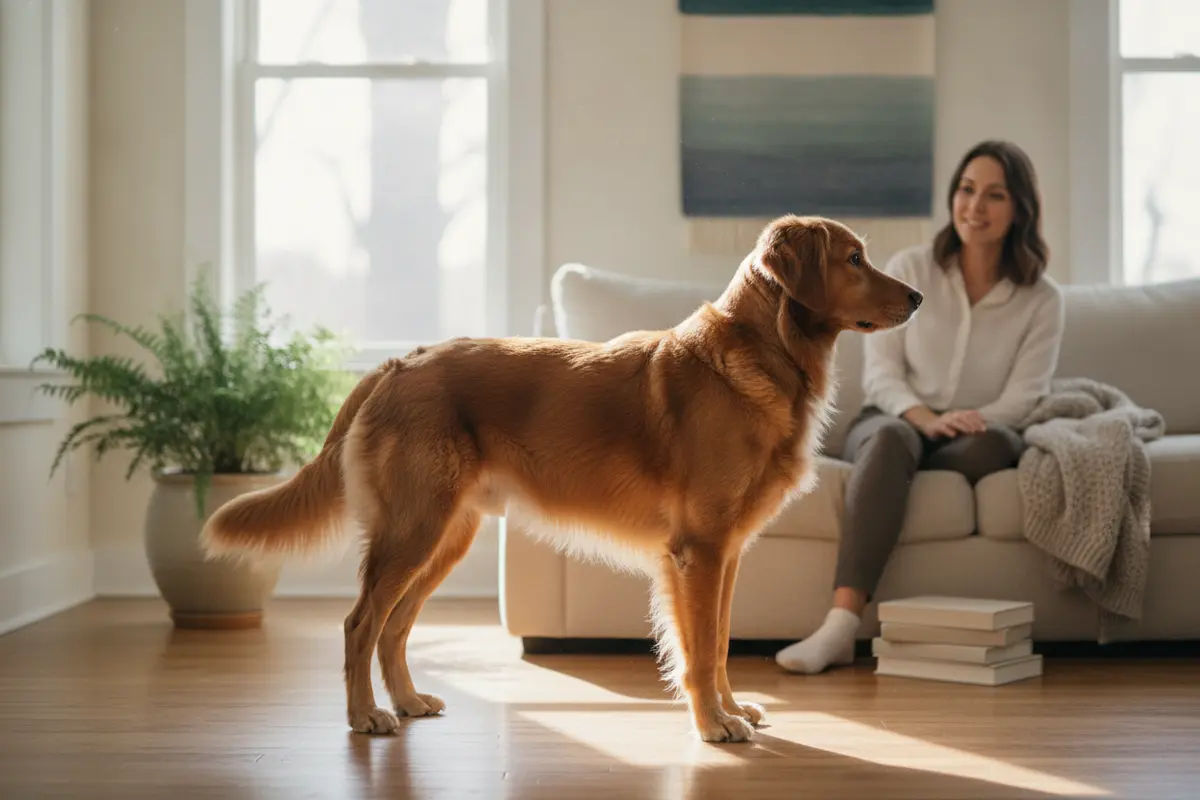
Compare posture, movement, face, ears, and tail together. Notice the dog’s normal behavior, then look for changes and the circumstances in which they occur.
Comfort, uncertainty, and stress: what should you notice?
It helps to think in broad groups rather than labels. Signs that may go with comfort include a loose body, smooth movement, and the ability to disengage and settle. Possible signs of uncertainty or stress include turning away, lowering the body, becoming still, repeatedly trying to leave, or showing a tense face. A dog can move from comfortable to uneasy quickly if the situation changes, so keep observing throughout an interaction.
Some dogs communicate quietly. They may first look away, shift their weight, or move to the edge of a space. If those signals are overlooked, they may escalate to more obvious behavior such as barking, growling, or snapping. Do not punish a warning signal. Instead, stop the interaction, increase distance, and consider what is making the dog uncomfortable. A warning is important information that people should respond to safely.
Research and educational resources emphasize observing the dog’s signals as a whole. Purdue’s canine body language resource notes that reading signals can help people understand how dogs feel in particular environments and avoid situations that place them in difficulty. That principle is practical: if a dog looks tense around a visitor, give it a quiet retreat rather than expecting it to tolerate a greeting.
Shop This Post

Featured in this article
Zymox Otic Pet Ear Care with 0.5% Hydrocortisone - Enzymatic Ear Solution for Dogs & Cats - 1.25 oz
$22.49
Shop Now →


What details in the setting can change a signal?
A dog’s surroundings are part of the observation. The same posture may appear during a familiar routine and a stressful event, so ask what has changed. Note the location, noise level, distance from people or animals, access to an exit, and whether food, toys, resting places, or handling are involved. A dog that moves away from a busy doorway may be seeking a quieter place. A dog that stiffens when someone reaches toward a resting spot may be asking for the approach to stop. These examples are prompts for caution, not definitive explanations.
Consider the sequence, not just the final behavior. What did the person or another animal do immediately before the dog turned away, froze, barked, or left? Did the dog have a chance to move off? Did the intensity ease when the activity stopped? Observing what happens before and after helps you adjust the setup. For example, if a dog becomes tense when several people gather around, invite the group to step back and give the dog access to a separate room. Avoid calling the dog back into the crowd to see whether it will tolerate another greeting.
It can also help to compare behavior across familiar situations. Note how the dog usually responds to a trusted person, a quiet walk, or a regular meal routine. This baseline is not a fixed rule, because comfort and energy vary. It simply gives you a more useful comparison than assuming every dog expresses itself in the same way. Breed, age, health, previous experience, and individual temperament all affect what you might observe. When you are uncertain, choose the response that creates more room and less pressure.
Common signals at a glance
The table below is a prompt for observation, not a diagnostic key. Any one signal can mean different things depending on the dog and setting. Use the possible response that gives the dog more choice and reduces pressure.
Loose posture and easy movement
What it may suggest: The dog may be comfortable in that moment.
Safer response: Continue calmly, and let the dog choose whether to stay or move away.
Turning away, moving off, or avoiding contact
What it may suggest: The dog may want more space or a pause.
Safer response: Stop reaching, give room, and do not follow or corner the dog.
Stiff body, fixed attention, or sudden stillness
What it may suggest: The dog may be tense or uncertain.
Safer response: Pause the activity and increase distance without sudden movements.
Repeated barking or growling during an interaction
What it may suggest: The dog is communicating discomfort, alarm, or another strong response.
Safer response: End the interaction safely; avoid punishment and get qualified help if it recurs.
Loose, playful movement that changes to avoidance
What it may suggest: The dog may be ready to stop or take a break.
Safer response: Pause play and let the dog decide whether to re-engage.
How do you respond to dog body language safely?
When you are unsure, make the interaction easier for the dog. Stop what you are doing, turn your body slightly sideways, avoid reaching over the dog, and allow it to move away. Do not block its exit or ask children to approach a dog that is trying to retreat. If the dog chooses to come closer, keep your movements calm and do not assume that proximity means it wants to be petted.
- Pause. Stop touching, playing, or moving closer when you notice tension or avoidance.
- Create space. Give the dog an open route to leave. Move people or other animals back if that can be done safely.
- Observe. Look at the whole body and the setting. Notice what occurred immediately before the change.
- Let the dog choose. Do not force a greeting, hold the dog in place, or repeatedly test whether it will accept contact.
- Plan for next time. Reduce the pressure or change the setup. Seek individualized guidance if the behavior is intense, recurring, or difficult to manage safely.
These steps also help during everyday handling. For instance, if a dog turns away as someone reaches for its collar, stop and give it room rather than grabbing. A well-fitted dog walking leash can be part of a controlled outing, but equipment does not replace close supervision or a calm approach. Keep a safe distance from unfamiliar dogs, and ask the handler before allowing an introduction.
How do you make greetings and handling easier?
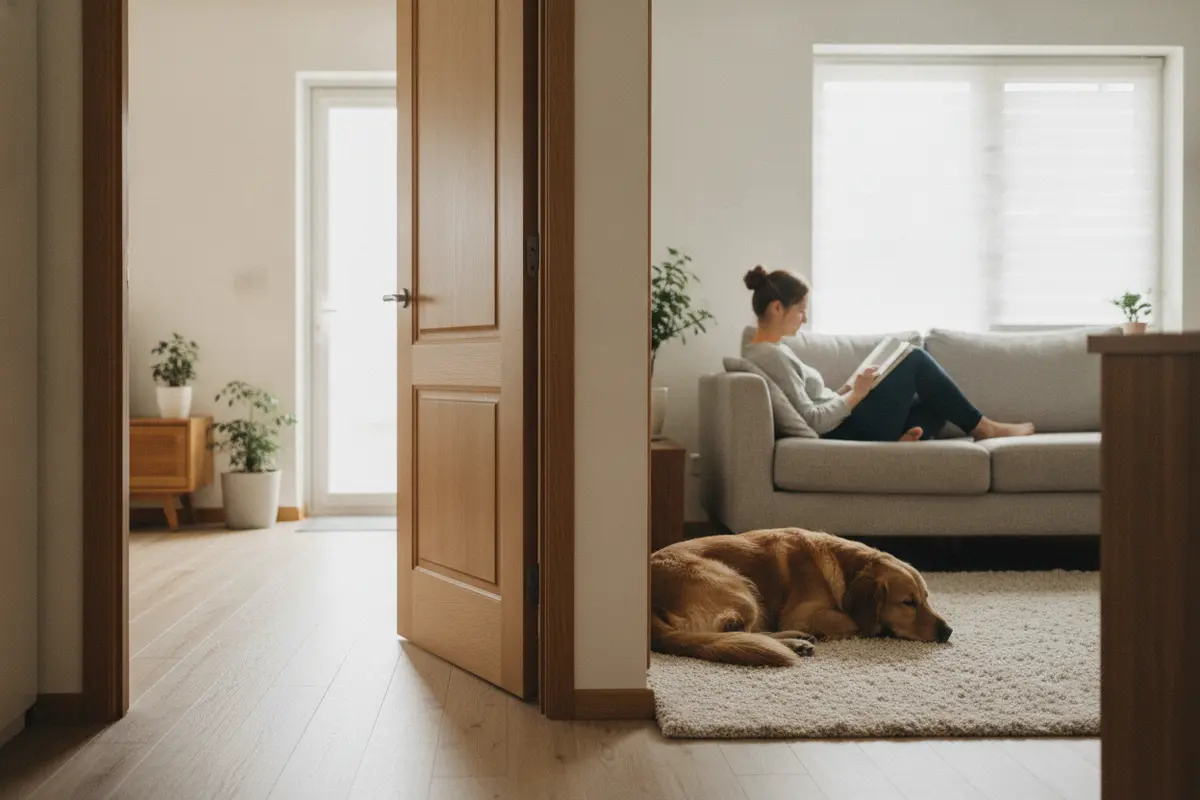
Plan a greeting so the dog can opt out. In a home, use a gate or a separate quiet space before visitors arrive, rather than waiting until the dog is already surrounded. Ask guests to avoid leaning over, staring at, or reaching for the dog. They can stand or sit calmly and let the dog decide whether to approach. If the dog stays away, that is a complete answer. Do not lure it close and then attempt to pet it while it is unsure.
Keep a greeting brief even when the dog comes forward. After a few moments of calm contact, stop reaching and see whether the dog moves closer again or chooses to leave. This pause gives the dog a chance to communicate through movement. If it turns away, stiffens, or steps back, end the greeting. Avoid hugging, holding, or putting your face close to a dog’s face. Friendly history does not remove the need to notice what the dog is communicating in the current moment.
Routine care can involve close contact, so use the same patient approach for brushing, collar adjustments, or checking paws. Work in a calm area with a clear exit. Handle only as much as needed, pause between steps, and notice whether the dog can remain loose and re-engage. If it repeatedly pulls away or becomes tense, stop rather than restraining it for a non-urgent task. For care that cannot wait or cannot be completed safely, ask a veterinarian about an appropriate plan. A blog guide cannot tell you why a specific dog resists handling.
Reading signals during play, greetings, and daily routines
Play can include quick movement, pauses, and changes in intensity. Do not assume that all active behavior means a dog is enjoying the interaction. Interrupt briefly and see what happens when the dog has a choice. Does it return with loose movement, or does it leave, hide, or settle elsewhere? Respect the answer. Supervise play, especially when dogs differ in size, age, play style, or familiarity.
Toys can make play more engaging, but watch the dog rather than focusing only on the toy. A dog that is relaxed and voluntarily re-engages is giving you useful feedback. If the dog becomes tense around an item, guards it, or struggles to disengage, avoid taking the item by force. Give space and seek qualified guidance if guarding creates a safety concern. For supervised play, compare suitable options in the interactive dog toys collection. Choose a toy that fits the dog’s size and play habits, and check it regularly for wear.
New greetings need the same patience. Let a dog approach at its own pace, and keep the greeting brief. Avoid crowding it, hugging it, or putting your face close to its face. A dog may tolerate a situation without enjoying it. Children should be taught to leave resting, eating, or retreating dogs alone and to ask an adult before approaching any dog.
Enrichment can offer an appropriate focus, but it is not a fix for fear or a substitute for supervision. A plush dog toy may suit some dogs’ play preferences; observe how the individual dog uses it and remove damaged toys. Reward-based activities can also be easier to manage when you have treats ready. A treat bag for training rewards can keep rewards accessible during a short, calm practice session. These are general ideas, not claims that a product changes behavior.
How can children and other household members respond?
Clear household rules make it easier for everyone to respect a dog’s signals. Children should not disturb a dog that is sleeping, eating, chewing, or using a retreat area. Teach them to avoid climbing on, hugging, chasing, or taking items from a dog. An adult should supervise interactions closely and step in early if a dog moves away or becomes still. Young children may not recognize subtle changes, so do not rely on them to interpret signals or manage an interaction on their own.
Set up a dog-only resting place that people agree not to enter or use as a play area. A gate can help separate the dog from visitors or household activity while still letting it settle without being approached. Tell guests the rules before they meet the dog, and do not ask the dog to demonstrate friendliness. If the dog is uncomfortable, separation is a sensible choice, not a failure. Never leave a child alone with a dog, even when the dog is familiar.
When two dogs share a home, observe how they move around resting areas, food, toys, and doorways. Manage space so neither dog is cornered or forced to compete for access. Feed separately if needed, and avoid reaching between dogs that are tense. If conflict repeats or you cannot keep interactions safe, use barriers and seek individualized professional advice rather than trying to settle the issue by forcing the dogs together.
Keeping a useful record of behavior changes
If a behavior concerns you, write down what you observed instead of relying on a broad label such as “unfriendly.” Record the setting, people and animals present, what happened immediately beforehand, the visible body signals, how long the behavior lasted, and what helped the dog settle. Note whether the behavior is new or has changed over time. A short, factual record can help you explain the situation to a veterinarian or qualified behavior professional.
Never stage a stressful situation just to collect more evidence. Prioritize safety. If a dog has shown threatening behavior, keep people and animals separated as needed and get individualized advice. If the dog’s behavior changes suddenly, or you notice signs that could indicate pain or illness, contact a veterinarian. A blog guide cannot diagnose the cause or determine the right treatment for an individual dog.
For a practical record, write down observable actions rather than conclusions. “Turned head, licked lips, and moved behind the chair when a visitor reached over” is more useful than “did not like the visitor.” Include what happened after you created space, such as whether the dog settled, continued to avoid the person, or remained tense. If the situation involved a leash, doorway, meal, toy, grooming, or another routine, note that as well. These details can reveal patterns to discuss with a professional without asking you to diagnose the cause yourself.
Also note the dog’s normal routine and any recent changes you know about, such as a different environment or schedule. Do not assume a single change explains the behavior. A veterinarian can evaluate health concerns, and a qualified behavior professional can help assess repeated behavior patterns. If you feel there is an immediate safety risk, prioritize separation and contact an appropriate professional for direct guidance.
Record what happened, what you saw, and what changed. For sudden behavior changes, possible pain, or repeated safety concerns, consult an appropriate professional rather than relying on an online interpretation.
Shop interactive dog toys today
Frequently Asked Questions
Does a wagging tail always mean a dog is happy?
No. A wag only tells you the tail is moving. Consider its position and tension along with the dog’s posture, face, movement, and the situation. If the dog seems stiff, avoid contact and give it space.
What should I do if a dog turns its head away?
Pause and stop reaching toward the dog. Turning away may be a request for less interaction, so give the dog room and let it decide whether to approach again. Do not follow or corner it.
Can I tell exactly what a dog feels from its ears or eyes?
No single feature gives a certain answer. Breed, individual anatomy, the dog’s usual behavior, and context all matter. Read several signals together and respond cautiously when you are unsure.
Should I correct a dog for growling?
Do not punish a growl. Stop the interaction and create distance if you can do so safely. Repeated or concerning growling calls for individualized help from a veterinarian or qualified behavior professional.
When should I ask a veterinarian about a behavior change?
Contact a veterinarian if a change is sudden, persistent, or appears alongside possible pain or illness. A veterinarian can assess health concerns; a qualified behavior professional can help with an appropriate behavior plan when needed.
Use observation to make interactions kinder
Learning dog body language is less about memorizing a fixed dictionary and more about noticing the individual dog. Watch the whole body, consider the setting, and respect signals that ask for a pause or more space. Calm observation helps you make safer choices and gives your dog more control over everyday interactions.


