


A horse blanket size chart is only useful after you measure the horse, not the blanket hanging in the aisle. Most charts list body length in inches, taken from the center of the chest to the center of the tail. Height in hands is a rough hint, not the size. This guide shows the tape method, how to read common inch sizes, and what to do when your horse lands between two numbers.
Shop horse blankets and sheets
What does a horse blanket size chart actually measure?
The number on a chart is a length, not a height and not a weight. A 72 inch blanket is cut for a horse whose body measures about 72 inches on the path the blanket will cover. Two horses that both stand 15 hands can need different sizes if one is long-backed and the other is short and deep.
Most turnout, stable, and sheet charts in the United States use that chest-to-tail length. A European rug may be labeled in centimeters, so convert before you compare. Neck covers, belly bands, and cooler cuts are extra features. They do not replace the body-length number.
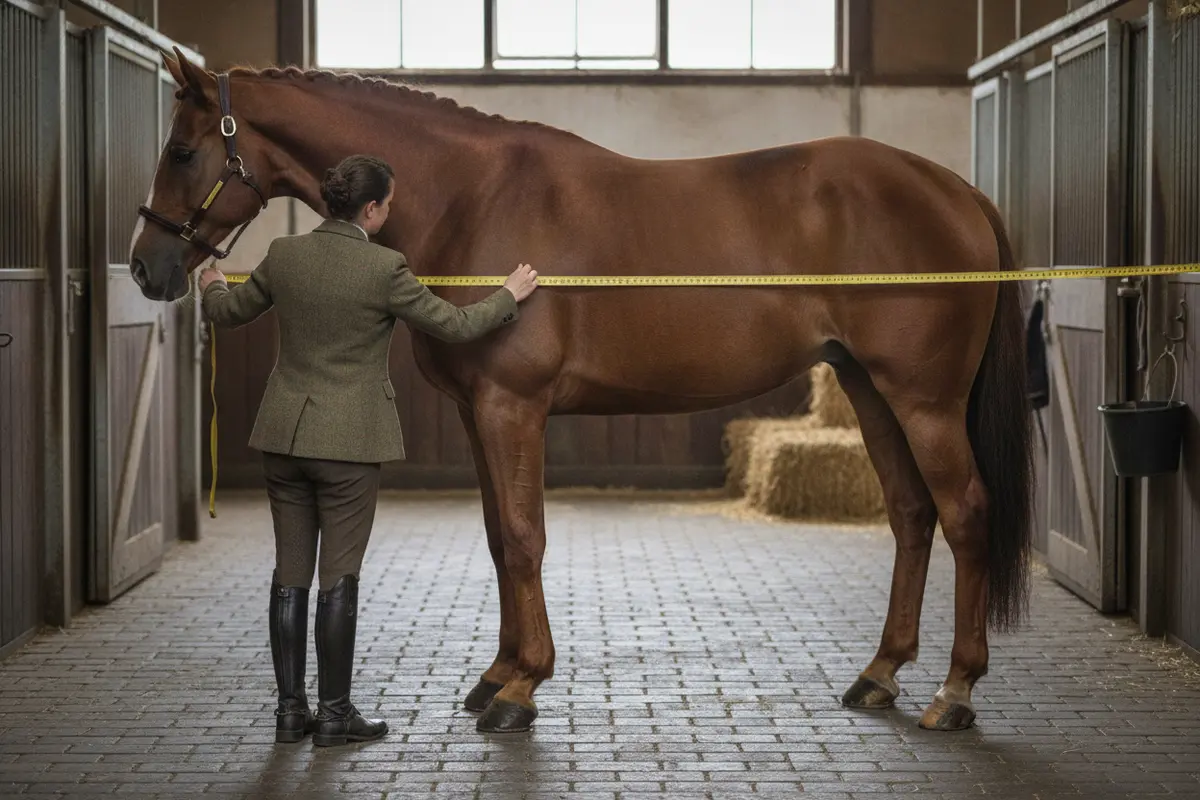
Quick answer: Measure from the center of the chest, over the point of the shoulder, to the center of the tail. That inch number is the size you look up on the horse blanket size chart. Then try the blanket on and check the shoulders.
How do you measure a horse for a blanket?
Stand the horse square on level ground, with the head in a natural position and all four feet bearing weight. A horse stretching for hay, resting a hind leg, or standing downhill can change the outline enough to shift the size.
Use a soft fabric tape. If your tape is short, use a non-stretch string and measure the string afterward. Do not use elastic cord. Brush off mud where the tape will lie, but do not mash the coat flat.
- Place the zero end at the center of the chest, where the front edges of a blanket would meet.
- Run the tape over the point of the shoulder, not up over the withers.
- Keep the tape level along the side to the center of the tail, also called the dock.
- Read the inches while the tape is snug, not tight, and write the number down.
- Measure a second time. If the two readings differ by more than an inch, reset the horse and start again.
The University of Maine Cooperative Extension blanketing guide uses this same chest-to-dock path and reminds owners that each brand can fit a little differently. PetMD's measuring guide also treats blanket length as the distance from the center of the chest to the hindquarters, and it tells you to follow the directions that came with the blanket.
Where should the tape sit on the shoulder?
The tape should cross the point of the shoulder, the bony front of the shoulder, and then travel back along the side. If you arc the tape up over the withers, the number gets longer than the blanket's cut and you may order a size that is too big. If you drop the tape under the belly, you are measuring girth, which is not a blanket size.
Horse blanket size chart in inches
Use the table below as a shopping map, not as a promise that every brand cuts the same. The inch column is the body length you just measured. The height column is only a common range, so two horses of the same height can still need neighboring sizes. Always match the number on the product page before you add it to the cart.
| Measured length | Common height range | Typical horse | What to confirm on the product page |
|---|---|---|---|
| 48 to 60 inches. | Under about 13 hands. | Small pony or weanling. | Confirm a pony or foal cut, not a scaled-down horse cut. |
| 63 to 69 inches. | About 13 to 14.2 hands. | Large pony or small horse. | Confirm whether 66 and 69 are both offered. |
| 72 to 75 inches. | About 14.2 to 15.2 hands. | Many stock-type and sport horses. | Check shoulder shape if you are between 72 and 75. |
| 78 to 81 inches. | About 15.2 to 16.2 hands. | Longer or bigger-bodied horses. | Compare a standard neck with a bigger neck opening. |
| 84 inches and up. | About 16.2 hands and taller. | Large horse or draft type. | Confirm a draft or big-horse cut, not just a longer hem. |
Read each row as a starting band. A 48 to 60 inch measurement usually belongs on a pony or foal cut. A 63 to 69 inch horse is often a large pony or a small horse, so check whether the maker offers both 66 and 69. The busy middle of most charts is 72 to 75 inches. That band covers many stock-type and sport horses, and shoulder shape matters if your tape sits between those two numbers.
From 78 to 81 inches, look at the neck opening as well as the length. A longer horse can still bind in a standard neck. At 84 inches and above, confirm that the product is a large-horse or draft cut. A longer hem on a regular pattern is not the same thing.
Hooves and Paws listings give you several relevant product paths to compare after you take the measurement. Review the Weaver Leather stable blanket, the Professional's Choice cotton day sheet, or the Weaver rainsheet, then follow the size notes on the individual product page. Those notes take priority if a product uses a different cut, size ladder, or measurement method.
Key takeaway: Shop the inch size on the product, not a height guess. The same horse can be a 72 in one brand and a 75 in another if the cut or the measuring notes differ.
What if your horse is between two sizes?
If the tape reads 73 or 76, do not average the sizes and hope. Go back to the product notes and the horse in front of you.
- Choose the larger listed size when the horse is broad through the chest, has a steep shoulder, or already rubs at the front of a shorter blanket.
- Stay with the smaller listed size when a longer blanket has climbed onto the withers, hung past the tail, or twisted in the hind legs.
- If both sizes are a guess, order the one you can exchange, then do the hand checks below before you leave it on overnight.
A closed front that you cannot slide a hand under at the point of the shoulder is too tight, even if the length looks right. The University of Maine guide suggests checking that spot, and the withers, by hand. If your hand will not fit, loosen the chest closures or try the next size up.
Length and weight are different decisions. Once the inches are settled, use the horse blanket weight guide to choose light, medium, or heavy fill. For a wider look at sheet, stable, and turnout styles, the complete horse blanket guide covers types and care without replacing this chart.
How should you check the fit after you use the chart?
Put the blanket on slowly, fasten the chest first, then the belly straps, then the hind-leg straps. Walk the horse a few steps and look again. A correct length meets these checks.
- The front closes without pulling the withers forward or leaving a gap you could fit a fist through at rest.
- The shoulder can reach forward. If the fabric locks when the leg extends, the cut or the size is wrong.
- The back edge ends near the tail. It should cover the barrel and hindquarters without dragging on the ground or the hocks.
- Belly straps cross near the midline and allow about three fingers of room, snug enough that a hind hoof cannot step through.
- Leg straps hang with a little slack. Too low and a hoof can catch them. Too high and they rub.
Remove a blanket that will stay on for long stretches and look at the shoulders, withers, and chest. Red skin, missing hair, or a wet patch under a waterproof layer means the fit or the blanket type needs another look. A stable blanket is not a turnout, and a mesh fly sheet is not a winter rug, even when the inch size matches.
Do the same check after the horse has walked, grazed, or rolled. A blanket that looks level in the stall can shift once the shoulder moves. If the front climbs, the back twists, or one leg strap tightens, stop and reset the closures before you blame the size chart. Sometimes the inch size is right and a twisted strap is the whole problem.
Write down what you see. Note the measured inches, the brand, the size you tried, and whether the shoulder or the tail was the trouble spot. That note saves a second wrong order when you shop the same horse next season.
Which cuts do not follow a standard size chart?
Some products in the horse blankets and sheets collection use a different label on purpose. Read that label before you force it onto the chart above.
- Neck combos and big-neck cuts. The body may still be sized in inches, but the neck opening is deeper. A standard 78 can be the right length and still bind a thick neck.
- Coolers sold by finished dimensions. The Weaver fleece cooler is listed as 74 by 90 inches and 80 by 96 inches. Those are the cloth measurements, not a chest-to-tail blanket size.
- Pony and foal ranges. A 54 or 60 inch sheet is a real size for a small horse. Do not size a pony up into a horse cut just because the next number looks more common.
- Contoured European rugs. A Shires turnout such as the Tempest Original Lite combo may list 66, 69, 72, and 75 inches. Compare those numbers with your tape, then check the neck and shoulder because the shape is not identical to a standard U.S. stable blanket.
Key takeaway: If the product page shows two dimensions, a neck size, or centimeters, stop and read the maker's note. The standard horse blanket size chart does not translate those labels by itself.
When should you measure again?
Remeasure before you buy a new blanket, and again if the horse changes shape. A winter weight gain, a clipped spring coat, a growing youngster, or a lost topline can move the fit even when last year's tag still says 78.
Also remeasure if you switch brands. A blanket that fit in one cut can rub in another at the same inch size. Keep the tape number with the horse's blanket notes so the next order starts from a measurement, not from memory.
Young horses need this more often than settled adults. A weanling or yearling can outgrow a 54 or 60 inch sheet in one season. An older horse that drops weight through the barrel may suddenly swim in a size that fit last winter. Measure again instead of taking the hem up with extra straps.
If you keep more than one horse, label each tape number with the horse's name. Sharing a "78 that fits everyone" is how rubs start. The chart is a tool for one body at a time.
Shop blankets in your measured size
Frequently Asked Questions
How do I measure a horse for a blanket size?
Stand the horse square. Measure in inches from the center of the chest, over the point of the shoulder, to the center of the tail. Use that number on the size chart, then confirm the fit at the shoulder and tail.
What size is a 72 horse blanket?
A 72 is a 72 inch body length, not a 72 hand horse. It is a common size for many horses around 14.2 to 15.2 hands, but a long 14.2 hand horse may need 75 and a short 15.2 hand horse may still fit a 72.
Should I round up if my horse is between sizes?
Round toward the size that fixes the problem you can see. Go up if the shoulders bind or the blanket stops short of the tail. Stay down if a longer blanket climbs the withers or hangs into the hind legs. Check the return notes before you guess.
Do all brands use the same horse blanket size chart?
No. Most U.S. charts share the chest-to-tail method, but cuts differ. A neck combo, a big-neck blanket, a European rug, or a cooler sold by finished inches can fit differently at the same number. Read the product page.
Can I use my horse's height instead of a tape?
Height is only a backup when you cannot measure. Two horses of the same height can have different body lengths. If you already own a blanket that fits, you can start from that tag, then still measure before you buy a new cut.
How do I know a blanket is too small?
It pulls at the chest, locks the shoulder when the leg reaches, rides up onto the withers, or leaves the hindquarters short of the tail. Hair rubs at the shoulder or withers are another sign. Take it off and compare the next size.


