

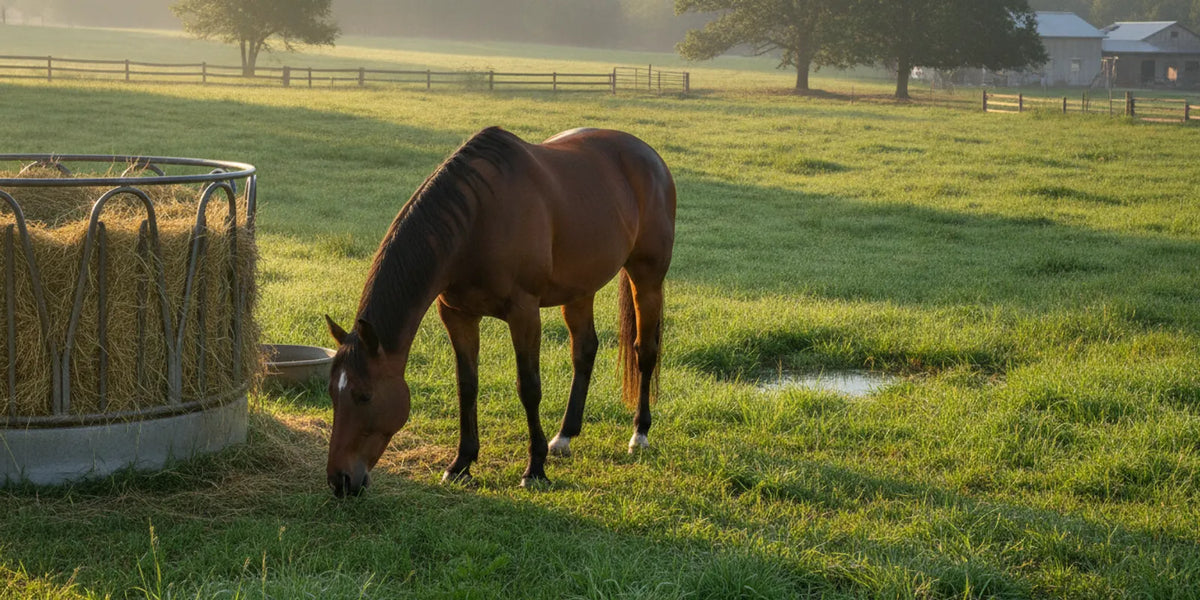
A vitamin E supplement for horses may be worth discussing when forage, workload, health, or management changes affect the overall diet. But a supplement is not automatically needed for every horse. The best starting point is to assess the individual animal and its complete ration, rather than buying from a broad product claim.
What does vitamin E contribute to a horse’s diet?
Vitamin E is a fat-soluble nutrient that functions as an antioxidant. Horses obtain it through feed, especially fresh green forage. The amount available in forage can vary with plant type, maturity, growing conditions, storage, and time in storage. A horse’s total intake also depends on the rest of its ration and any supplements already being fed.
That is why a single ingredient list or a pasture snapshot cannot settle whether a particular horse needs more. Consider the complete picture: grazing access, hay and other forage, fortified feed, current supplements, workload, and relevant health history. Keep labels and feeding amounts together so your veterinarian can see what the horse actually receives.
Start with the whole ration and the horse’s circumstances. A veterinarian can help decide whether a dietary adjustment is appropriate for that individual.
When should you ask about supplementation?
A conversation may be useful after a meaningful change in forage, feed, routine, or workload. For example, a horse moving from regular pasture turnout to mostly stored forage has a different feeding context to review. A new fortified feed or a change in supplement routine also gives you a reason to check whether the overall ration still fits. These changes do not prove a deficiency; they are prompts to take stock.
- Forage changes: Note whether the horse grazes, receives hay, or gets both. Tell your veterinarian what you know about the forage and how it is stored.
- Feed changes: Bring the complete label and the amount offered for any concentrate, balancer, or supplement.
- Workload changes: Describe the horse’s ordinary activity and what has changed, rather than relying on a general label such as “active.”
- Health questions: Report observed signs and ask for veterinary assessment. Do not use a supplement as a way to diagnose or treat an unexplained problem.
Research can inform a discussion without producing a universal prescription. One study comparing natural and synthetic forms measured serum concentrations in a specific research setting; it does not establish what every horse needs. Read the published study on natural and synthetic vitamin E as background, not as a substitute for an individualized plan.
How do you review the ration before buying?
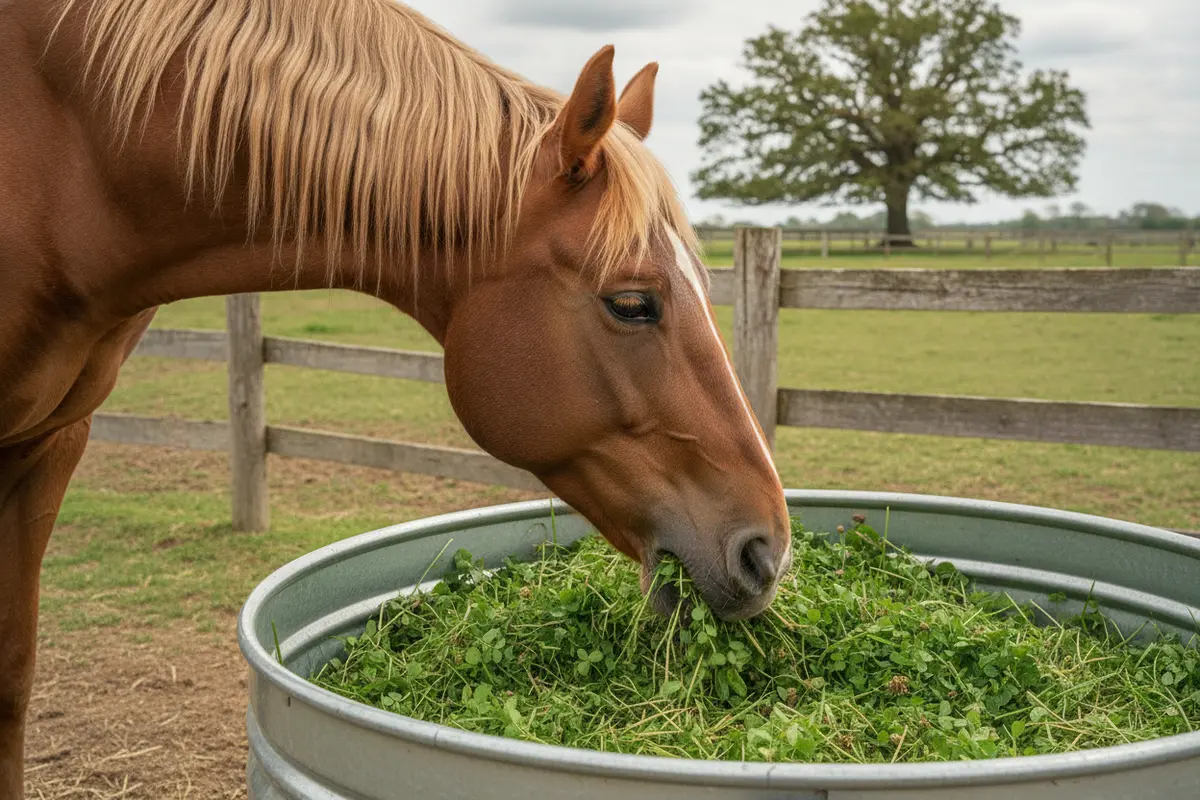
Make the review concrete. Write down the horse’s approximate weight if known, feeding schedule, forage type and amount, pasture access, every commercial feed, and every supplement. Include the reason you are considering a vitamin E supplement and any recent management or health changes. This gives your veterinarian a usable inventory instead of an incomplete impression.
- List each feed source. Include pasture, hay, concentrates, ration balancers, and relevant treats. If amounts vary by day, record the usual range and the reason for variation.
- Gather labels. Photograph the full label, including serving directions and nutrient information. Record the amount actually fed, since the labeled serving and your horse’s serving may not be the same.
- Check overlap. Look for vitamin E in more than one feed or supplement. Do not assume a product is the only source simply because it is the only one marketed as a vitamin supplement.
- Ask about a suitable plan. Your veterinarian can interpret the ration and advise whether a feed adjustment, supplement, or no change makes sense.
- Set a review point. Agree when to reassess, what information to track, and what should prompt a call. Do not increase an amount on your own while waiting.
The UC Davis Center for Equine Health resource on vitamin E offers general background on the nutrient in equine diets. Use it to prepare questions, while relying on veterinary guidance for your horse’s individual needs.
Bring a complete feed inventory, product labels, and measured serving amounts to the discussion. Those details are more useful than choosing a product based only on its front label.
What should you compare on supplement labels?
If supplementation has been discussed, compare products using information that supports accurate feeding. Read the current label and check serving size, amount supplied, form, directions, ingredients, and storage instructions. Similar package sizes or names do not mean products provide equivalent amounts. If a label is unclear, ask the veterinarian or manufacturer for clarification before feeding.
| Label detail | Why it matters | Question to ask |
|---|---|---|
| Amount per serving | Serving sizes differ, so amounts should be compared at the stated serving. | How much does the labeled serving provide, and what serving did the veterinarian recommend? |
| Form and ingredients | The full ingredient list helps identify what the product contains and whether it fits the plan. | Does this match the form discussed, and are there other active ingredients? |
| Feeding directions | Consistent measurement reduces guesswork and makes the plan easier to review. | How should I measure it, and how does the direction apply to my horse? |
| Other ration sources | Multiple feeds and supplements may contribute the same nutrient. | Has the complete ration been checked for overlap? |
| Storage and freshness | Following the label helps keep handling consistent and prevents avoidable deterioration. | How should the container be stored and handled after opening? |
Do not select by a single phrase such as “natural” or by a large package alone. Ask what information matters for the horse’s plan, how the amount will be measured, and what changes would require another review. Keep a photo or copy of the label in your feeding records in case packaging changes.
Hooves and Paws is a family-owned online retailer serving horse and pet owners since 1994. For practical equine care supplies, browse the horse health and first-aid collection. Choosing supplies is separate from deciding on nutrition or treatment, which should be guided by a veterinary professional.
How can you introduce a supplement responsibly?
Follow the plan and label directions agreed upon with your veterinarian. Use a consistent measuring method, and keep the product in its original container with its label available. Store it as directed and keep it where animals cannot access it without supervision. If more than one person feeds the horse, make sure everyone knows the agreed amount and where it is recorded.
Write down the start date, product name, serving amount, and other diet changes. If practical, avoid changing several feeds or supplements at once unless your veterinarian advises otherwise. A simple timeline makes follow-up clearer: it shows what changed, when it changed, and what the horse received. Record ordinary observations without treating them as a diagnosis.
If the horse refuses the product, develops a new concern, or has a change in health, contact your veterinarian before adjusting the amount or adding another supplement. Do not use a human product or improvise a serving for a horse without professional direction. If the ration changes again, update the inventory rather than relying on an old plan.
Common mistakes that make nutrition decisions harder
- Buying from a broad promise: Product descriptions cannot determine an individual horse’s need. Start with the animal and ration.
- Forgetting fortified feeds: Check all feed and supplement labels, not only products sold as vitamins.
- Measuring by eye: Use a consistent measure and the plan advised for this horse.
- Using a supplement to explain signs: Health changes need veterinary assessment, not an unsupervised nutrition trial.
- Changing several things together: Multiple simultaneous changes make it harder to identify what was altered and to report a useful timeline.
- Assuming pasture tells the whole story: Access to grass is relevant, but it does not by itself describe total intake or the entire ration.
Build a useful follow-up record
A short feeding log can make a veterinary review more productive. It does not need to be elaborate. Use one page or a phone note and update it when a feed, supplement, or management detail changes.
- Horse and date: Identify the animal and the date the note was updated.
- Forage routine: Record pasture access, hay type if known, approximate amount, and any recent change in storage or supply.
- Feed inventory: List each product, serving amount, and feeding frequency. Keep a label photo nearby.
- Changes and reason: Note what changed and why, such as a new feed or a seasonal turnout adjustment.
- Veterinary plan: Record the recommendation, how it should be measured, and when you should check back.
- Observations: Note relevant changes factually, with dates, and contact the veterinarian for concerns rather than interpreting them yourself.
For example, if a horse’s turnout schedule changes and the hay source changes in the same week, record both dates. Tell the veterinarian that the changes happened together. That is more accurate than attributing a later observation to one feed without evidence. If a new product is recommended, record the first day it is fed and keep the old label or package information for comparison.
Questions to take to your veterinarian
Bring the list and labels, then ask direct questions. You can write down the answers so the feeding plan is clear when you return to the barn.
- Does this horse’s current forage and feed give us a reason to consider vitamin E?
- Could any current product already be contributing it?
- Would changing a feed or forage routine be more appropriate than adding a supplement?
- If supplementation is recommended, what form and serving are suitable for this horse?
- How should I measure and introduce it, and should anything else change?
- When should we review the plan, and what information should I bring back?
- Which new signs or changes should prompt me to contact you promptly?
These questions keep the discussion focused on the animal rather than on product claims. If your horse is being assessed for a health concern, ask whether nutrition is one part of a wider veterinary plan and what follow-up is appropriate.
Make changes methodically
A practical decision does not need to be complicated. First, assemble the ration information. Next, ask a veterinarian to interpret it in light of the horse’s circumstances. If a change is recommended, use the agreed product and serving, write down the start date, and follow the agreed review plan. If no change is recommended, keep the record and revisit it when forage, feed, workload, or health circumstances change.
This approach is useful whether the answer is to supplement, adjust another part of the ration, or leave the current plan alone. It avoids treating a nutrient as a stand-alone fix and makes future conversations easier because the feeding history is clear.
Shop horse health supplies today
Frequently Asked Questions
Does every horse need a vitamin E supplement?
No. Whether one is appropriate depends on the full ration and the horse’s circumstances. Ask a veterinarian to review forage, fortified feed, and current supplements before adding one.
Can fresh pasture contribute vitamin E?
Fresh green forage can contribute vitamin E, but the amount available varies. Pasture access alone does not establish whether the horse’s total intake is suitable.
Should I choose natural or synthetic vitamin E?
Do not decide from label wording alone. Ask your veterinarian to interpret the product form, amount, and the horse’s needs. Research in a particular setting does not establish one universal choice.
Can I give my horse a human vitamin E product?
Do not substitute a human product or calculate a horse’s serving without veterinary guidance. Formulations and directions can differ.
How can I tell whether a supplement is helping?
Follow the veterinarian’s monitoring plan. Keep notes on the product, serving, diet changes, and relevant observations, and contact the veterinarian about concerns rather than changing the amount yourself.
What information should I bring to a nutrition discussion?
Bring forage and feed details, complete product labels, serving amounts, and a brief account of recent management changes. A clear inventory helps your veterinarian assess the whole ration.
A thoughtful decision starts with the horse’s total diet, careful label reading, and veterinary guidance. That process helps you choose supplies with confidence while keeping nutrition decisions specific to the animal in front of you.


