


Conventional metal shoes often stop a horse's hoof from expanding naturally when they hit the ground. This restriction can affect how your horse moves and feels on different surfaces. For many owners, the choice to go barefoot is about more than just saving money on farrier bills.
Shop hoof boots for horses and leg protection at Hooves and Paws.
Hoof boots for horses provide a tough and flexible choice for owners who want to keep natural hoof health by protecting the horse's sole and wall. These boots prevent wear on hard ground while letting the heels spread and pull back naturally during every step that your horse takes.
Unlike nailed shoes, some hoof boots allow natural heel expansion. This is closer to the way a horse moves when barefoot. They are easy to put on for rides and take off later, making them great for trail riding, health needs, or transitioning to barefoot. At Hooves and Paws, we have spent 30 years helping owners find the best gear to keep their animals happy, healthy, and sound.
Picking the right gear starts with knowing how hoof boots work and what sets them apart from metal shoes.
What are hoof boots for horses?
Hoof boots are a type of gear that horse owners use instead of metal shoes. These boots act like tough shoes for your horse. They shield the hooves from hard ground and sharp rocks. Unlike old shoes that nail into the hoof wall, boots are easy to take off. This lets you give trail riding protection only when your horse needs it. You can use them for long rides on rough paths and keep the horse barefoot at home.
Since 1994, our family at Hooves and Paws has helped riders find the right gear. We know many owners want to keep their horses barefoot for health. Hoof boots for horses make this easy by shielding the sole and frog on rough ground. They offer a good choice for people who want the perks of a barefoot horse. You get the protection you need without the risk of stone bruises during a ride.
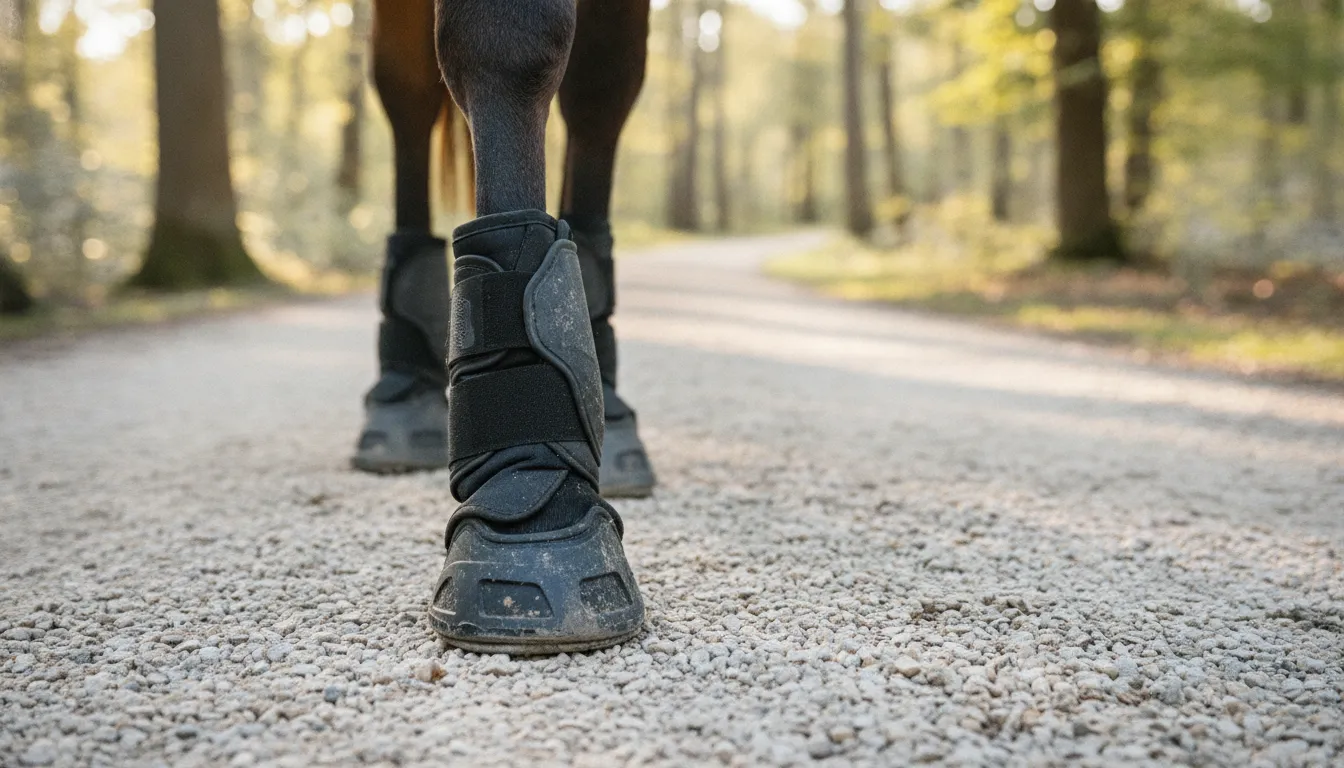
How boots help hoof health
One big reason to use boots is to allow for natural hoof movement. Metal shoes can stop the hoof from growing and moving when it hits the ground. Research shows that old-style shoes limit heel expansion compared to being barefoot. When the hoof can move well, it helps with shock and blood flow. Boots give this freedom while they still guard the foot from the trail.
Boots also help horses with thin or sore soles. If a horse is moving from shoes to barefoot, their feet might feel sore on rocks. Using therapeutic hoof care can give these horses fast relief. This help lets them move with joy while their hooves grow strong. It makes the move to barefoot much easier for the horse and the owner.
Options for different riding styles
New boots work well for more than just easy trail rides. You can find styles for long rides, jumping, or even deep mud. Some riders use all-terrain hoof boots that stay on at a fast gallop. Since you can buy them as one boot or a pair, it is easy to replace just one. This makes them a smart choice for long-term use and care.
Most top boots can last for hundreds of miles. You can also add pads or socks to stop rubbing. Whether you want breathable hoof boots for hot days or tough boots for rocks, there is a style for you. We back our items with 30+ years of work and a 365-day guarantee. Our goal is to make sure you get the best fit for your horse.
When does a horse need hoof boots?
Moving to barefoot
Many horse owners choose to pull metal shoes to improve hoof health. Metal shoes can keep the hoof from spreading and flexing as it should. Research shows that standard metal shoes limit how the heel spreads out. This can slow down blood flow and change how the hoof handles shock. When you first move to barefoot, your horse might feel some soreness on hard ground. Hoof boots for horses provide a safe bridge during this change.
They protect the tender sole while the hoof grows stronger over time. This allows the hoof to spread out naturally while still being safe from wear. It gives the horse the benefits of barefoot life with the safety of a shoe. The hoof wall grows about one quarter to one half inch each month. During this time, the old nail holes must grow out and the sole must get thicker. Hoof boots protect the foot as it goes through these major changes.
Riding on rough trails
Even a healthy barefoot horse may need extra help on certain paths. If you plan to ride on rocky or gravel trails, the ground can wear down the hoof wall too fast. It can also lead to stone bruises or sharp pain. Using trail riding protection helps you take your horse on any terrain without worry. These boots act like great sneakers for your horse.
They grip the ground and shield the bottom of the foot from sharp rocks and hard surfaces. This keeps your horse sure-footed and at ease during long rides. Some boots are even built for long trips and can last for hundreds of miles. Whether you ride through water, mud, or over sharp rocks, the right boot stays in place. Great boots use strong straps and soft pads to stop rubs while giving a solid grip on the trail.
Help for hoof injuries
Hoof boots are also vital tools for horses with hoof issues or health problems. If a horse has thin soles, abscesses, or laminitis, they need soft support to heal. These problems can make every step painful for the animal. Special therapeutic hoof care boots can hold medicine or thick pads in place.
They keep the area clean and dry while the horse stays in a stall or small paddock. You can even add custom pads or gaiters to make the fit even better. This extra layer of care helps the horse stay at ease as they heal. At Hooves and Paws, we use our 30 years of expert knowledge to find the best gear for your horse's needs. We know that every horse is unique and needs a specific fit for the best results.
Turnout and expert advice
Sometimes a horse needs boots just to stay safe in the field. If your horse has brittle hooves, a light boot can help. It prevents the hoof from chipping on hard ground or mud. This is helpful for horses that lose shoes often. But you should be careful not to leave them on for too many hours.
Trapped moisture can soften the hoof too much or cause rubs. It is best to check the boots every day and let the feet breathe. Before you buy, talk to your farrier or vet about the best plan. Our family-owned team is here to help you find the best match with our 365-day satisfaction guarantee and free shipping. We want you and your horse to be happy with everything you buy from our shop.
How to choose the right hoof boots for horses
Picking the best hoof boots for horses takes time and care. At Hooves and Paws, we use our 30 years of expert skill to help you find what you need. Many people look for boots when they move their horse to barefoot care.
This shift helps the hoof grow in a healthy way. Metal shoes can stop the hoof from moving as it should. A study from nih.gov found that metal shoes limit how much the heel can expand. Using boots instead lets the hoof move and expand in a normal way.
The right boots give your horse grip and safety on any trail. We know that every horse is one of a kind. This is why we carry a wide range of brands and styles.
Our goal is to make sure you find a pair that stays on and keeps your horse happy. Whether you want trail riding protection or a boot for field work, we can help. We also offer a 365-day satisfaction guarantee on our products to give you peace of mind.
Find the right size for a good fit
A boot that fits well is the most vital part of a good ride. If a boot is too loose, it may spin on the hoof or get lost in the mud. If it is too tight, it can cause sores or rub the skin. You should measure your horse's feet right after a trim from the farrier.
This ensures you get the most exact numbers. Use a tape or a ruler to find the width of the hoof at the widest point. Then, measure the length from the toe to the very back of the hoof wall. Do not include the heel bulbs in this length.
Many horses have front and back feet that are not the same size. Be sure to measure all four feet before you buy. Once you have your numbers, look at the size charts for the boots you like. Keep in mind that some brands fit round feet better.
Others are made for oval feet. If your horse has a hoof shape that is hard to fit, you can add pads or shims. These small tools help fill in gaps and keep the boot snug. Correct sizing is a key part of using hoof boots well (renegadehoofboots.com).
Steps to pick the best boots
- Measure each hoof right after a fresh trim to get the most exact width and length.
- Compare your hoof numbers to the size chart for the brand you want to buy.
- Think about where you ride and choose a sole with the right amount of grip.
- Pick a closure style, like Velcro or straps, that is easy for you to use.
- Check for holes that let water out if you often ride through mud or creeks.
Think about your terrain and gait
The ground you ride on tells you what kind of sole you need. For rocky or hard trails, look for all-terrain hoof boots with thick, tough soles. These soles act like a shield for the hoof.
They stop sharp rocks from hurting the sole or the frog. If you ride in soft sand or dirt, a lighter boot with less tread may be a better pick. These boots are often easier for the horse to move in at faster speeds. You want a boot that stays out of the way of your horse's normal gait.
You should also think about how long your rides are. If you go on long trail rides, look for boots that stay cool and dry. Some breathable hoof boots use mesh to let air flow.
This helps keep the hoof from getting too soft or damp during a long day of work. If your horse has tender feet, you might look into boots made for therapy. These often have softer soles to help a horse heal (scootboots.com). We are here to help you find a boot that works for you and your horse.
When you buy from us, you get help from a family-owned shop that has been around since 1994. We offer same-day shipping on orders placed before 2 PM PST to get your gear to you fast.
Plus, our free shipping in the lower 48 states makes it easy to get what you need. If the boots do not work out, our 365-day guarantee means you can shop with peace of mind. We take pride in our service and our many five-star reviews from happy horse owners.
Hoof boot types and best uses compared
Hoof boots give horse owners an easy way to protect barefoot feet. At Hooves and Paws, we have spent 30 years helping people find the right gear. We know that every horse has unique needs for their feet.
Unlike metal shoes that stay on, boots can be used only when needed. This choice lets the hoof grow and work in a real way. Research shows that hoof boots for horses allow for better heel movement than fixed shoes. This help is great for the horse's health and comfort.
Main hoof boot styles
Trail boots are built for rugged paths. They use thick soles to shield the hoof from rocks. These boots are often easy to put on and take off. Most riders use them for trail rides or light work. Many models like all-terrain hoof boots offer a grip that keeps the horse safe on wet grass.
Therapy boots serve a different role. They are for horses with thin soles or foot pain. These boots are soft and have a loose fit. They are not for fast riding. Instead, they provide therapeutic hoof care during stall rest or light field time. Some therapy boots stay on for long times to help a horse heal.
Sport boots are for the pro rider. They are light and stay secure during fast runs. These boots must fit well to avoid rubs. They are common in long rides and jump sports. Toughness is a key factor here. High-end boots can last for 500 to 600 miles of use.
Comparing boot features
Choosing the best boot means looking at the trade-offs. Some boots offer high shield but might be heavy. Others are light but only for soft ground. Here is a look at how the main types stack up.
| Boot Type | Best Use | Main Benefit | Toughness |
|---|---|---|---|
| Trail | Rocks and dirt | Easy to use | Very high |
| Therapy | Injury care | Deep comfort | Medium |
| Sport | Fast work | Low weight | High |
| Turnout | Field time | Soft edges | Medium |
This table shows that your choice depends on the ground. Trail boots are the workhorse of the group. Sport boots offer more speed but need a tight fit. Therapy boots focus only on health and rest.
Sizing and build for comfort
Fit is the most vital part of using hoof boots. A boot that is too large will spin or fall off. A boot that is too tight can cause sores or pain. You should measure the hoof after a fresh trim for the best results.
We offer expert help with sizing to make sure you get it right. You can also use pads to change the fit. Soft pads add extra cushion for horses with sore feet. Gaiters can help stop dirt from getting inside the boot. These parts make the boot better for your horse.
Most hoof boots use tough parts like thick plastic or nylon. These parts resist mud and water. They do not get heavy when wet. The soles often have patterns to help with grip. Some boots use cables to stay on. Others use Velcro for a quick fit. Check your boots often for wear. Swap out a single worn boot to save you money.
How should hoof boots fit?
A good fit is the key to using hoof boots for horses. If the boots are too loose, they can twist or fall off. If they are too tight, they might rub the skin or hurt the hoof.
Unlike metal shoes, boots allow for normal movement. Studies show that metal shoes can stop the heels from opening up, while boots let the hoof flex. At Hooves and Paws, we have spent 30 years helping people find the right size for their horses.
Measuring after a fresh trim
You must measure your horse's feet at the right time. The best time is right after a fresh trim. Hooves change shape as they grow, so old sizes will not work. You will need to find the width and the length of each hoof.
Use a ruler to find the widest part of the hoof from side to side. Then, find the length from the toe to the line where the heel starts. Do not include the bulbs of the heel in this size. Most brands offer a chart that uses these two numbers. If your horse is between sizes, you may need to look at a new brand or style.
Signs of a snug fit
A boot should fit like a glove. It should be snug but not pinch the soft parts of the foot. You should not be able to twist the boot by hand once it is on and tight. If the boot turns easily, it is too big.
Look for a tight lock that stays shut during work. Some boots use straps, while others use wires or tape. Check for any gaps between the boot and the hoof wall. Gaps can let in dirt and rocks, which can cause sores. Look for these signs of a good fit:
- The boot does not twist or turn when the horse walks.
- There are no large gaps near the top of the boot.
- The heel bulbs sit firmly inside the back of the boot.
- The straps or buckles do not press into the skin.
If you plan to go on long trips, check out our guide on trail riding protection to see how each fit handles rough ground.
Hoof shape and brand choices
Every horse is unique, and so is every brand of boot. Some brands are made for round hooves, while others fit oval shapes. If your horse has very high or very low heels, some models might work better than others. You can also use add-ons like pads or wraps to get a better fit.
Pads can help if a hoof is a bit small for the size. Wraps help keep the boot in place and protect the skin from rubbing. Since we are family-owned and have been in business since 1994, we know which brands fit which hoof types. We also offer a 365-day guarantee, so you can buy with trust.
How to use and care for hoof boots safely
Safe use starts with a good break-in period. New hoof boots for horses are like new hiking boots for people. They need time to soften and match the horse's shape. Start with short rides of ten to fifteen minutes.
Watch the skin around the pastern and bulbs for any red spots or heat. If you see signs of rubs, stop and check the fit. You can add pads or soft wraps to help with the transition. Taking it slow helps keep your horse comfortable and prevents sores. It also lets the horse get used to the feel of the extra weight on its feet.
Check the fit and tread
Always inspect your boots before you tack up. Look at the soles to ensure the tread is not worn flat. Good grip is vital for safety on slick or rocky paths. Check that all straps, buckles, and wires are in good shape and work well.
A loose boot can trip a horse or get lost in deep mud. For extra safety, you can use specialized trail riding protection to guard the lower legs from brush and rocks. Regular checks ensure the gear stays secure through every mile. You should also verify that the hoof is trimmed well so the boot fits as the maker intended.
A well-set boot should not turn or twist on the foot. If you can spin the boot by hand, it is too big. A tight fit prevents dirt from getting inside and keeps the boot in place at a gallop.
If you struggle to get the boot on, the hoof may be too long. Routine trims every four to six weeks are best for a good fit. This care keeps the hoof in the best shape for barefoot health. It also makes sure the boot can do its job to guard the sole from sharp stones and hard ground.
Clean and dry your gear
Mud, sand, and grit are the main causes of rubs. After every ride, take the boots off and shake out any dirt. Use a stiff brush and water to scrub away dried mud from the inside and outside.
Sand trapped inside acts like sandpaper against the soft skin of the hoof bulbs. After cleaning, let the boots dry in a shady spot with good air flow. Avoid high heat or direct sun, as this can make the materials brittle or warp the shape. Keeping the gear clean and dry extends the life of the materials and prevents skin issues.
Safe storage and maintenance
Store your boots in a cool, dry place when you are not using them. Putting wet boots in a closed box can lead to mold and bad smells.
Many owners find that using all-terrain hoof boots helps them switch between barefoot time and protected rides easily. Research from the National Institutes of Health shows that letting hooves expand naturally is better for health than using fixed metal shoes. By caring for your boots, you support this natural movement while keeping the sole safe from harm during work.
Watch for wear and tear
Over time, even the best boots will show signs of age. Check the hardware for rust or fraying. If a boot feels too loose or moves around while the horse walks, it may be time for a new set. Most quality boots can last for hundreds of miles with the right care.
At Hooves and Paws, we have over 30 years of expertise in finding the right gear for your needs. We offer a 365-day satisfaction guarantee so you can shop with peace of mind. Taking care of your gear ensures your horse stays happy and sound on every trail. We ship same-day for orders placed before 2 PM PST to help you get your gear fast.
Browse hoof boots for horses and leg protection options before your next ride.
Frequently Asked Questions
Are hoof boots good for horses?
Hoof boots are a great choice for many owners because they protect the feet while keeping natural hoof movement. Unlike metal shoes that can limit how the heel spreads, boots let the hoof function as it should when barefoot.
According to research, barefoot horses show much better heel spread than those in standard shoes. This helps the foot soak up shock and helps blood flow. Boots offer a flexible way to keep horses barefoot while giving help on hard trails.
How long can a horse wear hoof boots?
Most horses only wear boots during work or riding, but some models can stay on for longer. High-quality boots are built to last and can handle many miles on the trail. Some boots can travel up to 600 miles according to makers. To keep your horse safe, you should check the fit and clean the boots often. Always take the boots off to let the feet dry and breathe after you finish your ride.
What are the best hoof boots for horses?
The best hoof boots depend on your horse and the type of riding you do. You should look for boots that fit well and stay in place on rough ground.
Premium brands offered by Hooves and Paws experts provide different styles for trail riding or fast work. It is key to choose boots with a good grip and a design that keeps the hoof healthy. A 365-day guarantee helps you feel sure about your choice when you shop for new gear.
What are three types of hoof boots?
There are three main types of hoof boots made for clear needs. Trail boots are built for long rides on rough land and have a strong grip. Fast boots are light and designed for high-speed work like jumping or racing.
Lastly, comfort boots give help to horses with sore feet or those who are healing. According to makers, you can also add pads to these boots for more support. Choosing the right type helps keep your horse safe and sound in any work.
Ready to find the right hoof boots for your horse?
Every day your horse goes without the right foot support is a day they might feel sore. Tough trails and hard ground can wear down hooves faster than they grow when they have no shoes. Waiting to get the gear you need might mean keeping your horse in the stall while they heal.
Starting your search today keeps your riding plans on track and helps your horse stay sound and happy. You will get more out of your time with them when you know their feet are safe from rocks and bruises. Our team has spent thirty years helping horse owners find the best fit for their needs.
Ready to contact our horse gear experts? Shop hoof boots and leg protection to keep your horse sound today.


