


An automatic cat feeder can make meal times more predictable, but only when it matches the cat, the food, and the household. The useful version releases a measured amount on a schedule you can test. It stays clean, and a person can still feed the cat if the app, the clock, or the power fails.
This guide covers portion control, food type, schedules, backup power, cleaning, cameras, and multi-cat homes. It does not replace a veterinarian's feeding plan, and it does not rank individual products. A puzzle toy that slows a fast eater is a different tool, covered in the cat puzzle feeder guide for fast eaters.
Shop cat toys and scratch posts
What an automatic cat feeder actually does
Most automatic cat feeder designs store food and release it on a clock you set. A dry-food model usually holds kibble in a hopper and turns a wheel or auger for a set time. A wet-food model usually opens one sealed compartment at a time. A selective model may open only for a cat wearing a collar tag or carrying a registered microchip.
Those designs solve different problems. A timed dry feeder can split one daily ration into several small meals while you are at work. A chilled tray can hold canned food for a shorter window. A microchip feeder can keep one cat out of another cat's prescription diet. Buying the model with the most buttons does not help if it cannot handle the food your cat actually eats.
Gravity feeders are a separate category. They refill a bowl whenever it empties, so they do not control portions. They can suit a healthy cat that a veterinarian has cleared to graze. But they are a poor fit for weight management or a household where one cat steals food.
The American Association of Feline Practitioners feeding statement encourages multiple small meals, a calm place to eat, and separate spaces when cats compete. A programmed feeder can support that pattern. It still needs a person to confirm that food arrived and that the cat is eating normally.
Decide if an automatic cat feeder fits
An automatic cat feeder is often a good fit for a healthy adult cat whose meals need to happen during a workday, overnight, or a short outing. It can also help a home stop free-feeding after a veterinarian recommends a set daily amount. The machine delivers the plan. It does not create the plan.
Ask a veterinarian before you change meals for a kitten, a senior, a pregnant or nursing cat, an underweight cat, or an overweight cat. The same is true for diabetes, kidney disease, urinary disease, stomach trouble, or any condition that changes food or water needs. A cat that suddenly eats less, stops eating, vomits, or seems unwell needs a person, not a new schedule.
Weight loss needs the same care. The Cornell Feline Health Center obesity page warns against sudden starvation diets and says weight reduction should follow veterinary direction. Do not use a feeder to impose a sharp calorie cut. Program the daily amount your veterinarian or the food plan already set, then watch body condition and appetite.
A feeder is also a poor reason to leave a cat alone for a long stretch. Before you rely on it, confirm that it dispensed food, the bowl is reachable, water is fresh, and the cat looks normal. For an overnight trip or longer, arrange a person who can check the cat and the machine. A camera can show a bowl. It cannot refill water, notice illness, or handle a jam.
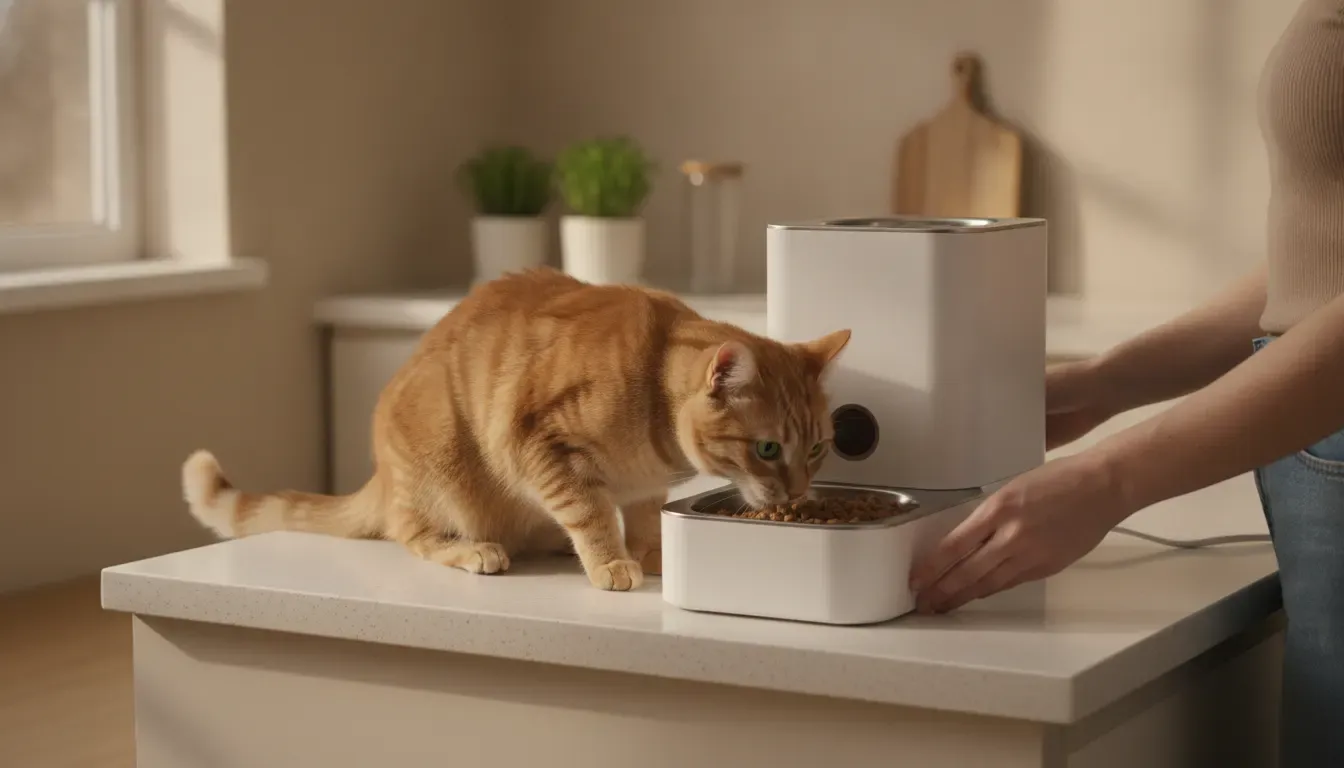
Introduce the machine while you are home. Place it beside the familiar bowl, leave it off, and let the cat sniff it. Offer one supervised meal from the new bowl before you move the whole routine. A loud motor or a deep, narrow dish can make a cautious cat walk away.
Shop This Post

Featured in this article
Ducky World Yeowww! Juguete de hierba gatera orgánica de 7" para gatos de granja
$12.11
Shop Now →

Match the feeder to the food
The first buying decision is dry food, wet food, or both. A kibble hopper will not keep canned food at a safe temperature. A short-window tray will not hold several days of dry food. Start with the food, then compare apps and cameras.
| Feeder type. | Best fit. | Check before you buy. |
|---|---|---|
| Dry-food hopper. | Measured kibble meals on a repeatable clock. | Kibble size, jams, portion accuracy, and cleaning access. |
| Wet-food tray. | Canned meals for a short, planned window. | Cooling method, seals, tray count, and washable parts. |
| Ice-pack tray. | A few wet meals while someone is out for part of the day. | How long the pack stays cold in your room. |
| Refrigerated unit. | Wet or fresh food that must stay cold longer. | Noise, size, power needs, and cleaning time. |
| Selective-access feeder. | Cats on different diets or portions. | Tag or chip reliability, and whether the cat accepts the bowl. |
Dry-food hoppers
Compare hopper size with how often you can refill, not with the largest number on the box. A bigger hopper is not always better. Food can go stale, and a deep bin can hide crumbs, oil, and a stuck piece of kibble. Look for a wide opening, a lid a cat cannot pry off, a removable bowl, and a chute you can see into.
Portion labels are not universal cups or calories. One brand's "portion" may be a motor spin, a volume setting, or a serving the manufacturer defined with its own kibble. Run several test releases into a cup, then weigh them on a kitchen scale. Repeat the test if you change kibble size, shape, or brand. Oily or oddly shaped pieces jam more often.
Wet-food trays
Wet food needs sealed compartments, a cooling plan, and parts you can wash. Ice packs usually cover a shorter window than a powered cooler. If the feeder cannot keep the food cold for the time you need, do not leave canned food in it. Follow the food label, the feeder manual, and your veterinarian.
The FDA pet food storage page says to refrigerate or discard unused canned or pouched food promptly, wash bowls after use, and store food properly. A dry hopper is not a workaround. Put only the food the feeder maker says it can hold, and do not pack a tray the night before unless the design is made for that.
Mixed meals
A cat that eats both wet and dry food may need two setups, or one machine with truly separate jobs. Write down the full daily ration so a scheduled kibble drop does not land on top of a canned meal. The device is only as accurate as the plan behind it.
Which automatic cat feeder features matter
Once the food type is settled, spend your attention on the features that fail in real kitchens. A camera is optional. A way to feed the cat when the app is down is not.
- Portion control. Pick settings small enough for your plan and easy to check. Several small releases often fit a cat better than one large dump, but only if each release is accurate.
- Scheduling. You want enough daily meals, a visible clock, and a simple way to change weekends, daylight saving, or a travel day. Confirm the schedule is stored on the feeder, not only in the phone.
- Jam alerts. Test your real kibble. A useful alert tells you a meal did not drop. A silent failure is worse than a basic timer you can see.
- Power backup. Batteries and a saved local schedule are different features. Ask whether the unit switches over by itself, keeps the clock, and shows you that it ran on backup.
- Cleaning. Removable bowls, reachable seals, and a chute you can wipe matter more than a glossy shell. Check which parts are dishwasher-safe and which must be hand-washed.
- Lid security. A determined cat will paw, nose, and shove. Look for a latch, a stable base, and a cord routed where it cannot be chewed.
- Noise. Run a cycle while the cat is in the room. A sharp grind can undo weeks of careful introduction.
- Manual backup. Physical buttons or a clear hand-release should work with no Wi-Fi. If the only control is an app, plan for the day the phone or the router fails.
Treat phrases like "exact portions" and "fresh all day" as claims to test, not facts. Keep the manual and the model number. If a part fails, those details are what support and safety notices ask for.
App cameras and two-way audio can be comforting, and a low-food sensor can prevent an empty hopper. Neither one proves the right cat ate the meal. Use them as a check on the machine, then still look at appetite, weight, and behavior when you are home.
Set portions and schedules safely
- Set the daily amount. Use the food label as a starting point and ask a veterinarian when weight, age, or illness changes the target.
- Weigh real output. Run several cycles with the kibble you will use. Write down the grams, not just the on-screen portion number.
- Split meals on purpose. Many cats do well with smaller meals through the day. The count should match the cat and the feeder's reliable minimum, not a generic chart.
- Save a backup plan. Write the schedule on paper. Practice feeding without the app before you depend on it.
- Move over slowly. Keep the old bowl nearby for the first supervised meals. Shift one meal at a time if the cat hesitates.
- Recheck after changes. A new kibble, a moved feeder, or a time change can alter output or appetite. Weigh another cycle and watch the bowl.
The American Association of Feline Practitioners' feeding guidance favors frequent small meals, a calm place to eat, and a plan built for the individual cat. That is a useful design rule. It is not a universal meal count or a universal portion size.
Keep fresh water in a separate spot, not jammed against the feeder. A cat water fountain guide can help if your cat drinks more from moving water. The bowl shape matters too. Whisker-friendly dishes and material choices are covered in the cat food bowl guide, which is about the dish itself, not the timer.
Use an automatic cat feeder with more than one cat
One shared feeder is not automatically fair. A confident cat may guard the bowl, finish the portion, or scare a timid cat off before the meal is gone. An empty bowl only tells you that some food disappeared.
Watch the first week in person. Feed where each cat can leave without being cornered by people, dogs, or another cat. Distance and a visual barrier often reduce conflict more than a louder app alert. Some homes need one feeder per cat.
A collar-tag or microchip feeder is worth a look when one cat needs a prescription diet, a different portion, or protection from a food thief. Read how the lock identifies the cat, what happens if the tag falls off, and whether the opening is wide enough for your cat to eat comfortably. Do not make it the only option until every cat has used it without stress.
A dual-bowl drop can suit two pets that eat the same food at the same time and do not steal. It does not identify either cat, and it does not guarantee an even split. If you see weight change, vomiting, food guarding, or a cat that waits and never eats, call a veterinarian or a qualified behavior professional.
Clean, test, and plan for time away
Cleaning is part of the feeding schedule, not a monthly extra. Dump old food before you refill, wash bowls and trays as the manual directs, and dry every piece before it goes back. Moisture left in a hopper turns crumbs into a jam. Do not dunk the electrical base unless the maker says that exact part can be washed that way.
Run the feeder at home for several days before a day you will be out. Test the first meal, a later meal, the battery takeover, the manual release, and any alert. Listen for grinding, check that the bowl stays put while the cat eats, and confirm the next meal is still on the clock after you unplug the router.
A short log is enough: date, food, measured output, scheduled time, whether it dropped, and how the cat ate. That record helps when a cat is on a controlled plan, and it shows a failed meal before the hopper looks empty. For a longer absence, pair the feeder with a person who can visit. Automated cleanup is a different problem, covered in the automatic litter box guide, and it does not change the need for someone to see the cat.
If you also want play while you are gone, look at automatic cat toys for time away. Toys do not replace meals, and a feeder does not replace exercise. Hooves and Paws carries cat toys and scratch posts if you are building that separate part of the routine.
Browse cat enrichment supplies
Frequently asked questions
Are automatic cat feeders safe?
They can be safe when the model matches the food, portions are measured, parts are cleaned, and a person checks the cat and the machine. They do not replace veterinary care or in-person supervision on long trips.
Can an automatic cat feeder help with portion control?
Yes. It can split a set daily amount into scheduled meals. Weigh the output, because portion numbers vary by model and by the kibble you use.
Can I put wet food in any automatic cat feeder?
No. Use a wet-food tray or a cooled unit, and follow its timing and cleaning rules. A dry hopper is not a safe place for canned food.
How often should I clean an automatic cat feeder?
Wash food-contact parts as often as the manual says, and any time you see residue. Dry them fully before the next fill. Do not wait for a smell.
Will one automatic feeder work for two cats?
Sometimes, if they eat the same diet and do not guard the bowl. Separate feeders, or a tag or microchip model, are safer when portions or diets differ.
Do automatic cat feeders need Wi-Fi?
No. Basic timers run on the device. Smart models may use Wi-Fi for alerts or remote changes. Pick one you can still operate when the network is down.
How long can a cat stay alone with an automatic feeder?
A feeder can cover meals for a short, planned absence after you have tested it. It does not cover illness, water, a jam, or a cat that feels unwell. Arrange a person for overnight trips and longer.
Should I use a feeder if my cat stops eating?
No. A sudden appetite change can be a medical problem. Contact a veterinarian instead of hoping the next scheduled meal fixes it.
Final thought: The right automatic cat feeder is the one that drops the right food in a measurable, clean, and repeatable way. Test it while you are home, keep a manual backup, and let daily observation stay part of the routine.


