


A dog bed should give your dog a comfortable place to rest, but the best choice depends on more than color or softness. Size, sleep position, support, fabric, cleaning routine, and where the bed will be used all matter. This dog bed guide gives you a practical way to compare options and choose a bed your dog can use every day.
Start with your dog's size and sleeping space
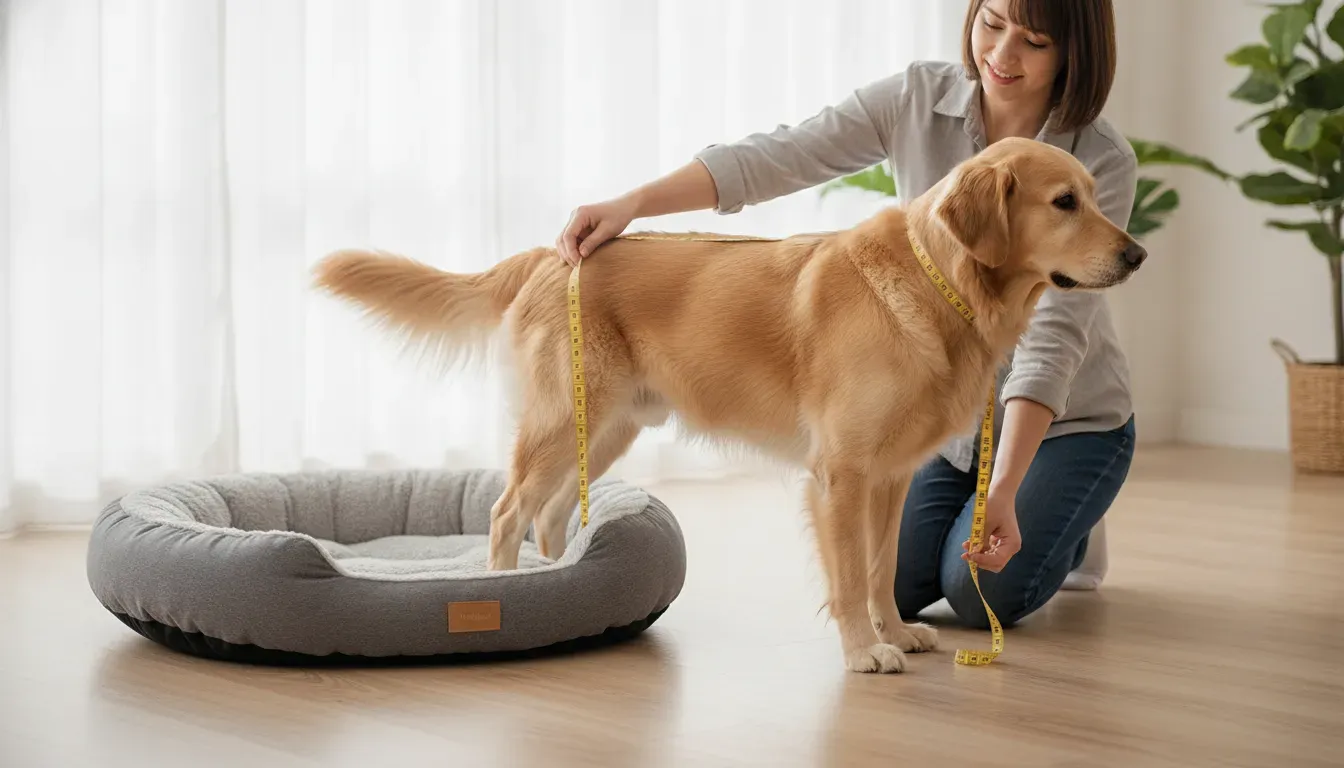
A dog bed should let your dog lie down fully, turn around, and change position without hanging over the edge. Measure your dog while standing, then compare that measurement with the bed's usable sleeping area, not only its outside dimensions.
Bed sizing is the first filter because a bed that is too small can become an unused piece of furniture. A bed that is much too large may feel less secure to a small dog, especially if your dog prefers curling up. Start with a simple measurement instead of relying only on breed labels or weight ranges.
How to measure your dog for a bed
- Measure from the tip of the nose to the base of the tail while your dog is standing naturally.
- Measure across the widest part of the body, including the shoulders or hips.
- Add several inches to both measurements so your dog has room to stretch and reposition.
- Compare the result with the interior sleeping area listed by the manufacturer.
- If your dog sprawls, measure again when your dog is relaxed in its favorite sleeping position.
Do not count a thick bolster, raised rim, or decorative edge as usable sleeping space. A dog that sleeps with its head on a rim may appreciate a bolster, but the flat center still needs to accommodate the body. For a growing puppy, choose a size that will remain useful as the dog matures, while making the space feel inviting with a washable blanket if needed.
Which dog bed style fits your dog's sleep position?
Match the bed shape to the way your dog already rests. Bolster beds suit dogs that curl or lean, open mattresses suit stretchers, cave beds suit dogs seeking cover, and portable mats suit travel, crates, trailers, and outdoor use.
Watch your dog for a few minutes before shopping. Sleep position often tells you more than breed or age. A dog that circles and tucks its nose may prefer a supportive rim. A dog that stretches across the floor needs a broad, open surface. A dog that burrows under blankets may be happier in a covered or cave-style bed.
| Bed style | Often suits | What to check |
|---|---|---|
| Mattress or platform | Dogs that stretch, sprawl, or change positions | Flat sleeping area, enough length, and cushioning that does not bottom out |
| Bolster or couch | Dogs that curl, lean, or rest their head on an edge | Low entry, stable sides, and enough interior room |
| Cave or covered bed | Dogs that seek privacy, warmth, or a den-like space | Ventilation, easy access, and a cover that can be cleaned |
| Elevated bed | Dogs that rest outdoors or prefer airflow underneath | Stable frame, safe height, durable fabric, and a level surface |
| Travel mat or camp bed | Dogs that travel to shows, trails, campsites, or work areas | Foldability, moisture resistance, insulation, and carrying convenience |
A bed should support a natural position rather than force your dog into one. If your dog repeatedly avoids a new bed, check the size, heat retention, location, and texture before assuming the dog simply does not like beds. Place it near a familiar resting area and give your dog time to investigate it without pressure.
Dog bed options for home and travel
Shires Digby & Fox Waterproof Padded Dog Bed: A wipe-clean, waterproof option made with 600D nylon and insulating polyfill. The product page lists small and large dimensions for different dogs and spaces, including vehicles and stable areas.
Weaver Leather Terrain Dog Camp Bed: A portable choice with a waterproof rip-stop top, insulated core, reflective binding, and a compact zippered bag. Its listed 35.5-inch by 26.5-inch size may suit owners who need a travel bed for a larger dog.
Shop This Post

Featured in this article
Doggie Design Alpine All Weather Dog Parka - Waterproof Fleece Lined Reflective - Multiple Sizes
$25.00
Shop Now →

Support and cushioning matter more than maximum softness
Look for cushioning that supports your dog's body without collapsing flat. Dense foam, layered padding, or a well-filled insert can provide a more stable resting surface than a very soft bed that compresses quickly under the dog's weight.
Softness feels appealing when you press a bed with your hand, but your dog experiences it with the whole body. The more useful question is whether the bed stays supportive after your dog lies down. A supportive surface can make it easier for a dog to settle, rise, and change positions.
Choosing support for puppies and adult dogs
Puppies need a bed that is comfortable, easy to clean, and sized with growth in mind. Removable covers are especially practical during house training or teething. Avoid loose parts, exposed foam, or cords that a puppy could chew. A washable mat inside a crate can be useful if it fits securely and leaves enough room for the puppy to stand and turn.
For healthy adult dogs, choose support based on body size, activity level, and sleep habits. Athletic dogs that spend time outdoors may need a durable, insulated surface for recovery between activities. Dogs that spend most of the day indoors may prioritize a breathable cover and a cushion that keeps its shape.
When an older dog needs extra consideration
An older dog may benefit from a stable, supportive bed with a low entry. Look for a surface that does not slide across the floor when your dog stands up. A raised edge can provide a headrest, but a high step-over can be inconvenient for a dog with limited mobility. If your dog shows new pain, stiffness, difficulty rising, or a change in sleep habits, consult a veterinarian rather than treating a bed as a medical solution.
Choose materials for the way your household really lives
The most practical dog bed is one that matches your cleaning routine and environment. Washable covers help in homes with shedding or muddy paws, waterproof surfaces suit travel and outdoor use, and breathable fabrics can be more comfortable in warm rooms.
Material selection is a daily-use decision. A beautiful bed that cannot handle hair, dirt, or regular washing may be frustrating within a few weeks. Before buying, check whether the cover removes, how it closes, whether the insert can be cleaned, and whether the care instructions fit your available laundry routine.
- Washable fabric: Useful for shedding dogs, puppies, muddy paws, and households that want a regular cleaning schedule.
- Water-resistant or waterproof fabric: Helpful for patios, vehicles, barns, camping, and dogs that return wet from outdoor activities.
- Rip-stop or heavy-duty nylon: Worth considering for travel, active dogs, and spaces where the bed may rub against equipment.
- Fleece and plush: Comfortable for dogs that like warmth, but these fabrics may hold hair and moisture unless the cover is easy to remove.
- Breathable cotton or mesh: Useful in warmer rooms when airflow is more important than added insulation.
- Foam or layered fill: Can provide stable support, but inspect the cover and seams regularly if your dog chews.
Pay attention to seams, zippers, corners, and the underside. A durable top surface is less helpful if the zipper breaks or the base slides on hardwood. For an outdoor or travel bed, look for features that make it easier to dry, fold, carry, and store between uses.
How should you choose a dog bed for a puppy, senior, or large breed?
Age and body size change the buying priorities. Puppies need cleanable, chew-aware construction; seniors often need stable support and easy entry; large breeds need a generous sleeping area, strong seams, and cushioning that holds its shape.
Puppies
Choose a puppy bed that can handle accidents and frequent cleaning. A removable cover, simple construction, and secure seams make maintenance easier. Keep the bed in a quiet location where the puppy can rest but still feel connected to the household. If the puppy chews, remove damaged pieces promptly and replace the bed when it becomes unsafe.
Senior dogs
Prioritize support, a low entry, and a non-slip base. A bed with a flat section may be easier to access than one with a tall rim on every side. Place it away from drafts and in a location that does not require navigating stairs. Observe whether your dog can enter, turn, settle, and rise comfortably.
Large and giant breeds
Measure rather than guessing. Large dogs need enough length to stretch and enough width to turn without pushing against the edge. Check the manufacturer's weight guidance, interior dimensions, support construction, and seam strength. If the bed will sit in a crate or vehicle, measure that space too, because a bed that fits the dog may not fit the intended location.
Dogs that chew, dig, or nest
No bed is indestructible, and a durability label should not replace supervision. Choose tightly constructed materials, protected seams, and a design without loose decorative parts. For dogs that dig before lying down, a rugged, easy-clean surface may be more practical than a delicate plush cover. Inspect the bed often and remove it if foam, filling, or hardware becomes exposed.
Think about temperature, location, and daily routine
Select a dog bed for the place where it will actually be used. Indoor beds can prioritize comfort and appearance, while vehicle, barn, patio, and camping beds need moisture management, durability, insulation, portability, or airflow.
Make a list of the bed's real locations before you shop. One bed may stay in the living room, while another travels in a vehicle or rests in a crate. A portable bed that folds into a bag can be more useful for trips than a thick cushion that is difficult to move. In a warm room, airflow and a breathable surface may matter more than deep insulation. On a cold floor, an insulated layer can help create distance between your dog and the surface.
Keep the bed away from direct heat sources, damp corners, and high-traffic areas where people may trip over it. If your dog spends time around horses, trailers, or muddy outdoor areas, consider a surface that can be wiped clean and dried quickly. The Shires Digby & Fox bed is one example of a product designed around waterproof nylon, wipe-clean maintenance, and stable-to-vehicle use. The Weaver Leather Terrain Dog Camp Bed is another example centered on portability, insulation, and travel storage.
For homes with multiple dogs, observe whether each dog prefers its own space. A shared bed can work if every dog can lie down without crowding, but separate beds may reduce competition and make it easier to match each dog's support and size needs.
Build a simple dog bed comparison checklist
Compare beds in the same order every time: usable dimensions, sleep style, support, materials, cleaning, durability, location, and return or satisfaction terms. A consistent checklist helps you choose for your dog's habits instead of buying based on appearance alone.
Save the product pages for the beds you are considering and answer these questions before adding one to your cart:
- What are the interior sleeping dimensions, and will my dog have room to stretch?
- Does the shape match my dog's preferred position?
- Will the cushion stay supportive for my dog's size?
- Can I remove and clean the cover or surface?
- Will the fabric handle hair, moisture, scratching, or outdoor use?
- Does the bed fit the room, crate, trailer, or vehicle where it will be used?
- Is the entry easy for a puppy, senior dog, or dog with limited mobility?
- Are seams, zippers, fill, and non-slip features appropriate for my dog's habits?
- Can I monitor wear and replace the bed before it becomes unsafe?
Once you have answered those questions, narrow the choice to the bed that solves the most important daily problem. For one dog, that may be easy cleaning. For another, it may be a large flat surface, a stable entry, or a portable design that makes travel less stressful.
What should you do after bringing the bed home?
Introduce the new bed gradually, place it near a familiar resting area, and use positive reinforcement without forcing your dog onto it. Check the fit and condition regularly, then wash or wipe the bed according to its care instructions.
Set the bed in a calm location where your dog already chooses to rest. You can place a familiar blanket nearby, offer praise when your dog investigates it, and allow the dog to decide when to settle. Avoid moving the bed repeatedly during the first few days unless the location is unsafe or disruptive.
After your dog begins using the bed, inspect it at least weekly. Look for flattened cushioning, loose stitching, damaged zippers, moisture, and exposed filling. Clean the surface as directed and let damp materials dry completely before use. Recheck the fit if your dog is still growing, gains or loses weight, or changes its preferred sleep position.
Choosing a dog bed is not about finding one style that suits every dog. It is about matching the bed to the body, habits, environment, and routine of the dog who will use it. With accurate measurements and a short comparison checklist, you can make a more confident choice and create a dependable place for your dog to rest.
Frequently Asked Questions
How big should a dog bed be?
Choose a dog bed that lets your dog lie fully on the surface, turn around, and change positions. Measure from the nose to the base of the tail, measure the body width, and compare both measurements with the bed's interior sleeping area. Add room for dogs that sleep stretched out.
What type of dog bed is best for a dog that stretches out?
An open mattress or platform-style dog bed usually gives a stretching dog more usable room than a heavily enclosed design. Check the flat area rather than the outside dimensions, and choose cushioning that supports the body without quickly flattening.
Are waterproof dog beds worth considering?
Waterproof or water-resistant surfaces can be useful for dogs that travel, spend time outdoors, return wet from walks, or rest in barns and vehicles. Confirm how the seams, zipper, underside, and insert are constructed, because one water-resistant panel does not make every part of a bed waterproof.
What dog bed is easiest to keep clean?
A bed with a removable, washable cover is often easiest to maintain indoors. For muddy or wet environments, a wipe-clean waterproof surface can reduce drying time. Follow the product's care instructions and let the bed dry fully before your dog uses it again.
What should I look for in a dog bed for a senior dog?
Look for stable support, a low entry, a non-slip base, and enough room to change positions. Avoid treating a bed as a substitute for veterinary care. If your senior dog has new pain, stiffness, trouble rising, or a sudden sleep change, ask a veterinarian for guidance.
How do I choose a dog bed for a puppy?
Choose a puppy bed with a washable cover, secure seams, and a size that leaves room to grow. Avoid exposed foam, loose trim, or detachable pieces if your puppy chews. Inspect the bed often and replace it if damage creates a swallowing or entanglement risk.
Can one dog bed work indoors and outdoors?
Some durable dog beds can move between indoor rooms, vehicles, patios, barns, and travel areas, but check the construction and care requirements first. A portable bed should be easy to carry, dry, and store, while an indoor bed may prioritize appearance and plush comfort.


