


Finding the best uv protection fly mask for horses starts with your horse, not a percentage printed on a package. A mask for a light-faced horse in bright pasture turnout may need different coverage than a lightweight insect barrier for a shaded paddock. Compare the stated UV performance, the shape of the eye area, mesh breathability, ear and nose coverage, closure, and how well the mask stays comfortable during real movement.
The best UV protection fly mask for horses has a clearly stated product-specific UV claim and enough coverage for the horse's sun and insect exposure. It also needs clear eye space, breathable mesh, and a secure fit. UV protection is not complete sun protection. Use shade and veterinary guidance when needed, and inspect the mask every day for shifting, rubbing, dirt, or wear.
This guide is a comparison framework for choosing among available fly-mask designs. It focuses on how to interpret product details and test a mask in daily use. It does not treat one UV percentage as universally best for every horse. Instead, use the recommendations below to match construction and coverage to your horse's face, environment, and routine.
What Makes the Best UV Protection Fly Mask for Horses?
The best choice balances four things: the protection the product actually states, the area it covers, the horse's ability to see and move naturally, and the mask's condition over time. A mask that offers broad facial coverage but presses into the eyes is not a good choice. A comfortable mask with no stated UV performance may not meet the needs of a horse that spends long hours in strong sunlight.
Start by identifying the exposure you want to manage. Consider direct sun, the horse's coat and facial markings, insect pressure, turnout duration, and whether the horse rubs or removes headwear. A horse with a pink or lightly pigmented muzzle may benefit from an extended nose panel. A horse bothered by gnats around the ears may be more comfortable in a design with ear covers. Another horse may need a simpler, cooler mask that it will reliably wear.
Use the product's own UV statement
UV performance is a product detail, not a universal rating for every fly mask. Read the product title, description, and specifications together. Look for a stated blocking percentage or a clear description of UV-protective fabric. The claim may apply to a particular panel or material, so check whether the area you want protected is made from that material. A mask cannot protect skin that it does not cover.
Do not turn a product claim into a promise about complete sun protection. A fly mask can reduce sunlight reaching covered areas, but it does not protect the entire head, body, or muzzle when the design stops above that area. It also does not diagnose or treat eye disease, skin disease, photosensitivity, or an injury. Persistent squinting, swelling, discharge, cloudiness, or rubbing calls for prompt veterinary advice.
Prioritize vision and eye clearance
The mesh should stand away from the eyelashes and eyelids. Look at the mask from the front and side while the horse is calm. The eye area should hold its shape when the horse lowers its head. The horse should be able to look forward and to the side without a sagging panel blocking its view. Check the seams and edging for rough areas before the first turnout.
Construction is always a tradeoff. Fine mesh may help block small insects, while a more open mesh may provide more airflow. Reinforced eye shaping can preserve clearance, but the added structure should not create a pressure point. Soft binding and a smooth interior are useful when a horse has sensitive facial skin. Compare the whole design rather than focusing on one feature in isolation.
Choose coverage that matches the horse's actual exposure, then confirm that the mesh stays off the eyes and the product remains breathable. The highest stated UV percentage is not a good trade if the horse rubs, loses vision, or will not wear the mask.
Which UV, mesh, ear, and nose features should you compare?
Compare fly masks by the job each panel performs. Face mesh primarily blocks flies, dust, and airborne debris. UV-protective fabric helps limit sunlight reaching covered areas when the product states that performance. Ear covers address insects around the ears. A nose panel extends coverage toward the muzzle. These features can appear together, but they should be selected because they fit your horse's needs, not because the design looks more complete.
Face mesh and airflow
Look for mesh that maintains a stable shape around the eyes and does not collapse toward the face. Breathability matters during warm weather and long turnout. Moisture, sweat, dust, and skin oils can collect inside a mask, so the material should also be practical to remove and clean. If the mesh is very fine, inspect it more often for clogging and damage. If it is more open, decide whether the opening size is appropriate for the insects in your area.
A secure lower edge helps keep the mask in place, but it should not pull tightly against the cheeks or muzzle. The edge should cover the intended area without interfering with grazing, drinking, or chewing. A smooth finish around the face is especially important for horses that are prone to rubbing.
Ear covers
Ear covers can help when flies and gnats repeatedly bother the ears. They may be useful for a horse that shakes its head, rubs its ears, or returns from turnout with irritation around the ear area. Check that each ear pocket is deep enough for the horse's ears without folding or pressing them. The fabric should not twist and should allow ordinary ear movement.
Ear coverage is not required for every horse. It can add warmth and fabric around the head, so consider whether the horse tolerates that construction. A mask without ears may be the better everyday option for a horse in low insect pressure or a cool, shaded environment.
Nose panels and facial coverage
An extended nose panel can help cover more of the muzzle from insects and sunlight. It is worth considering for horses with light-colored or pink skin on the nose, especially when they spend extended periods in open sun. The panel must remain clear of the nostrils and should not obstruct grazing or drinking. Check the lower edge when the horse lowers its head.
Coverage is not the same as complete sun protection. A nose panel protects only the area it covers, and a mask does not replace shade or a broader management plan. If your horse shows signs of sun sensitivity or skin irritation, ask a veterinarian about the complete care routine.
Shop This Post

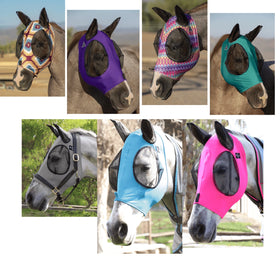
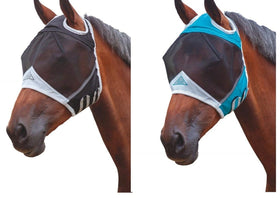
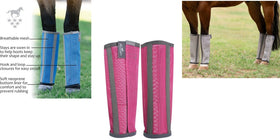
Product recommendations for different turnout needs
A product recommendation is most useful when it explains why an option may fit a particular routine. The following products are listed on the Hooves and Paws site. Confirm the current specifications and available size before ordering, then use the fit checks later in this guide.
| Design priority | Product to compare | What to verify |
|---|---|---|
| UV-specific face coverage | Cashel Econo Horse Equine Sun Fly Mask | Stated UV details, eye clearance, and size |
| Ears and nose fringe | Shires Fine Mesh Fly Mask with Ears and Nose Fringe | 60% UV listing, ear fit, and nose coverage |
| Detachable nose coverage | Shires Fine Mesh Fly Mask with Ears and Detachable Nose | Panel attachment, nostril clearance, and fit |
| Sun-focused design | Cool Cashel Crusader Sun Fly Mask | Construction, coverage pattern, and sizing |
- For a stated UV and full-face emphasis: Review the Cashel Econo Horse Equine Sun Fly Mask with UV Protection. Compare its listed UV details, face shape, and available coverage with your horse's needs.
- For ears and nose-fringe coverage: Consider the Shires Fine Mesh Fly Mask with Ears and Nose Fringe. The product listing identifies 60% UV protection, along with ear and nose-fringe coverage.
- For ears and a detachable nose option: Compare the Shires Fine Mesh Fly Mask with Ears and Detachable Nose. A detachable panel can be useful when the horse's nose coverage needs change between turnout conditions.
- For a sun-focused mask design: Review the Cool Cashel Crusader Sun Fly Mask. Evaluate the listed construction, eye clearance, and sizing rather than assuming any sun-focused name provides complete sun protection.
These are not interchangeable recommendations. The Shires options make sense to compare when ear or nose coverage is important. The Cashel Econo listing is a logical starting point when you want to review a UV-specific product page. The Cashel Crusader listing is worth considering when a sun-focused design and coverage pattern fit your horse. Always use the product page as the source for current construction and availability.
For a broader seasonal setup, browse the fly-season protection collection. A mask may be one layer of a plan that also considers turnout timing, shade, leg protection, and insect control. If the face is protected but the horse remains distressed by insects elsewhere, the mask alone may not solve the problem.
Use the product page to verify the UV claim and included coverage. Use your horse's behavior and turnout conditions to decide whether ears, nose protection, fine mesh, or a lighter design should take priority.
How should a horse fly mask fit?
A horse fly mask should stay in position without pressing against the eyes, restricting the ears, rubbing the face, or interfering with grazing and drinking. Check the fit while the horse stands quietly, then check it again during movement. A mask that looks acceptable in a stall can shift when the horse lowers its head or rubs against a safe surface.
Check the eye area first
From the front, confirm that the mesh is not touching the eyelashes. From the side, confirm that the eye panel holds its shape and leaves room in front of the eye. Look for folds, collapsed mesh, or a stiff edge that may create pressure. If the horse blinks more than usual, rubs its face, or resists the mask, remove it and inspect the cause.
Check the ears, cheeks, and lower edge
Ear pockets should sit over the ears rather than fold them forward or backward. The cheek area should lie smoothly without a wrinkle that rubs. The lower edge should cover the intended area while leaving the nostrils clear. Ask the horse to lower its head for hay or grazing if that is safe in your setting. Watch for the mask riding upward or twisting to one side.
Check the closure and movement
Fasten the closure according to the product instructions. It should be secure without being tight. Run a clean finger along the face edge to identify pressure points. Observe the horse walking, turning, grazing, and drinking. Recheck the mask after the first short wear period rather than leaving a new mask on for a full day without inspection.
- Fit the mask while the horse is calm and standing.
- Check the eyes, ears, cheeks, nose, and closure.
- Observe walking, grazing, and drinking.
- Remove and inspect the mask after the first short wear period.
- The mesh remains away from the eyes.
- The horse can see, breathe, graze, and drink normally.
- The ears can move without being folded or trapped.
- The closure stays fastened without pressing into the skin.
- No new rubbing, sweating, swelling, or hair loss appears along the edges.
How do you match coverage to sun and insect exposure?
Match the design to the horse's normal day. Record where the horse spends the most time, which hours are brightest, and when insects are most active. Note whether the horse has light facial skin, white markings, a history of rubbing, or sensitivity around the eyes and ears. This simple profile is more useful than choosing the most enclosed mask by default.
For bright, open turnout
Prioritize a clearly stated UV feature and coverage over the areas exposed to direct sun. An extended nose option may be useful when the muzzle is lightly pigmented. Consider shade and turnout timing as part of the same plan. A mask cannot protect uncovered skin, and a horse should still have access to appropriate shelter and water.
For high insect pressure
Compare mesh density, ear coverage, nose coverage, and the fit around the cheeks. Ear covers may be useful for a horse bothered by gnats. A nose panel may help with flies around the muzzle. If insect irritation continues despite a well-fitted mask, discuss the broader management plan with your veterinarian.
For hot or humid weather
Airflow and moisture management deserve extra attention. A mask that stays damp or dirty against the face can become uncomfortable. Choose a design that can be removed, washed, dried, and checked regularly. Watch for sweating under the binding and give the horse a break from the mask when conditions and management allow.
UV protection can be useful, but it is only one part of sun care. A horse that has persistent eye or skin changes needs professional assessment. Do not use a mask to conceal discharge, swelling, cloudiness, or a wound.
Cleaning, inspection, and replacement routine
Clean the mask whenever it is visibly dirty and inspect it before each use. Dust and dried debris can irritate the face or interfere with vision. Washing also gives you a chance to find stretched mesh, loose stitching, rough binding, and weakened closures before they become a larger problem.
Before each use
- Shake out dust and inspect both sides of the mesh.
- Check the eye panels for shape, tears, and debris.
- Feel the inside seams and binding for rough or stiff spots.
- Confirm that ear pockets and nose panels are not twisted.
- Check the hook-and-loop or other closure for secure attachment.
- Look at the horse's face for new rub marks, swelling, or irritation.
When washing
Follow the care instructions for the specific product. Remove loose debris first. Use the recommended water temperature and a gentle cleaning method. Rinse thoroughly so residue does not remain against the skin. Allow the mask to dry fully before putting it back on the horse. Do not return a damp mask to a closed tack container.
When to retire the mask
Replace a mask when the eye area no longer holds its shape, the mesh has a tear, the edges are rough, or the closure no longer keeps the mask secure. A visible hole can expose the face and may worsen during wear. Discard a design that repeatedly shifts into the eyes or causes rubbing after fit and size have been checked.
Keep a spare mask if your horse relies on daily face protection. A backup makes it easier to wash and dry the primary mask without rushing. Store clean masks in a dry, ventilated place away from sharp tack and direct heat.
Shop UV Fly Masks and Fly Protection Today
Frequently Asked Questions
How much UV protection do horse fly masks provide?
It depends on the product and material. Some listings state a specific UV-blocking percentage, while others describe UV-protective construction without giving a number. Read the exact product details and confirm which panels carry the claim. UV protection covers only the areas covered by the mask and does not replace shade, broader sun care, or veterinary treatment.
Which fly mask offers the best UV protection?
The best option is the one that combines a clear, product-specific UV claim with coverage and fit your horse can tolerate. Compare the stated percentage, eye clearance, mesh, ear and nose options, sizing, and care requirements. A mask that offers more theoretical coverage but shifts or rubs may be less useful than a comfortable design your horse wears consistently.
Are fly masks with ears necessary for UV protection?
Not always. Ear covers are primarily a response to insects and irritation around the ears, although they may add coverage to that area. Choose them when your horse needs ear protection and tolerates the extra fabric. For a horse with little ear irritation, a mask without ears may provide sufficient face coverage and better airflow.
How do you know if a horse fly mask fits correctly?
The mask fits correctly when the mesh stays away from the eyes, the horse can see and move normally, the ears are not folded or restricted, and the lower edge does not interfere with the nostrils or mouth. Watch the horse graze, drink, and walk. Inspect the face after wear for rubbing, sweat, swelling, or hair loss.
What is the difference between mesh and UV-blocking fly masks?
Mesh describes the physical fabric or panel that helps block insects and debris while allowing airflow. A UV-blocking claim describes the material's stated ability to reduce ultraviolet exposure. Some masks combine both features. Do not assume that every mesh mask has the same UV performance. Check the specific product listing and the areas covered.
How often should you clean a horse fly mask?
Inspect the mask before every use and clean it whenever it is dusty, sweaty, wet, or visibly soiled. A horse in a dusty paddock may need more frequent cleaning than a horse in a clean, shaded setting. Follow the product's care directions, rinse away residue, and let the mask dry fully before reuse.
Choose a comfortable fly-season setup
The best uv protection fly mask for horses is not defined by one number alone. Compare the product's stated UV performance, the areas covered, eye clearance, mesh, fit, and maintenance needs. Then select the design that matches your horse's actual turnout and that you can inspect consistently.
Hooves and Paws has served horse, dog, and cat owners since 1994 with a curated selection of trusted supplies and personal service. The store offers free continental U.S. shipping with no minimum order threshold and a 365-day satisfaction guarantee. Shop Fly Season Protection to compare masks and related protection for your horse's routine.


