


Horse sleep looks different from a dog curled on a bed or a person sleeping straight through the night. Horses doze in short stretches through the day and night, often while standing, then lie down for the deeper sleep they cannot get on their feet. If you have never seen your horse flat out in the stall, that absence can be normal, but never lying down at all is a different problem.
Shop Horse Blankets and Sheets
This guide covers what normal horse sleep looks like and why standing rest alone is not the whole story. It also covers what a stall or turnout needs so a horse can lie down and rise without a struggle. Think of it as practical barn guidance rather than a diagnosis. Sudden collapse, injury after a fall, or a horse that stops lying down and also stops eating belongs with your veterinarian.
What does normal horse sleep look like?
Horses are polyphasic sleepers, resting in several short bouts across 24 hours instead of one long night. A review of equine sleep studies put average total sleep at about 231 minutes, roughly 3 hours and 50 minutes. Individual horses and separate studies vary widely around that average. Some overnight recordings captured more than 5 hours of sleep inside a 12-hour window. A single "horses only sleep 3 hours" rule misses that real spread.
Most of that time is non-REM sleep. In the pooled studies, non-REM made up about 77.5% of total sleep time, about 179 minutes on average, and REM about 17.5%, about 40 minutes. REM bouts are short, and reported sequence lengths are often only a few minutes before the horse wakes, stands, or shifts.
Most true sleep happens after dark, but dozing is scattered through the day. A horse at the gate with a dropped hip, a low head, and a loose lower lip is usually in light rest, not the deep stage that restores them.
Quick answer: Normal horse sleep is several short rests totaling a few hours a day. Only a slice of that, often around 30 to 60 minutes of REM across the day, requires lying down.
Why horses rest standing up
A horse can lock the stay apparatus in the hind limbs and rest one hind leg while the other bears weight. That locking system lets them doze without the full effort of standing, and it lets them move if something startles them. Light non-REM sleep, including some slow-wave sleep, can happen during that standing rest.
Standing sleep is useful, but it is not a substitute for lying down. Muscle tone drops in REM, so a horse that slips into REM on its feet can buckle at the knees or fetlocks and catch itself. Owners often describe the moment as "falling asleep and almost going down." One near-collapse after a long trailer ride can be simple fatigue rather than a pattern. Repeated buckling, scraped knees, or several startled wake-ups during one night means you should ask whether they are getting any sleep while lying down.
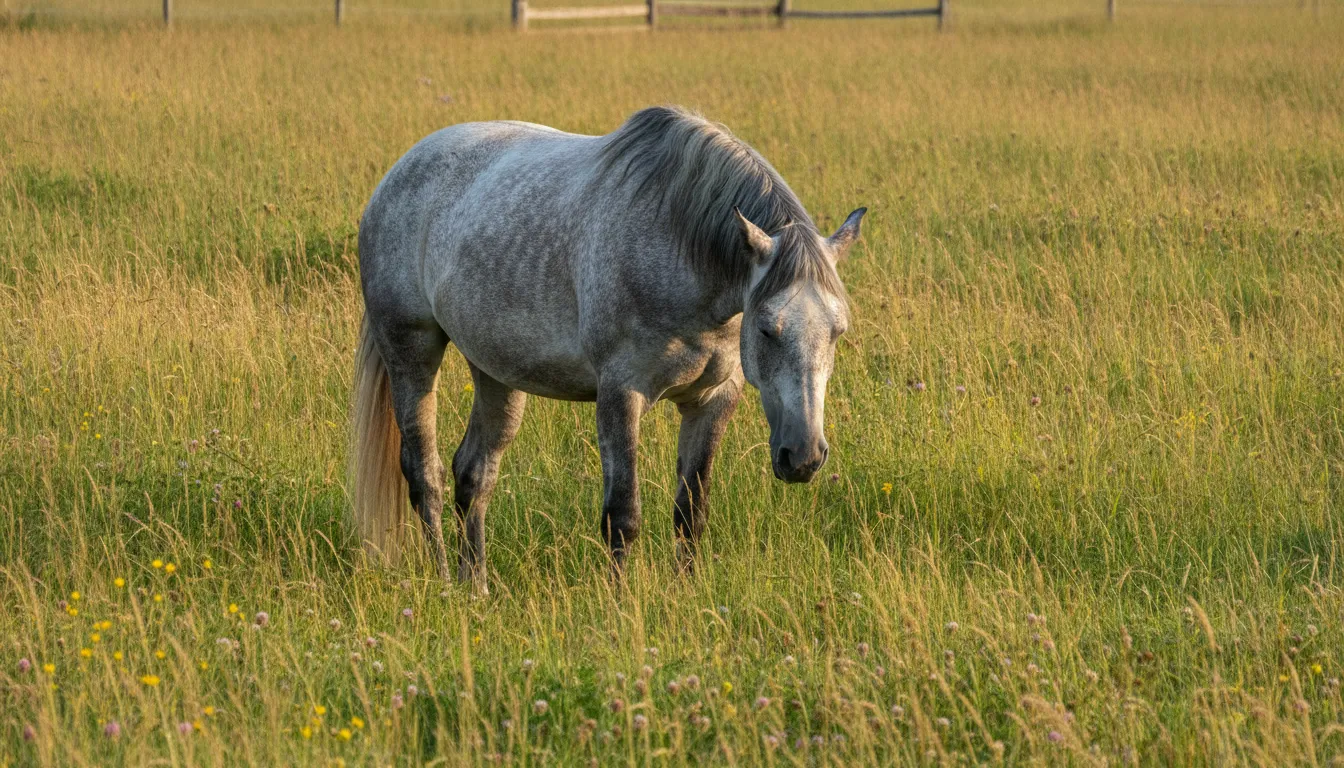
You can usually tell ordinary light standing rest from a real problem. In normal dozing, the horse still reacts to a voice or a stall door and weight shifts smoothly. There are no fresh sores on the front of the fetlocks. In sleep-related collapse, the front end drops suddenly, the horse may catch a toe, and the same scene repeats when the barn is quiet.
When do horses have to lie down?
REM sleep needs recumbency because the body loses muscle tone in that stage. Kentucky Equine Research notes that horses need at least about 30 minutes spent lying down in each 24 hours to meet REM needs. The Greening and McBride review put average REM, or lateral rest, near 40 minutes, while single studies ranged from under 10 minutes to more than 100. That spread depends on how sleep was measured and on how long each group of horses was watched.
Horses use two lying positions:
- Sternal recumbency. In this posture the horse rests on the sternum with the legs folded under the body. They can rise faster from here, and much non-REM sleep happens in this position.
- Lateral recumbency. The horse is flat on its side. This side-lying posture is where longer REM tends to show up. A flat-out horse with slow breathing, twitching ears, or a flicker of the eyelids is usually asleep rather than in distress.
Adult horses do not stay down for hours in the way that foals commonly do. A 20 to 40 minute lie-down, followed by standing and a return to hay, is a healthy adult pattern. Foals lie down far more, which is normal for growth and not the adult benchmark.
Key Takeaway: A horse that never lies down can still look "asleep" at the rail. Without those down periods, REM debt builds even if standing rest looks peaceful.
How much sleep is enough?
Use published ranges rather than a stopwatch on one night. Published totals depend on whether researchers counted standing rest, recorded only the overnight hours, or used brain-wave monitoring. Treat the figures below as a barn checklist, then watch your own horse for a week.
| What you are judging | Typical range from equine sleep research | What to do in the barn |
|---|---|---|
| Total sleep across studies | About 65 to 382 minutes. The study average sits near 231 minutes, which is about 3 hours and 50 minutes. | Do not panic when your horse is not lying down for hours at a time. Look for several separate rest bouts rather than one long nap. |
| Non-REM share | About 77.5% of total sleep time in the pooled average. In clock time, that share is about 179 minutes. | Standing dozing and sternal rest both count. A hip-shot horse dozing at midday can be entirely normal. |
| REM or flat-out rest | The pooled average is about 40 minutes. Many of the published studies land between roughly 30 and 60 minutes. | Confirm that your horse lies down on most days. The 30-minute figure is a floor for REM rather than a target you should try to force. |
| Single REM sequence | Often about 2 to 5 minutes. | Short lying bouts are normal. Hours spent flat out, especially with sweating or obvious pain, is not sleep. |
Those totals come from a 2022 review in Frontiers in Veterinary Science. Greening and McBride pooled earlier stall observations and brain-wave studies (doi:10.3389/fvets.2022.916737). Kentucky Equine Research uses the 30-minute lying-down floor when explaining why a horse must lie down. Age, pain, herd rank, and bedding will move an individual horse around inside that range.
What keeps a horse from lying down?
Horses lie down when they feel they can get up again. Take away space, a trusted herdmate, or pain-free joints, and many horses simply stay on their feet.
Stall size and surface
A horse needs room to fold the legs, roll to the side, and push up without hitting a wall. Tight tie-stalls and narrow overnight pens are common reasons a horse stops lying down even when hay and water are fine. Hard rubber with no bedding also cuts lying time. Horses on mats alone rarely stayed down long enough for a full REM quota, while a larger bedded area let both high- and low-ranking horses lie down. If you are choosing a floor, the horse stall mats guide covers mat choice. Sleep still depends on bedding over that mat, so knees and hocks are not meeting bare rubber.
Herd rank and turnout
In a group, a low-ranking horse may wait until a dominant horse is down, or get driven off a favorite bedded spot. Small bedded areas tend to cut those lying bouts short. A second dry area, or a quiet pen, often corrects the pattern faster than any supplement.
Pain, age, and weather
Getting up from flat-out rest loads the front end and the back. Arthritis, hoof pain, or a recent injury can make that effort feel unsafe, so the horse skips REM. Cold, wet ground and insects create the same problem outdoors. A soaked horse standing in mud at 2 a.m. is choosing safety over sleep, and that choice is a reasonable tradeoff when the ground is unsafe.
Weather comfort is a separate decision from sleep stages. Use the when to blanket a horse chart for temperature and fill, and the blanket measuring guide for fit. A blanket that is tight across the chest, or that rubs at the withers, will keep a horse standing. That can happen even when the forecast says they need cover.
How should a stall be set for sleep?
Set the stall for the moment the horse commits to lying down, not for how it looks at feeding time.
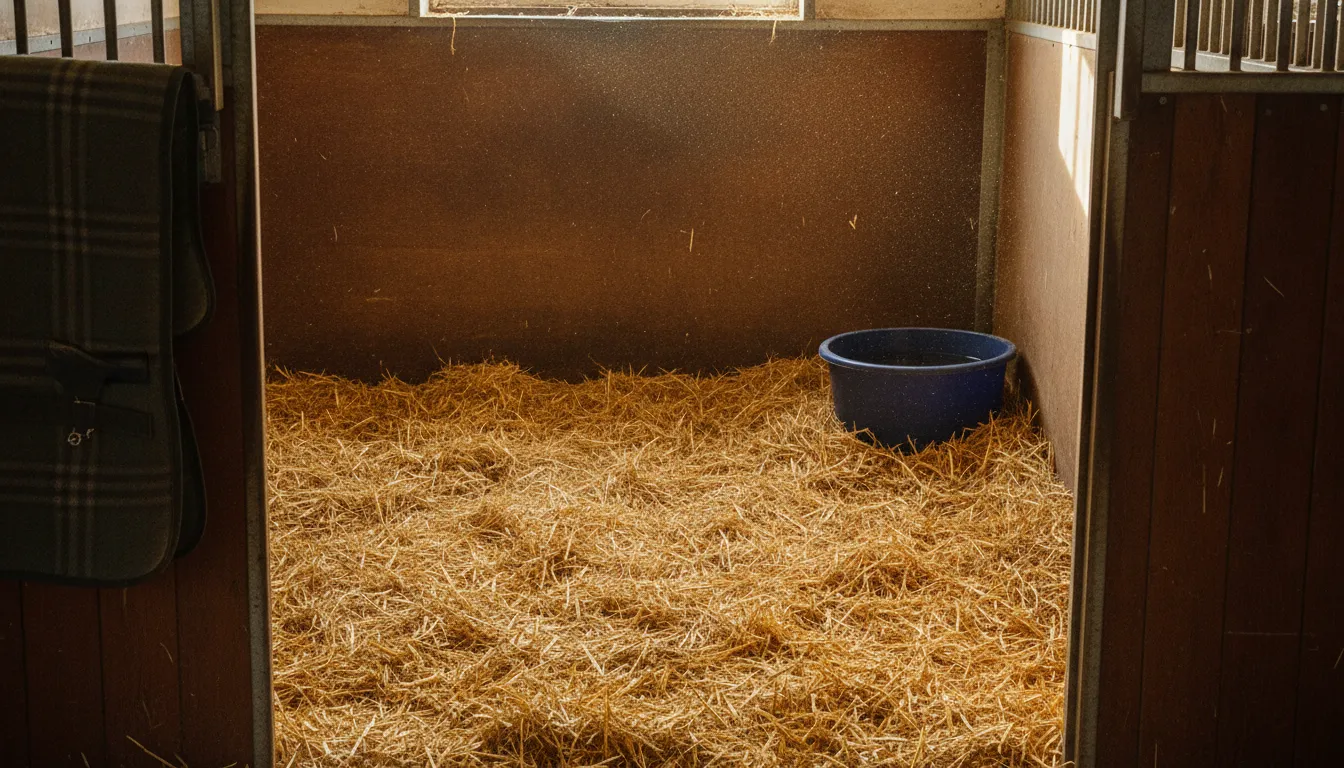
- Leave a clear lying rectangle. Keep water, mineral tubs, and tack out of the center. The horse should be able to stretch flat without pinning a leg under a bucket.
- Bed the knees and hocks. Banks of bedding along the wall waste the surface the horse actually uses. A level bed deep enough that you do not see the mat when they pivot is the practical test.
- Keep the air dry. Ammonia and a wet spot in the usual lying corner will push the horse back to standing rest. Strip that corner even if the rest of the stall looks clean.
- Protect skin before they sweat or rub. A clean stable sheet on a dry horse, or a stable blanket when the barn is cold, keeps them willing to stay down. A crusted or twisted sheet does the opposite.
- Watch one quiet night. Check last thing and first thing for the flat patch in the bedding, chest shavings, and tail hair on the surface. Those marks tell you more than a camera you forget to review.
For stalled horses that already eat well, steady forage supports the overnight rest window. Keep the overnight hay note separate from a full feeding plan. The slow feeding guide covers hay nets and gut rest. Hang the net so a lying horse cannot get a leg through it.
Quick answer: If the bedding shows a full body print most mornings and the horse rises without a scramble, the stall is doing its job. If the bed is undisturbed for several nights, change space or pain management before you change feed.
Shop Horse Health and First Aid
Stable blankets that help a stalled horse settle
Blankets do not create sleep. They remove a reason to stay standing, whether that is chill on a clipped horse or a dirty sheet that itches the moment the horse lies down. Match the layer to the barn, then check fit while the horse is lying down, not only at the cross-ties.
The Weaver Leather 420D Stable Blanket is a stall blanket with 300-gram polyester fill and a 420-denier outer shell. The product page lists it for indoor stall use, not wet turnout, and offers sizes from 68 to 84 inches. Use it when the horse is dry and inside and the temperature chart says they need fill.
The Weaver 1200D Ripstop Stable Blanket uses a heavier 1200-denier ripstop shell with 200-gram fill. The product page describes it for horses that rub or chew lighter blankets in the stall. Size it so the chest closes without a gap when the horse is sternal.
On milder nights, skip fill. The Weaver 420D Stable Sheet is an unfilled sheet in the same 68 to 84 inch size range. It keeps shavings and stable dust off the coat so a horse can lie down and stand up clean. A sheet that twists under the belly is worse than leaving the sheet off. Recheck the leg straps after the horse rises the first time.
If you are still choosing a style, start with the horse blanket guide for stable versus turnout, then ask one question: will the horse lie down in it?
Signs of poor horse sleep
Sleep loss in horses is easy to miss because a tired horse can still stand quietly. Look for a pattern across several days rather than one odd afternoon.
- No flat patch in the bedding, night after night, in a horse that used to lie down.
- Scrapes, swelling, or hairless spots on the front of the fetlocks or knees from catching a buckle.
- Repeated knee-buckling in the quiet hours, especially in older horses or horses new to a stall.
- A horse that lies down, tries to rise, and stalls halfway up. That is pain or footing until a veterinarian says otherwise.
- Dozing so hard at meal time that the horse misses the start of feeding. This often follows a move, a show weekend, or a change in herdmates.
Fix the obvious limits first. Add lying space, a bedded surface, a second rest spot for a low-ranking horse, and a blanket that does not bind. Call the veterinarian when collapse repeats, when there are wounds, or when lying down stops along with appetite, manure, or soundness. Do not treat suspected sleep loss with sedation or with extra work meant to tire the horse out.
Key Takeaway: One missed night happens on travel days. A week without a lying spot, plus front-leg scrapes, means the horse is not getting REM sleep even if they look relaxed at the stall door.
A simple 7-day rest check
You do not need an overnight camera to learn the pattern. For one week, note four things each morning:
- Was there a body-shaped print, and was it sternal, flat, or both?
- Any new scuffs on the front fetlocks?
- Did the horse lie down in turnout if the stall bed was unused?
- Did anything change: blanket, neighbor, footing, or workload?
A horse that prints the bed five mornings out of seven and rises cleanly is usually fine. That can be true even if you never catch them in the act. A horse with no prints and new fetlock scuffs needs a management change this week, not next season.
Frequently Asked Questions
Do horses sleep standing up?
Yes. Horses can doze and enter lighter non-REM sleep while standing, using the stay apparatus so one hind leg rests. They still have to lie down for REM sleep because muscle tone drops in that stage.
How long do horses sleep?
Across published studies, average total sleep is about 231 minutes a day, close to 3 hours and 50 minutes, with a wide range. REM accounts for roughly 40 minutes of that on average. Individual horses and busy show schedules can sit outside those averages.
Is it bad if my horse never lies down?
Occasional nights standing are common after travel or in a new barn. Never lying down, especially with fetlock scrapes or partial collapse, means the horse may be missing REM sleep. Check space, bedding, herd stress, and pain. Involve your veterinarian if that pattern continues.
Why do horses lie flat on their side?
Lateral recumbency is a normal sleep position and the one most often linked with REM. Short stretches of 20 to 40 minutes are typical for adults. Call a veterinarian if the horse cannot get up, is sweating, or stays down far longer than usual.
Do blankets help horses sleep?
Only by making the stall comfortable enough that a horse is willing to lie down. A dry, well-fitted stable sheet or stable blanket can keep a clipped or cold horse from standing all night. The wrong size or a twisted strap will keep them up. Match fill to barn temperature instead of adding warmth out of habit.
Help your horse lie down tonight
Horse sleep is a management job: a bed they trust, room to rise, and a layer that does not fight them when they go down. Hooves and Paws has outfitted horse owners since 1994, with a 365-day satisfaction guarantee and free shipping in the continental U.S. Start with a stable sheet or stable blanket that fits, then walk the stall tonight and look for a clear stretch of bed.
Shop Horse Blankets and Sheets or call (760) 247-5523 if you want help matching a size before you order.


