


A kind beginner spur is a blunt tool, not a sharper heel. If you are learning how to put spurs on boots and choosing between a ball-end and a bumper, start with the shape that touches the horse: a small knob or rolling ball, or a smooth bar with no rowel teeth. This guide compares those two styles, who they suit, and how to use them gently. For Western selection basics, read the Western Spurs beginner's guide. For strap threading and heel placement, use the English spurs on boots guide.
What is a ball-end spur, and what is a bumper?
Both styles replace a toothed rowel with a blunt end. The difference is the shape of that end and how much of it meets the horse.
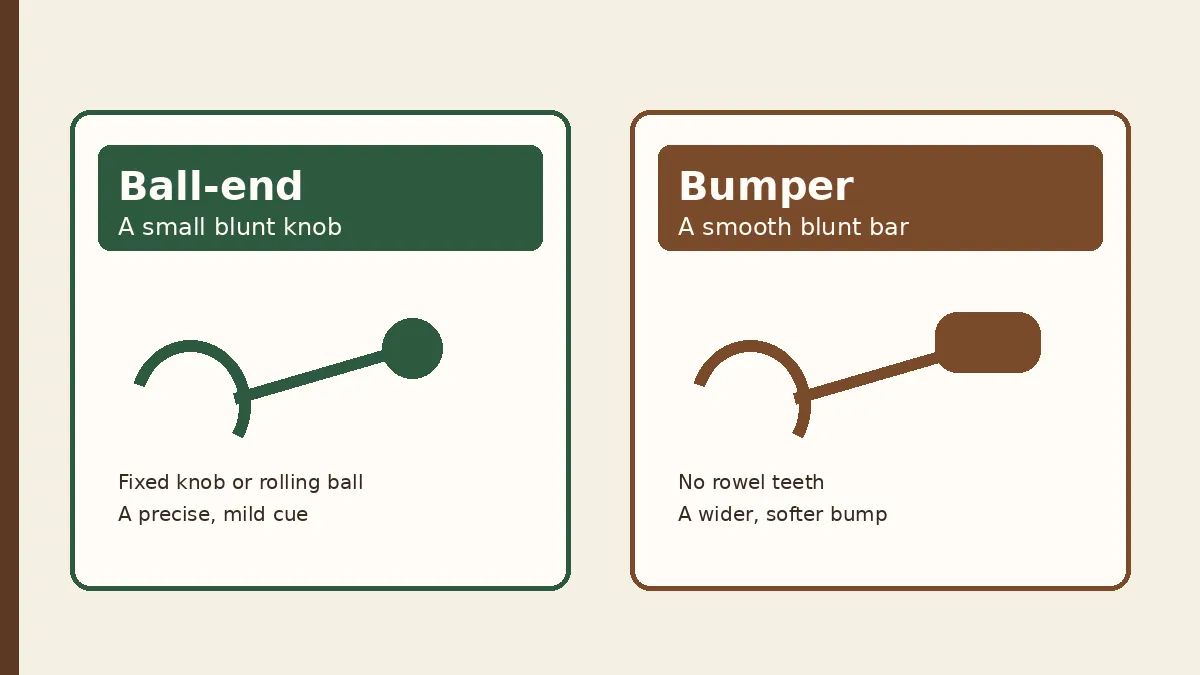
- Ball-end. The shank ends in a small fixed knob or a smooth rotating ball. Contact is concentrated in one small, rounded point, so the cue can feel precise without teeth.
- Bumper. The shank ends in a smooth, wider bar or blunt tip with no rowel at all. The cue is a broader bump rather than a pinpoint.
- Other blunt cousins. A roller-ball spur is a ball that spins, so it glides instead of dragging. A blunt rowel still has points, but the points are rounded. That is milder than a sharp rowel and sharper than a true bumper.
Quick answer: Choose a ball-end when you want a small, exact cue. Choose a bumper when you want the softest, widest contact and no rowel teeth at all.
How does each style feel to the horse?
The horse feels pressure where your heel already asks, only more clearly. A ball-end puts that pressure on a small round surface. A fixed knob stays put. A rolling ball turns as the leg moves, which is why riders use it on thin-skinned or recently clipped horses that rub easily.
A bumper spreads the same aid across a smooth bar. There is nothing to catch hair or skin the way a pointed rowel can. It is still a spur: a hard bump in the wrong place, or a constant bump, is uncomfortable. Kind hardware does not fix a busy heel.
Key Takeaway: Ball-end contact is small and precise. Bumper contact is wider and smoother. Neither should stay on the horse between asks.
Which riders and disciplines does each suit?
Match the end to the horse's sensitivity and the job, not to how advanced you feel.
| Style | Best starting point | Less ideal when |
|---|---|---|
| Fixed ball or knob | Western pleasure, trail, and green or sensitive horses that need a mild, exact cue | You tend to rest the heel on the horse's side |
| Rolling ball | Sensitive, thin-skinned, or clipped horses, including many English school horses | You need a very broad, non-rolling bump |
| Bumper | Young horses, spur-sour horses, and riders who want no rowel teeth, including barrel racers who want a soft bump | You need the smallest possible contact point |
| Blunt rowel | Riders moving on from a bumper who still want rounded, not sharp, points | The horse is already reactive to light heel pressure |
Discipline labels on a product page describe the maker's intended use. They are not a rule that a pleasure rider cannot wear a bumper, or that a barrel horse must.
How to put spurs on boots without repeating the whole fitting lesson
Set the spur on the boot's heel rest so the shank points down and slightly back, with the blunt end clear of the horse until you ask. Strap styles buckle around the front of the boot. Strapless quick-on styles slip onto the heel. If the band rocks or the end points at the horse at rest, stop and refit before you ride. The boot-attachment guide walks through heel placement and strap threading in full. The Western beginner's guide covers shank length, straps, and how to choose a first Western pair.
Quick answer: The blunt end should touch the horse only when you close the leg on purpose. At the walk, with a quiet leg, it should not.
How should a beginner use a blunt spur?
Use the spur as a clearer version of a leg aid you can already give, not as a way to make a horse go.
- Ask with the calf first. Add the spur only if the horse already understands that aid and does not answer.
- Touch once, then release. A ball-end or bumper that stays pressed on teaches the horse to ignore pressure.
- Keep the heel down and still between asks. A swinging heel bumps the horse by accident.
- Stop if the horse swishes, tucks, or rushes. Go back to the leg, or ask a trainer to watch one ride.
- Check the skin and hair after you unsaddle. Broken hair or a rubbed patch means the spur was too long on, too sharp for that horse, or poorly placed.
A short shank keeps the cue close to your heel. The verified picks below use 1 inch to 1.75 inch shanks, which is a beginner-friendly range. A longer shank reaches farther and is easier to use by mistake.
Compare blunt spurs in the shop
Which verified ball-end and bumper spurs are in stock?
These details come from current Hooves and Paws product listings. Prices are the listed pair price at the time of writing and can change.
| Product | Kind end | Fit and shank | Listed price |
|---|---|---|---|
| Weaver Leather Women's 21st Century Spurs | Fixed blunt ball, described as a gentle knob end | Ladies' contour, 1 inch shank, 3/4 inch band, stainless steel. Maker notes Western pleasure and trail. | $56.99 |
| Weaver Leather Men's 21st Century Ball Spurs | Knob or ball end | Men's plain band, 1 inch shank, 1 inch band, stainless steel | $75.39 |
| Professional's Choice Floral Ball Spurs | Smooth rotating ball, sold as a mild ball instead of rowel teeth | 1.75 inch shank, floral engraved stainless steel. Listing names horsemanship and trail. | $105.99 |
| Shires Roller Ball Spurs #6267 | Stainless ball that rolls 360 degrees so it glides instead of dragging | One-size English schooling spur. Listing calls out thin-skinned and clipped horses. | $39.49 |
| Professional's Choice Floral Bumper Spurs | Smooth bumper, no rowel. Listing calls the 1 1/4 inch shank a soft bump | 3/4 inch heel band. Maker positions them for young horses, sensitive mounts, and barrel racing. | $104.99 |
All five were available as a pair when this guide was checked. A blunt rowel is a different tool: the Professional's Choice Floral Ladies Spurs use an 8-point blunt rowel on a 1 3/4 inch shank, listed at $135.99, for riders who want rounded points rather than a ball or a bumper.
Key Takeaway: If you want no teeth, shop the bumper or a fixed or rolling ball. If you want rounded points, shop a blunt rowel and treat it as the next step, not the softest one.
What should you skip on a first pair?
Leave sharp rowels, long shanks, and oversized bands for later, and only with a reason. A band that does not match the boot heel will twist, and a twisted spur pokes even when the end is blunt. Strapless quick-on spurs are convenient, but they still have to sit on the heel rest without rocking.
If you show, the class rulebook decides what "kind" is allowed to look like. Dressage, reining, and breed shows do not share one spur rule. Before you pack a bumper or a ball-end for a licensed show, read the current spur section in the USEF Dressage Attire and Equipment booklet or the rulebook for the class you enter. A schooling spur that is gentle at home can still be illegal in the ring because of shank direction, rowel type, or material. This guide is about choosing a blunt end for everyday riding, not about clearing tack for a particular class.
Use a short at-home test before you commit to a style. Ride the first few minutes with no spur and a steady lower leg. Put the ball-end or bumper on only for one aid the horse already knows, such as a transition or a bend, then take the leg off. If your heel bumps the horse between those asks, the kinder fix is a quieter leg, not a different shank. Check the hair where the spur rested when you unsaddle. Broken hair means too much contact, even with a blunt end.
Hooves and Paws is a family-owned shop that has outfitted horse, dog, and cat families since 1994, with a 365-day satisfaction guarantee and free shipping in the continental United States. If a band is wrong for the boot, that guarantee is the practical way to correct the fit.
Shop Spurs and Spur Straps Today
Frequently Asked Questions
How do I put spurs on boots the first time?
Rest the band on the boot's heel rest, point the shank down and slightly back, and fasten the strap or slip a quick-on spur on until it does not rock. The blunt end should miss the horse until you ask. Use the English fitting guide for the full strap steps.
Are ball-end spurs kinder than bumper spurs?
They are kind in different ways. A ball-end is a small rounded point, so the cue is precise. A bumper is a smooth bar with no teeth, so the cue is broader. The kinder choice is the one you can use with a quiet leg on that horse.
Do bumper spurs still work if the horse is dull to the leg?
Yes, as a clearer bump, not as a sharper one. If the horse ignores a correct leg aid, a bumper can underline that aid. If the horse ignores everything, fix the aid and the training before you look for more spur.
Can a beginner wear roller-ball spurs?
Yes, when the horse is thin-skinned, clipped, or rubs easily. The rolling ball glides instead of dragging. It is still a spur, so the same touch-and-release rule applies.
What shank length is reasonable for a first blunt spur?
The in-stock ball and bumper options here use about 1 inch to 1.75 inch shanks. Shorter keeps the cue near your heel. Longer reaches farther and is easier to bump the horse by accident.
Will a blunt spur mark the horse?
It should not leave broken hair or rubbed skin. Check after you unsaddle. Marks mean too much pressure, too long a contact, or a poor fit, even when the hardware is blunt.


