


A saddle pad does more than sit between your saddle and your horse. Its shape, materials, thickness, and adjustment options can influence pressure distribution, stability, moisture control, and overall comfort. That makes the right pad a fit decision, not simply a matter of choosing a favorite color or the thickest available option.
CSI saddle pads are custom-designed wool and felt options valued for targeted fit, adaptable inserts, and thoughtful pressure distribution. The best choice still depends on your saddle's tree width, panel shape, discipline, and your horse's back. So product features should support a properly fitted saddle rather than compensate for one that does not fit.
This guide brings the key decisions together, from materials and cushioning to knee blocks, contours, insert selection, and comparisons with other premium pad brands. Start by looking at the design philosophy behind these pads and why fit-specific construction matters in everyday riding.
What Makes CSI Saddle Pads Different?
When riders discuss csi saddle pads, the conversation usually centers on a practical question: how well does the pad support the fit of a particular horse and saddle? CSI pads are custom-designed for specific fits, with an emphasis on distributing pressure rather than simply adding bulk beneath the saddle. That design approach makes them especially relevant for riders who want to evaluate comfort, stability, and clearance as one connected system.
A saddle pad cannot correct an improperly fitted saddle, but it can influence how the saddle sits and how forces are managed during work. Research on sports horses has found that tree width affects saddle pressure distribution, thoracolumbar dimensions, and movement patterns. Those findings reinforce an important buying principle: a pad should complement the saddle's shape and the horse's back, not be selected by appearance alone. Read the research on tree width and saddle pressure distribution for additional technical context.
Custom design instead of a one-shape-fits-all approach
CSI's defining distinction is its focus on custom design. The brand describes its pads as built to provide specific fits and features. Allowing the pad's construction to be considered alongside the horse's back, saddle style, and intended use. That does not mean every rider needs a fully customized pad. It does mean that details such as spine shape, thickness, edge placement. And insert configuration deserve attention when a standard pad leaves pressure points, shifts during a ride, or reduces useful clearance.
Look for a pad that follows the saddle without bunching under the panels. It should provide enough clearance over the withers and spine, while maintaining stable contact through the weight-bearing areas. A pad that is too thick in the wrong location can change the saddle's balance. One that is too short or poorly shaped may create pressure at the edges. The goal is controlled contact and consistent positioning, not maximum cushioning everywhere.
Pressure distribution is central to the fit conversation
Even pressure distribution matters because the horse's back responds to the complete saddle and rider combination. A thoughtfully designed pad can help maintain a more predictable interface between those components, but riders should still inspect the saddle fit before blaming or crediting the pad. Check for even sweat patterns, dry spots, hair disturbance, slipping, and signs of sensitivity after work. These observations are useful alongside professional saddle-fit guidance.
Hooves and Paws approaches this category with the same care it applies to its wider equestrian selection. As a family-owned retailer with more than 30 years of experience, the store curates premium brands for riders who value dependable products and informed service. If you are comparing shapes and construction details, you can also browse our Western and English saddle pads to see options suited to different riding setups.
CSI Saddle Pad Materials Explained
The materials inside a saddle pad affect far more than appearance. They influence how well the pad breathes, manages sweat, cushions movement, and stays stable beneath the saddle. CSI saddle pads are commonly associated with wool and felt construction. But the complete system can also include fleece or smooth wear layers, moisture-management features, and foam or other cushioning elements.

Wool and Felt Provide Structure and Natural Cushioning
Wool and felt fills are valued because they offer a dense, resilient layer between the horse and saddle. Felt can help distribute contact across a broader area, while wool fibers provide loft and a degree of natural breathability. The right thickness and density matter. A pad that is too thin may not provide enough protection, while excessive bulk can change saddle balance or reduce clearance.
Material selection should therefore follow the saddle and the horse's back, not simply a preference for one fiber. A well-fitted pad should support the saddle without creating new pressure points. Research on equine saddle fit has found that tree width and pressure distribution can affect thoracolumbar kinematics and comfort. Which is why pad material should be considered part of the overall fit system, not an isolated feature. Read the equine saddle pressure research for additional context.
Fleece and Smooth Wear Layers Help Manage Contact
The layer closest to the horse may use fleece, a smooth textile, or another finished surface. Fleece can feel soft against the coat and may help create a comfortable contact surface. A smoother layer may be easier to brush clean and can reduce unnecessary friction when the pad is positioned correctly. Regardless of the finish, the pad should lie flat, clear the withers, and avoid bunching under the saddle or girth.
Moisture Management Supports Comfort During Work
Heat and sweat can make a horse uncomfortable and can contribute to rubbing when a pad does not dry effectively. Moisture-wicking construction is intended to move moisture away from the skin and help maintain a more comfortable environment during exercise. The moisture-wicking concept is documented in US Patent 7219486-B1. In practical terms, riders should still remove the pad promptly after work, brush away dried sweat, and allow it to air completely before the next ride.
Foam and Cushioning Cores Can Refine Fit
Some saddle pad designs add foam or a shaped cushioning core to improve shock absorption, stability, or fit. A foam receiving envelope is one documented approach to improving saddle cushioning and fit, as described in US Patent 5027589-A. Other padding methods are designed to support saddle stability and comfort, including the approach described in US Patent 6050067-A.
These options can be useful when a horse needs additional protection or when the saddle requires a specific amount of support. They should not be used to compensate for a fundamentally incorrect saddle fit. Compare the pad's thickness, contour, and cushioning with the saddle's panels, the horse's back shape, and the rider's discipline. The goal is even contact, adequate airflow, and dependable pressure relief throughout the ride.
Knee Blocks, Contours, and Fit: Matching the Pad to Your Saddle
A saddle pad should complement the saddle, not force it into a different position. Knee and thigh blocks, the shape of the spine, the wither clearance. And the material inside the panels all affect how the saddle settles and how pressure is shared across the horse's back.
Use blocks to support the rider without restricting the horse
Knee and thigh blocks can help keep the rider's leg in a consistent position, especially during transitions, jumping, or longer rides. The right block feels supportive without pushing the knee backward or locking the leg in place. If a block creates a pressure point against the rider's knee, it may be too large, too far forward, or poorly matched to the saddle flap.
Compare the block position with the saddle's own knee roll. A pad with substantial external blocks may work well with a saddle designed to accommodate them, but it can feel crowded under a close-contact or flatter-flapped saddle. Western riders should also consider whether the pad's contour and block profile sit smoothly beneath the skirt without creating a ridge at the front.
Match the spine and wither contour to the saddle
A contoured spine helps the pad follow the horse's topline while preserving clearance over the withers. The pad should lie flat from front to back, with no bunching along the spine and no pulled-down edge pressing into the withers. Lift the pad slightly into the gullet of the saddle rather than stretching it tightly downward. This creates room for movement and reduces the chance that the pad will shift as the horse works.
Choose the cut according to the saddle. An English saddle generally needs a pad shaped to follow the shorter panels and flap. While a Western saddle needs enough surface area to extend evenly beneath the bars and skirt. A pad that is too short can leave the saddle's weight concentrated near the edges. One that is too large may wrinkle, extend beyond the skirt unevenly, or interfere with the rider's leg.
Consider flocking, girth placement, and inserts together
Internal panel material is part of the fit equation, not just a comfort feature. Research indexed by PubMed found that panel flocking material and girth strap placement influence the saddle pressure pattern during riding. Read the study summary when evaluating how pad construction may interact with your saddle and girthing setup.
Look for a stable, even contact pattern after tacking up. The girth should lie in its intended position, and the pad should not pull forward or slide backward as you ride. Some CSI saddle pads are available with adjustable inserts, which can help fine-tune the fit for a particular horse and saddle combination. Because insert options vary, confirm availability with the manufacturer or a specialized retailer before ordering. Inserts should refine a sound saddle fit, not compensate for a saddle that is fundamentally too narrow, too wide, or unbalanced.
For a final check, inspect the horse's back after a short ride. Uneven sweat, dry spots surrounded by heavy sweat, shifting, or a consistent rub deserves attention. When the saddle, pad contour, blocks, and inserts work together, the result should be a secure rider position and even, comfortable contact.
How Do CSI Saddle Pads Compare to 5-Star and Best Ever Pads?
Riders often compare CSI, 5-Star, and Best Ever because all three are discussed in terms of pressure distribution, saddle stability, and fit. The right choice depends less on a general brand ranking than on your saddle, your horse's back, your discipline, and how much adjustment you need. Tree width, panel shape, and girth placement can change the pressure pattern beneath a saddle, so a pad that works well for one horse may not suit another.
The table below provides a practical starting point. Product specifications and available configurations can vary by model, so confirm current insert options, dimensions, and care requirements before ordering.
| Trait | CSI | 5-Star | Best Ever |
|---|---|---|---|
| Materials and construction | Models commonly emphasize wool or felt construction, layered cushioning, and a shaped design intended to manage pressure and support saddle stability. | Wool and felt options are commonly associated with durable Western pad construction and natural moisture management. | Wool and felt-focused designs are commonly selected for cushioning, breathability, and everyday Western use. |
| Fit customization | Fit-focused configurations may include adjustable inserts or model-specific shaping. Confirm available insert combinations for the pad you are considering. | Fit is generally selected through pad shape, thickness, and size rather than a single universal configuration. | Fit is generally selected through the pad's cut, thickness, size, and relationship to the saddle's existing clearance. |
| Block and contour options | Some designs use contours or support features to align with a particular saddle fit and riding position. Review the model details carefully. | Options tend to center on Western cuts, thicknesses, and contour choices suited to the saddle and horse. | Options tend to center on Western cuts and cushioning profiles, with selection guided by saddle fit and desired support. |
| Intended discipline | Primarily associated with Western applications, although the correct configuration depends on the saddle and intended use. | Primarily associated with Western riding and stock-saddle fit. | Primarily associated with Western riding and stock-saddle fit. |
| Price positioning | Premium positioning, with some comparable pads and configurations commonly listed around $425 to $600. | Premium positioning, varying by wool type, thickness, size, and construction. | Premium positioning, varying by materials, thickness, size, and construction. |
CSI may be the most useful direction when you need a more deliberate fit strategy, especially if insert availability or pressure-management features are central to your decision. A 5-Star or Best Ever pad may be a better match when you want a straightforward wool or felt option selected around your existing saddle clearance and discipline. In every case, check for even contact, adequate wither clearance, and a stable saddle after mounting. If you are comparing configurations, review the specific dimensions and ask about insert availability rather than relying on the brand name alone.
For a broader look at options for different horses and saddles, compare Western and English saddle pad options and review construction, cut, and fit details side by side.
How to Choose the Right CSI Saddle Pad for Your Horse
The right pad should support a correctly fitted saddle, not compensate for a tree that is too narrow, too wide, or unbalanced. Research on sports horses links tree width and saddle pressure distribution with changes in thoracolumbar and limb movement. So begin with the saddle and horse in front of you, then select the pad that complements both. Use this process to narrow your options.
- Assess your current saddle fit. Place the saddle on your horse without a pad and evaluate balance, contact, and stability. The deepest part of the seat should remain centered, the panels should make even contact, and the saddle should not rock or tip. Check the horse before and after work for rubs, dry spots surrounded by sweat, tenderness, or changes in way of going. A saddle pad can improve comfort and pressure distribution, but it cannot correct a fundamentally unsuitable saddle.
- Measure gullet and wither clearance. Confirm that the saddle has adequate clearance over the withers and spine when your horse is standing and moving. The pad should not crowd the withers or collapse into the spinal channel. Compare the available clearance with the CSI pad's design, thickness, and contour. Because tree width affects pressure distribution, do not choose a thick pad simply to create more cushion under a poor fit. If you are uncertain, ask a qualified saddle fitter to assess the combination.
- Choose the correct cut. Select an English cut for an English saddle and a Western cut for a Western saddle unless the manufacturer specifically recommends another configuration. Match the pad's spine, skirt, and girth area to the saddle so the material lies flat without bunching. Without extending into the rider's leg, or interfering with billets and rigging. You can explore our saddle pad collection when comparing suitable shapes.
- Pick the appropriate block height and type. Consider the saddle's existing knee or thigh blocks, your leg position, and the horse's back shape. A pad with more structure may suit a rider who needs additional stability, while a lower-profile option can preserve room beneath a close-contact saddle. Avoid selecting blocks by appearance alone. They should support your position without pushing your leg out of alignment.
- Trial ride and check pressure points. Ride long enough to evaluate the pad at walk, trot, and your normal schooling work. Recheck the saddle's balance, the pad's position, and your horse's response afterward. Look for bunching, shifting, uneven sweat patterns, or concentrated pressure near the withers, loin, and rear panels. The research literature shows that panel and girth-related factors can influence pressure patterns, so evaluate the complete saddle, pad, and girth system together.
- Adjust with an insert if needed. If the saddle is generally appropriate but your horse's shape or workload calls for a small correction, investigate an insert-compatible CSI configuration. Insert availability varies, so confirm the options with the manufacturer or a knowledgeable retailer before ordering. Inserts should make a measured adjustment, not serve as a substitute for professional saddle fitting. Recheck balance and pressure after every change.
Keep notes from each trial, including the saddle used, insert configuration, ride length, and your horse's comfort afterward. That record makes it easier to identify the CSI saddle pad setup that remains stable and comfortable over time.
How to Care for Your CSI Saddle Pad
Thoughtful care helps a CSI saddle pad retain its shape, cushioning, and ability to support a comfortable ride. After each use, let the pad cool before cleaning it. Use a soft-bristled brush to loosen dried dirt, hair, and sweat from wool or felt surfaces. Brush in the direction of the fibers rather than scraping aggressively, which can roughen the material or pull at the fill.
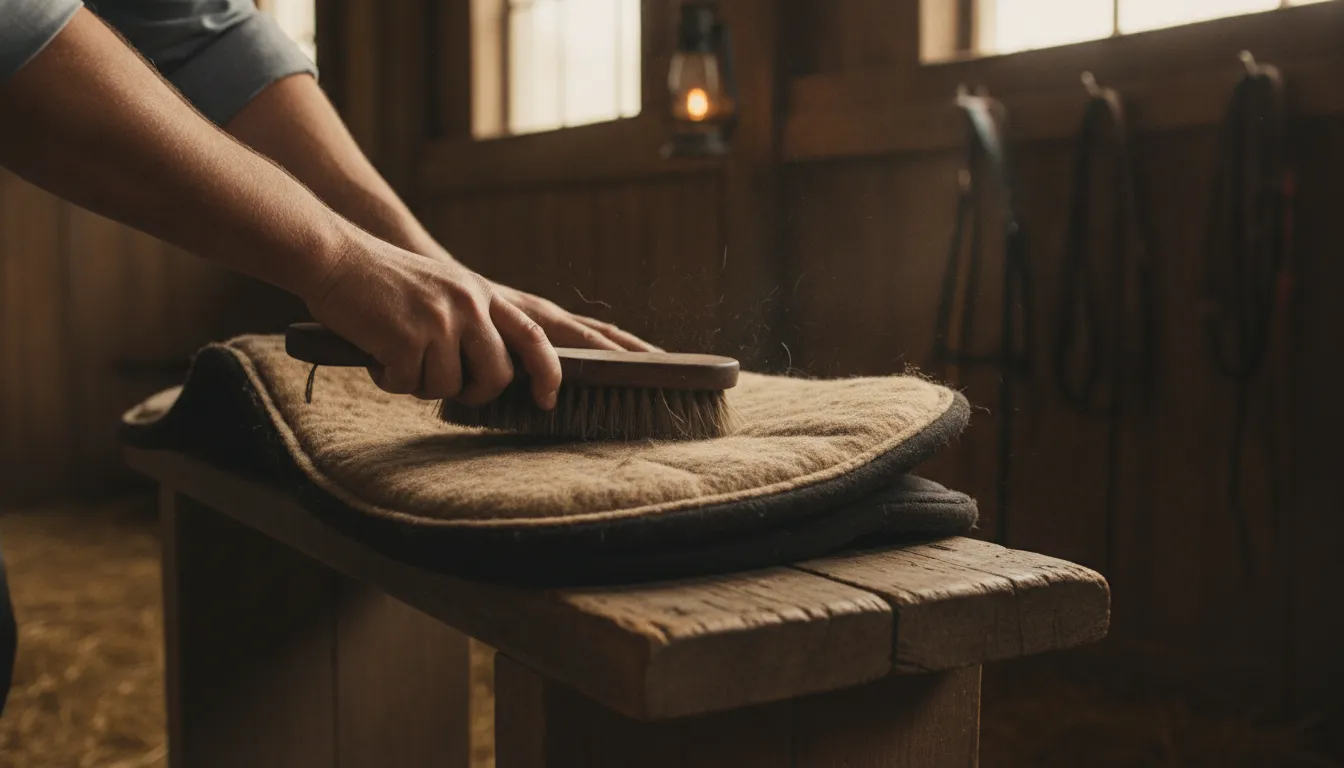
Pay particular attention to the areas beneath the saddle panels and around the girth. Sweat and compacted debris can gradually stiffen fibers, so regular light cleaning is better than waiting until buildup is difficult to remove. If the pad needs more than brushing, follow the care instructions supplied with that specific model. Avoid harsh cleaners unless the manufacturer expressly recommends them.
Air-Dry Wool and Felt Thoroughly
After riding or cleaning, hang the pad in a well-ventilated area and allow it to dry completely before storing it. Never put a wool or felt saddle pad in a machine dryer. High heat and tumbling can shrink, distort, or compress the fibers, changing the way the pad sits beneath the saddle. Keep it away from direct heat sources, such as radiators, heaters, and hot tack-room surfaces.
When possible, position the pad so air can reach both sides. Do not leave a damp pad folded over a rail or packed inside a closed tack trunk. Trapped moisture can create an unpleasant odor and may shorten the useful life of the materials.
Store the Pad Flat
Store your CSI pad flat, or support it evenly across a broad surface. This helps protect the fill from being compressed in one area. Avoid tight rolls, sharp folds, and heavy equipment stacked on top of the pad. A permanent crease can change the pad's contact pattern and create an uneven area beneath the saddle, potentially contributing to pressure points.
Inspect the pad regularly as part of your normal tack routine. Replace it when the fill remains flattened, the shape no longer follows the saddle. Or the material has developed hard spots, deep creases, or worn areas that brushing and proper drying cannot correct. A pad that has lost its structure may no longer provide the consistent support your horse needs.
Frequently Asked Questions
What makes CSI saddle pads different from other brands?
CSI saddle pads are designed around customized fit and pressure distribution rather than a one-shape-fits-all approach. The best choice still depends on your horse, saddle, riding discipline, and the way the pad sits beneath the panels.
Are CSI saddle pads customizable?
Some CSI options can be configured for specific fit requirements and may use different insert arrangements. Insert availability can vary by model, so confirm the current options with the manufacturer or a specialized retailer before ordering. Insert availability guidance is also provided by a CSI retailer.
How do I choose the right CSI saddle pad for my horse?
Start with a correctly fitted saddle, then match the pad's cut, spine contour, thickness, and block or insert configuration to that saddle. Check wither clearance, panel contact, girth position, and whether the pad stays stable during movement. Tree width and pressure distribution can affect equine comfort and movement, so a qualified saddle fitter is valuable. Equine saddle-fit research supports evaluating these factors together.
Can a CSI saddle pad fix saddle fit problems?
A saddle pad can fine-tune contact, cushioning, and stability, but it should not be used to disguise a fundamentally ill-fitting saddle. Have the saddle assessed first, then use the pad to address an identified need. Panel flocking and girth strap placement can influence pressure patterns during riding. Published pressure-pattern research supports this distinction.
What materials are used in CSI saddle pads?
CSI designs may combine wool, felt, fleece, foam, and inserts, depending on the model. Material choice affects moisture management, cushioning, durability, and how closely the pad conforms beneath the saddle. Moisture-wicking and cushioning designs are documented in equine saddle-pad and padding patents, including US-7219486-B1 and US-5027589-A.
Ready to Find the Right Saddle Pad?
Choosing a saddle pad is easier when you can compare shapes, materials, and fit considerations in one curated selection. Hooves and Paws brings together western and English options to help you focus on your horse's comfort and your saddle's needs. Browse the collection, then review each product's details before making your choice. Shop saddle pads today and get started with a pad that suits your riding setup.


