


If you are asking, does a slow feeder help ulcers / stable vices, the careful answer is that a slow-feed hay net may support a more natural, forage-focused routine, but it is not a treatment for ulcers and it cannot diagnose or resolve a stable vice by itself. Horses evolved to spend much of the day taking small bites of forage. A thoughtful feeding plan can help you provide more appropriate enrichment while you look at the full picture of your horse's health, workload, environment, and management.
What does slow feeding change about a horse's daily routine?
A slow feeder makes hay available through smaller openings, which can lengthen eating time and encourage more deliberate forage intake. The goal is a steady routine, not restricting a horse's access to needed forage.
A slow feeder changes the way hay is presented, not the nutritional value of the hay itself. Instead of a loose pile that may be consumed quickly, hay moves through a mesh opening or controlled feeder surface. This can encourage a horse to take smaller bites and spend more time foraging. Some horses also waste less hay because the forage remains contained and cleaner.
The practical benefit is often routine. A horse with more opportunities to nibble may have fewer long gaps between forage sessions. That can resemble natural grazing behavior more closely than one or two large hay meals. It is still important to calculate the total amount of forage, check body condition, and follow any ration plan provided by your veterinarian or equine nutrition professional.
Slow feeding is not automatically better for every horse or every setup. A very small mesh, poorly secured net, or abrupt change can create frustration and reduce intake. Choose equipment that is appropriate for the horse, observe how it eats, and make changes gradually.
How can slow feeding support gut-friendly management?
Slow feeding can help create a steadier forage routine, but it does not replace veterinary assessment, an appropriate diet, clean water, turnout, or an individualized ulcer-management plan.
Many owners consider slow feeding because they want to reduce long periods without forage. A consistent forage routine is one part of sensible gut-health management. Keeping hay available in a controlled, safe format can also help a horse stay occupied during stall time, travel, weather-related confinement, or other periods when turnout is limited.
That does not mean a slow-feed net prevents ulcers. Equine gastric discomfort and ulcer disease can involve many factors, including workload, stress, diet, medication history, and individual health. A horse that changes eating habits, loses weight, shows recurring discomfort, or develops a new behavior needs professional evaluation. A veterinarian can determine whether testing, dietary changes, or treatment is appropriate.
For everyday management, focus on the basics. Offer clean, suitable forage in an amount that fits the horse's needs. Keep fresh water available. Avoid sudden feed changes. Review concentrate portions and treat intake. Provide safe movement and social contact when possible. Then use a slow feeder as one practical tool within that larger plan.
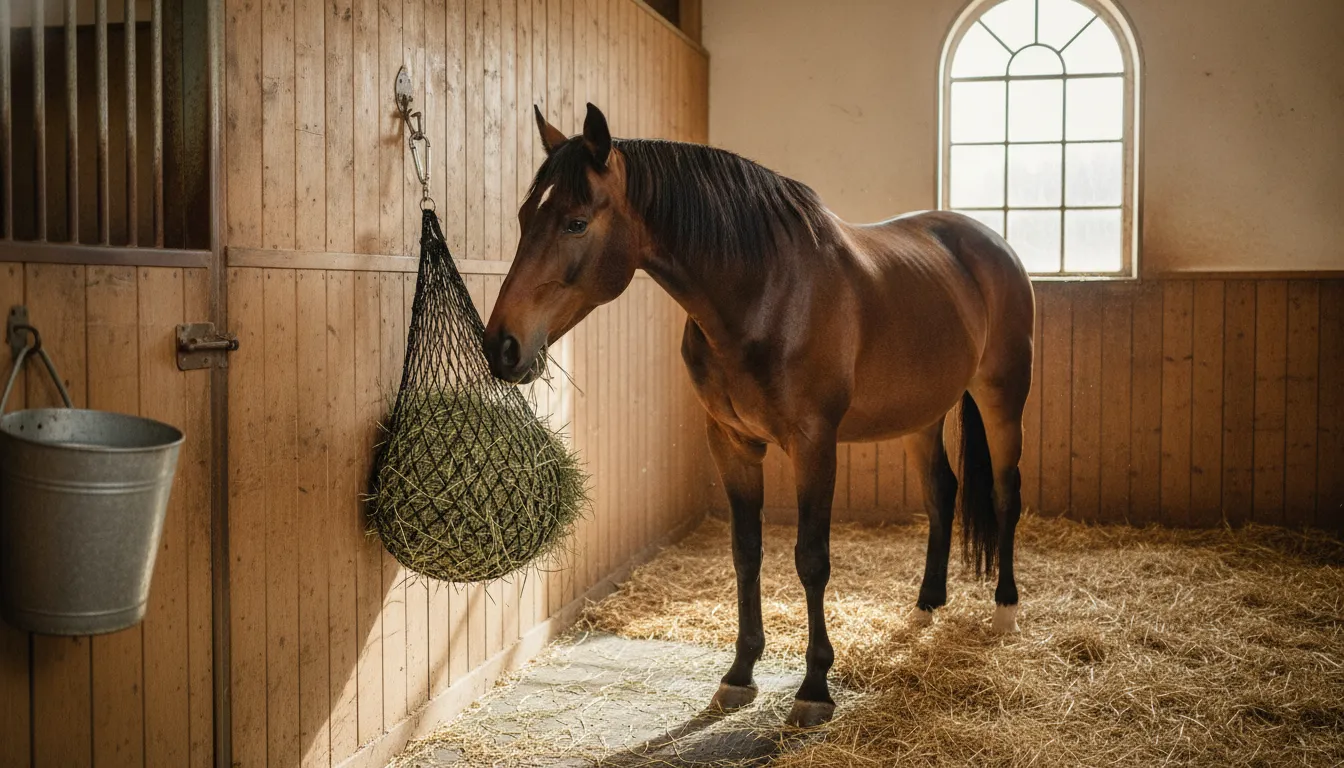
Slow feeding and stable vices: what should owners consider?
Cribbing, weaving, stall walking, pawing, and other repetitive behaviors can have multiple causes. More forage and enrichment may help with boredom or long idle periods, but a new or worsening vice deserves a veterinary and management review.
Stable vices are repetitive behaviors that may appear during stabling, feeding, anticipation, stress, or other predictable moments. Examples include weaving, stall walking, pawing, cribbing, wood chewing, and repeated door kicking. These behaviors are not a single diagnosis, and the same behavior can look different from one horse to another.
Slow feeding may be useful when a horse finishes hay quickly and then spends a long time without a forage activity. The net gives the horse something appropriate to do and may extend the time spent eating. It may also make feeding transitions less abrupt. Still, a slow feeder should not be presented as a cure for a vice. It cannot identify pain, anxiety, gastric disease, dental problems, or an unsuitable living arrangement.
Start by observing patterns. When does the behavior occur? Is it connected to feeding, a particular stall, separation from other horses, work, transport, or a change in routine? Has the horse's appetite, manure, weight, movement, or attitude changed? Record useful details and share them with your veterinarian and trainer. A management review may include forage access, turnout, social contact, exercise, dental care, stable design, and feed timing.
Choosing the right slow-feed hay net
A good slow-feed setup should be safe, durable, easy to inspect, and appropriate for the horse's feeding style. Consider the following before you buy or install one:
- Mesh opening: Smaller openings usually slow intake more, but the correct size depends on the forage, the horse, and the amount of frustration observed. Do not select a restrictive size simply because it promises the longest eating time.
- Material and construction: Look for strong stitching, reliable closures, and a design that can withstand daily use. Inspect for broken strands, sharp hardware, and stretched openings.
- Capacity: The net should hold the planned amount of hay without forcing the horse to pull awkwardly or allowing the load to spill out.
- Placement: Keep the feeder at a safe height and location. Avoid placing it where a hoof, leg, halter, or blanket could become caught. Follow the manufacturer's installation guidance.
- Horse-specific needs: Dental limitations, senior status, restricted diets, anxiety, and prior entanglement concerns all affect the right setup. Ask your veterinarian or equine professional for guidance when in doubt.
Some owners use more than one feeder so they can divide forage into several safe stations. Others combine a feeder with ground-level forage when that better fits the horse's posture and veterinary plan. The best choice is the one that supports adequate intake without creating a new safety problem.
It also helps to judge a feeder by the whole routine rather than by mesh size alone. Note how long the hay lasts, whether the horse pulls calmly, how much forage reaches the ground, and whether the net stays in its intended position. A setup that appears efficient but leaves the horse frustrated, unable to reach forage, or at risk of catching a hoof is not an appropriate improvement. When in doubt, choose easier access and ask a qualified professional how to progress safely.
How should you introduce a slow feeder?
Introduce the feeder when you can watch the horse. Start with a familiar amount of hay and a design that does not make access excessively difficult. Check whether the horse continues to eat, drinks normally, and settles into the new routine. If the horse becomes distressed, stops eating, or shows signs of discomfort, remove the equipment and consult a professional.
Make only one meaningful change at a time. If you change the hay, feeder, turnout schedule, and concentrate ration together, it becomes harder to tell what helped or caused a problem. A gradual transition also gives you time to check whether the mesh is wearing or whether the horse is learning to pull the net into an unsafe position.
Clean the net as needed and let it dry thoroughly. Dust, mold, wet hay, and contamination undermine an otherwise sensible feeding plan. Inspect attachment points every day, especially after the first few uses. A net that looked secure yesterday may stretch, tear, or shift after repeated pulling.
Supervise the first several uses. Stop using any feeder that creates an entanglement risk, prevents normal forage intake, has damaged strands or hardware, or causes the horse to panic.
Can a slow feeder replace turnout or veterinary care?
No. A slow feeder can be a useful enrichment and forage-management tool, but it does not replace safe turnout, social contact, exercise, dental care, appropriate nutrition, or veterinary care. It also cannot confirm whether ulcers or another medical issue are present.
Contact your veterinarian promptly if your horse has a sudden appetite change, weight loss, repeated colic-like signs, unusual lethargy, persistent discomfort, difficulty chewing, abnormal manure, or a marked change in behavior. If a stable vice appears suddenly or becomes more intense, treat that change as information rather than simply adding a more restrictive feeder.
Ask your care team how much forage your horse should receive, what form is appropriate, and how a slow feeder fits the plan. Horses with special dietary needs may require different mesh sizes, feeding surfaces, or monitoring. A solution that works for one horse may not be safe or suitable for another.
This guide is general educational information, not a diagnosis or treatment plan. If you suspect ulcers, pain, dental disease, or another health concern, arrange an examination with your veterinarian before changing management in a major way.
A practical slow-feeding checklist
- Review the horse's total forage needs with your veterinarian or nutrition professional.
- Choose a durable feeder with an opening size suited to the horse and forage.
- Install it where the horse can eat comfortably and safely.
- Supervise the introduction and confirm that intake remains adequate.
- Inspect the net, closures, and attachment points every day.
- Track appetite, weight, manure, behavior, and signs of discomfort.
- Adjust the broader management plan if the horse's needs change.
For owners comparing equipment, Hooves and Paws offers a curated selection of slow-feed hay nets for building a more measured forage routine. Review the product details, sizing information, and safety features before choosing a model. Our family-owned team has served horse and pet owners since 1994, with expert support and free continental U.S. shipping with no minimum order.
Shop Slow-Feed Hay Nets for a Better Forage Routine
Frequently Asked Questions
Does a slow feeder help ulcers?
A slow feeder may support a steadier forage routine, but it does not treat or prevent ulcers. If you suspect an ulcer or notice appetite, weight, manure, or behavior changes, ask your veterinarian for an evaluation and individualized plan.
Can slow feeding reduce stable vices?
It may help when a behavior is linked to long idle periods or quickly finished hay, but stable vices have many possible causes. Pair forage management with a review of health, turnout, social contact, exercise, and stable conditions.
What is the best mesh size for a slow-feed hay net?
There is no universal best mesh size. Choose an opening that slows intake without preventing adequate forage access or causing distress, and consider the horse's age, teeth, diet, and feeding history.
Can a horse sleep or lie down with a slow-feed hay net nearby?
Placement matters. Follow the manufacturer's instructions, avoid loose loops and unsafe hardware, and watch the horse before leaving the setup unattended. Remove damaged equipment immediately.
How often should a slow-feed hay net be inspected?
Inspect it before each use, especially at attachment points, closures, seams, and mesh openings. Replace it when strands break, openings stretch, or hardware becomes sharp or unreliable.
Should I change to a slow feeder if my horse starts cribbing?
Discuss the behavior with your veterinarian and care team first. A slow feeder may be one management option, but new cribbing can reflect stress, pain, feeding patterns, or other factors that need investigation.
Can I use a slow feeder for every horse?
Many horses can use one safely, but not every feeder suits every horse. Senior horses, horses with dental limitations, anxious horses, and horses with a history of entanglement need extra care and professional guidance.
Ready to make forage time more purposeful? Explore the Hooves and Paws slow-feed hay net collection and choose equipment that fits your horse's needs and your daily safety checks.


