


Updated September 16, 2026
Choosing the best hay nets for horses is about more than picking the smallest opening you can find. The right net should match your horse's eating habits, the type of forage you feed, the location where it will hang, and the strength needed for daily use. A thoughtful match can help extend feeding time, reduce hay waste, and make a stall or paddock routine easier to manage.
This guide compares small-hole, haylage, and heavy-duty designs, then explains how to choose mesh size, capacity, hanging style, and materials. It also highlights current Shires hay-net options available from Hooves and Paws, a family-owned retailer serving horse owners since 1994.
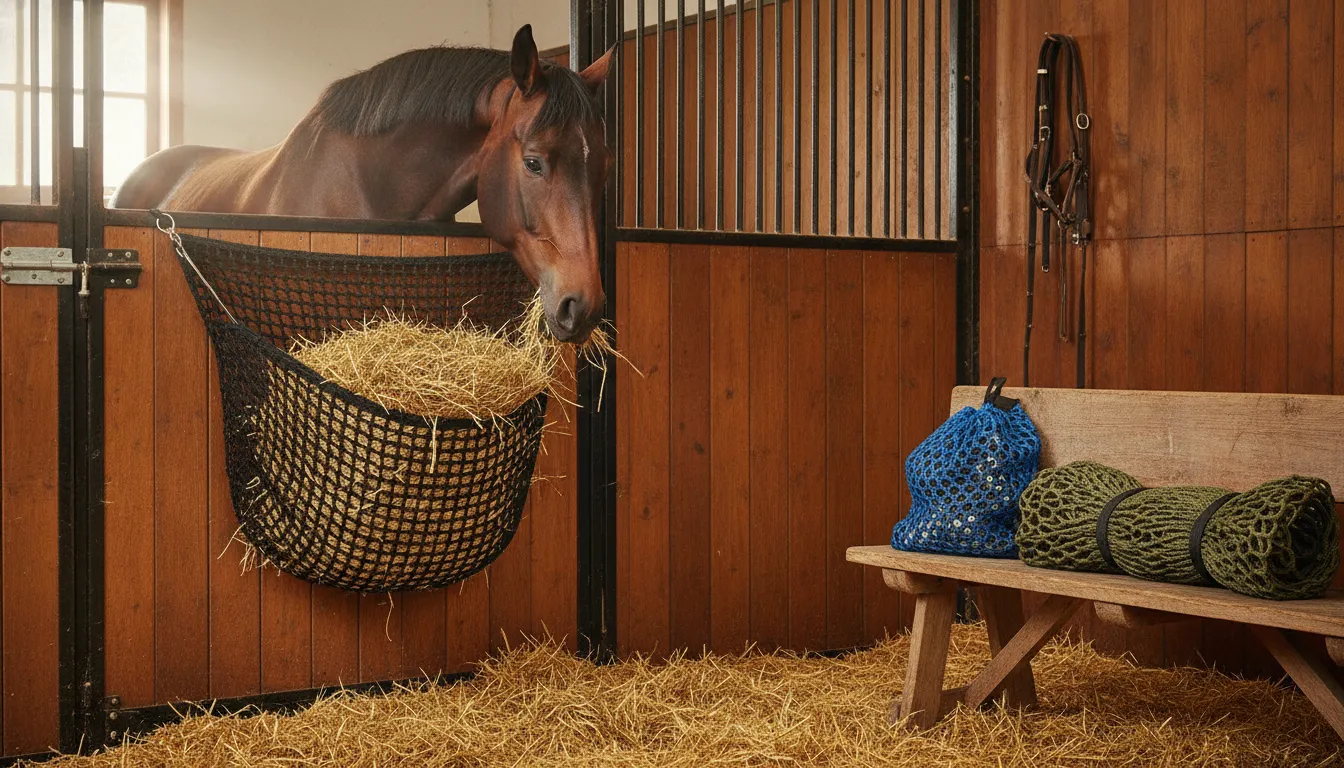
What makes the best hay nets for horses?
Quick answer: The best hay net balances an appropriate mesh opening, durable material, suitable capacity, secure hanging points, and a design that your horse can use comfortably. Smaller openings slow intake more, while larger openings may suit easy access, larger forage pieces, or horses that are new to slow feeding.
A hay net is a feeding tool, not a substitute for an individualized feeding plan. Horses vary in age, body condition, dental health, turnout schedule, and forage needs. If your horse has a history of choke, dental problems, or difficulty eating from a net, ask your veterinarian or equine nutrition professional before changing the feeding setup.
For many horses, a slow-feed net works by making each mouthful smaller and requiring more deliberate picking. That can spread forage over more of the day than a loose pile on the ground. It may also limit waste caused by pawing, trampling, or pushing hay into bedding. The result depends on the horse, forage, net, and setup, so inspect the system instead of assuming every net works the same way.
Small-hole, haylage, or heavy-duty: which style should you choose?
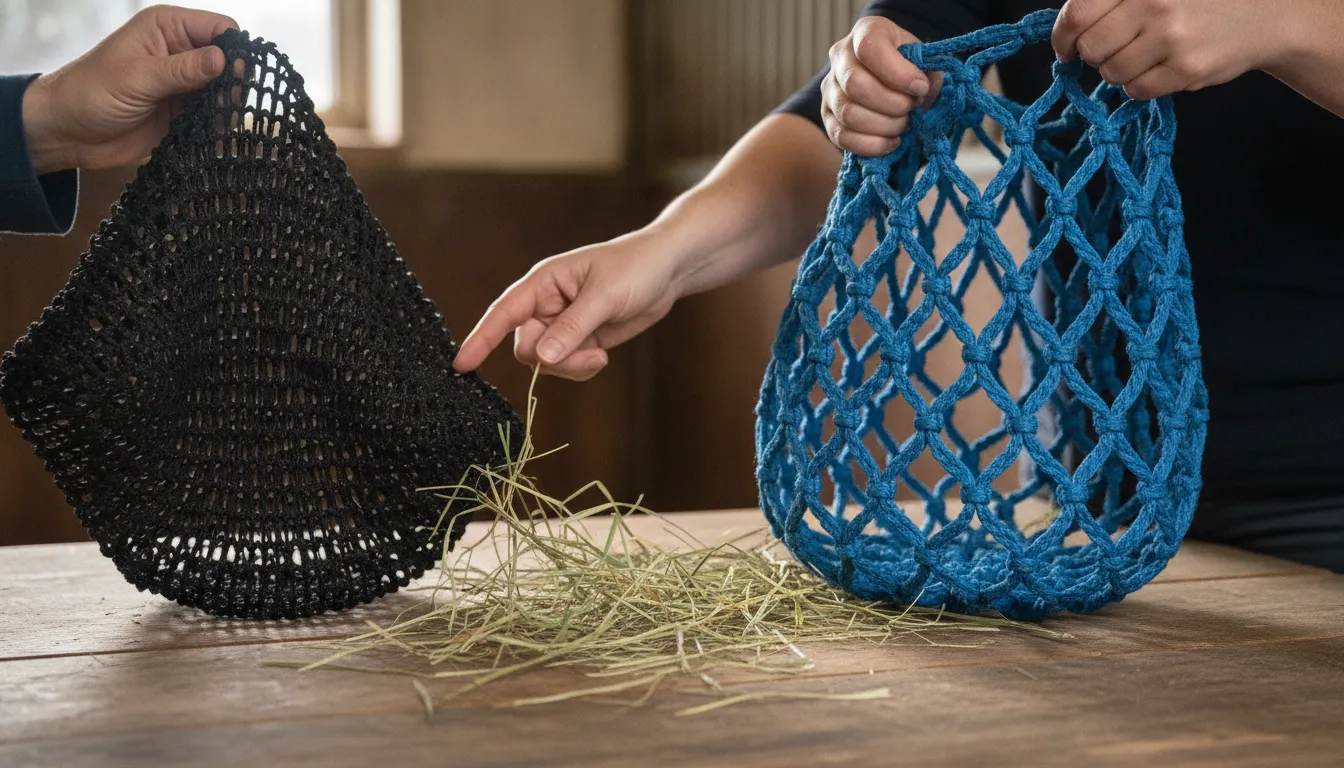
The three labels describe overlapping but useful design differences. Small-hole nets focus on restricting the size of each bite. Haylage nets are commonly built for compacted or denser forage and may use a soft mesh construction. Heavy-duty nets emphasize stronger cord, larger capacity, or resistance to persistent pulling. Read the product details carefully because naming conventions vary between brands.
| Net type | Best fit | What to check |
|---|---|---|
| Small-hole | Horses that eat quickly and need a more controlled pace | Opening size, forage compatibility, and whether the horse can comfortably pull hay through it |
| Haylage net | Haylage or compacted forage, depending on the product | Mesh flexibility, seams, dimensions, and the manufacturer's intended use |
| Heavy-duty | Frequent use, active pullers, larger loads, or demanding stable routines | Cord strength, knot or seam quality, attachment points, and safe placement |
These categories are not mutually exclusive. A heavy-duty net can also be a slow feeder, and a haylage net can also have relatively small openings. Use the construction and measurements as your decision points rather than relying on one label.
How do mesh openings affect feeding pace?
Key takeaway: Smaller openings generally make hay harder to pull out and can slow consumption, but the best opening is the one your horse can use without frustration, excessive pulling, or unsafe behavior.
Mesh size changes the amount of forage available with each bite. A 2-inch opening can create a slower-feeding experience than a wide-opening hay bag, but actual pace also depends on hay stem length, compression, moisture, the amount loaded, and how often the horse returns to the net.
Do not choose an opening solely because it sounds more restrictive. A net that is too difficult for a particular horse may lead to aggressive pulling, damaged teeth, or refusal to eat enough forage. Start with a reasonable design, observe the horse during several meals, and adjust only after checking intake, behavior, and body condition.
For a horse moving from loose hay to a small-hole design, introduce the net gradually. Offer it during a supervised meal, keep the net easy to reach, and confirm that the horse is pulling hay normally. An easy-to-use net that encourages steady forage intake is more useful than an ultra-restrictive net that creates stress.
How much hay should a net hold?
Capacity should match the amount of forage you intend to provide, the feeding interval, and the net's location. A small net can be convenient for a single meal, travel, or a short stall period. A larger net may be more practical when you need to load a longer feeding window, but it also becomes heavier and more difficult to hang securely.
Consider the net's empty dimensions and how much it expands when filled. A product listed as 40 inches or 45 inches may not hold the same amount as another net with the same nominal length. Cord thickness, shape, opening size, and the kind of hay you use all affect usable capacity.
- Choose a size that can hold the planned meal without forcing the seams or closures.
- Leave enough room to close and attach the net without creating a bulky knot near the horse's face.
- Check the loaded weight before hanging it in a stall or trailer.
- Use more than one net when appropriate rather than overfilling one small design.
What materials and construction details matter most?
Look at the cord, mesh, seams, closures, and attachment points as a complete system. Poly cord is popular because it can be flexible while offering useful durability for everyday feeding. Soft mesh can be comfortable to handle and suitable for certain haylage applications. Neither description alone proves that a specific net is right for every horse or environment.
Inspect the areas that receive the most stress. These include the top opening, corners, seams, drawstring or closure, and the loop used to hang the net. If your horse pulls hard, rolls the net, or shares a feeding area with other horses, construction quality becomes especially important.
Keep a simple inspection routine. Before filling, run your hands along the mesh and look for frayed cord, stretched holes, loose knots, or damaged attachment loops. Retire a net when damage could let a hoof become entangled or allow the horse to pull out large amounts of forage unexpectedly.
Which Shires hay nets are worth comparing?
Hooves and Paws carries several Shires options that illustrate the main choices in this guide. Review the current product page for dimensions, availability, color, and any updated specifications before ordering.
Shires Small Hole Haylage Net
The Shires Small Hole Haylage Net is a natural starting point when your priority is a more controlled feeding pace in a haylage-net format. Compare its size and construction with the forage you normally feed, then confirm that your horse can use the openings comfortably.
Shires Premium Haynet 2-Inch Hole
The Shires Premium Haynet 2-Inch Hole uses heavy-duty poly cord and 2-inch mesh openings. It is a practical comparison for owners who want a durable slow-feeding design with a clearly defined opening size for hay or haylage.
Shires Heavy Duty Hay Net, 50-Inch
The Shires Heavy Duty Hay Net 50-Inch is designed for owners who need a larger heavy-duty format. Check the loaded weight, hanging location, and available clearance before selecting a larger net for a stall or paddock.
Shires Heavy Duty Hay Net, 40-Inch
The Shires Heavy Duty Hay Net 40-Inch provides another size option in the heavy-duty range. A shorter net may be easier to load, carry, and position when a 50-inch format is more capacity than you need.
Shires Deluxe Haylage Net, 3-Pack
The Shires Deluxe Haylage Net 3-Pack can be useful when you want multiple nets for rotation, separate feeding stations, or different horses. A multi-pack also makes it easier to keep a clean spare available while another net is being inspected or washed.
How should you hang a hay net safely?
Quick summary: Hang the net securely, keep it clear of hazards, use an attachment point that can support the loaded weight, and check the horse's access from the ground. Never leave loose loops or excess cord where a hoof, shoe, or halter could become caught.
Choose a strong attachment point that will not pull loose under normal use. In a stall, the net should not be able to fall into the water bucket, become trapped under a door, or swing into a sharp edge. In a paddock, inspect the fence or feeder structure and consider whether another horse could push the net into a corner.
Many owners prefer to hang a hay net so the horse eats at a comfortable, natural height, but the exact position depends on the horse, the net, the enclosure, and the safety advice from your equine professional. Avoid hanging it where the horse must stretch awkwardly or where the bottom can drag across the ground and collect mud, manure, or bedding.
After filling, test the closure and attachment with your hands. Walk around the area and look for protruding loops. Observe the first several feeding sessions, especially when changing mesh size or moving the net to a new location. The setup is part of the product's safety, not an afterthought.
How do you choose the best hay net for a fast eater?
Start by identifying the problem you want the net to solve. If the issue is rapid consumption, compare a small-hole or 2-inch design. If the issue is durability or a larger meal, compare heavy-duty construction and capacity. If you feed haylage, prioritize a product intended for that forage and verify the dimensions that suit your routine.
Then consider your horse's behavior. A determined puller may need a stronger design and a very secure attachment. A horse that is new to nets may need a more forgiving opening and a supervised transition. A horse with dental or mobility limitations may need a different approach altogether.
- Measure the feeding area and note available clearance.
- Estimate the amount of forage the net must hold.
- Choose an opening that supports your feeding goal without creating frustration.
- Compare cord, seams, closures, and attachment loops.
- Plan how you will inspect, rotate, clean, and replace the net.
- Observe the horse and adjust the setup based on real use.
What common hay-net mistakes should you avoid?
The most common mistake is treating mesh size as the only decision. A small opening does not compensate for an insecure hanger, poor fit, damaged cord, or a net that does not hold the needed amount of forage. Another mistake is buying a large net without accounting for the weight when full.
Do not leave a new setup unattended before you know how your horse uses it. Watch for excessive pulling, pawing, trapped loops, rubbing, or refusal to eat. Replace a damaged net instead of tying a quick repair in a high-stress area and assuming it will hold.
Finally, do not use a hay net to hide a change in appetite, weight, or behavior. A horse eating less than expected, dropping feed, or showing signs of discomfort needs prompt attention. A net can support a feeding routine, but it cannot diagnose a health problem.
Compare Hay Nets and Shop Today
Frequently Asked Questions
What are the best hay nets for horses that eat too quickly?
Many owners start by comparing small-hole or 2-inch mesh designs because they make each mouthful smaller. Choose a net your horse can use comfortably, introduce it gradually, and monitor forage intake and behavior.
Are small-hole hay nets safe for every horse?
No single net is right for every horse. Consider dental health, mobility, feeding history, and behavior. Ask your veterinarian or equine nutrition professional for guidance when a horse has choke risk, dental disease, or difficulty eating from a net.
Is a haylage net different from a regular hay net?
Haylage nets are commonly designed around denser or wrapped forage, but product construction varies. Check the manufacturer's intended use, mesh flexibility, size, and closure before choosing one for your feeding program.
What size hay net should I buy?
Choose a size that holds the planned meal without overloading the seams or making the net too heavy to hang safely. Compare actual dimensions, opening size, forage type, and the location where the loaded net will be used.
How often should I inspect a hay net?
Inspect it before each fill and after heavy use. Look for frayed cord, stretched openings, loose knots, damaged seams, and compromised hanging loops. Replace the net when damage could create an entanglement risk or change how forage is released.
Where can I compare slow-feed hay nets for horses?
Browse the Hooves and Paws slow-feed hay net collection to compare current options. Product availability and specifications can change, so review the individual product page before ordering.


