

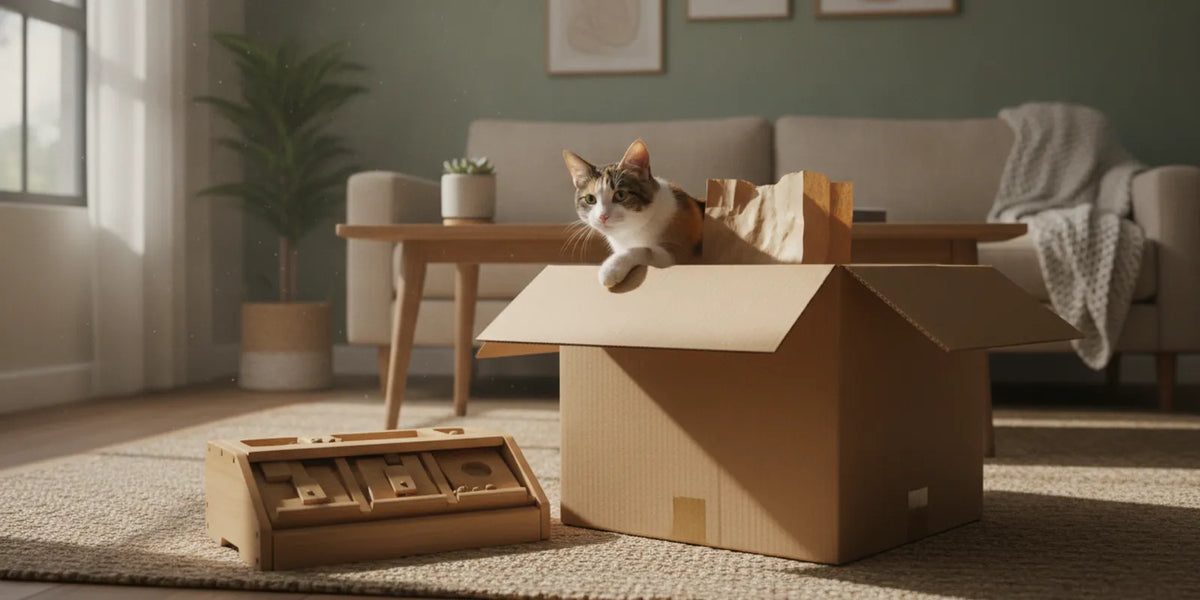
Cat enrichment activities give indoor cats safe ways to explore, play, forage, scratch, climb, and make choices. The best plan is not a shelf full of toys. It is a few suitable options, offered thoughtfully, with your cat’s comfort and interests guiding what comes next.
What counts as enrichment for an indoor cat?
Enrichment is a way to make the home more interesting and give a cat appropriate outlets for ordinary behaviors. It can include stalking a moving toy, searching for a piece of regular food, watching from a secure perch, scratching a stable surface, or choosing a quiet place to rest. These activities do not need to be expensive or complicated.
Think of the goal as offering choice, not making a cat perform. A cat may prefer observing a new object before approaching it. Another may enjoy a short chase game and then be ready to nap. Either response is useful information. A cat that walks away is not being difficult; it is telling you that this option, at this moment, is not appealing.
Key Takeaway
Offer different kinds of choice: movement, food seeking, hiding, scratching, climbing, and calm observation. Keep each option safe and let your cat decide whether to join in.
Enrichment also includes the way the home is arranged. A cat may benefit from a quiet resting area that is not beside a busy doorway, or from a stable route between a favorite bed and a window. If you want general feline-care resources as you shape the home environment, the American Association of Feline Practitioners is a professional resource for cat owners and veterinary teams.
How do common enrichment activities compare?
Use the table to choose an activity that fits the time you have, your cat’s preferences, and the space available. These are starting points rather than a checklist you must complete every day.
| Activity | What it invites | Good starting setup | Supervision and safety |
|---|---|---|---|
| Wand play | Stalking, chasing, shared play | Move a toy along the floor in short, varied passes | Stay with your cat and store the wand and string afterward |
| Food search | Sniffing and foraging | Scatter a few pieces of the cat’s usual food in an easy-to-find area | Use an appropriate amount and keep the search area clear |
| Food puzzle | Investigating and working for food | Start with visible, easy-to-reach pieces | Check that the puzzle is stable, clean, and not frustrating |
| Box or tunnel | Hiding, exploring, and observing | Set out a clean box with a wide, open entrance | Remove handles, staples, loose tape, and damaged sections |
| Perch or window view | Watching and resting at a height | Choose a secure spot with a comfortable route up and down | Prevent tipping and consider the cat’s mobility |
| Scratching surface | Scratching and stretching | Try a stable surface in an area your cat already visits | Replace it if it becomes unstable or sheds loose pieces |
The activities serve different purposes, so variety matters more than choosing one “best” toy. A wand game involves you and requires supervision. A puzzle may make part of a meal more interactive. A box can offer a low-effort place to investigate or hide. A perch can provide a calm vantage point without requiring active play.
Build a play routine around your cat’s signals
Begin by watching when your cat is alert and relaxed. Some cats show interest after a rest; others prefer a quiet moment when the household is settled. Offer a short invitation rather than trying to start play when the cat is asleep, eating, hiding, or trying to move away.
For wand play, keep the toy low and move it away from the cat in small changes of direction. Let it pause behind a safe object or travel along the edge of a rug. This gives your cat a chance to watch, approach, and decide whether to chase. Avoid repeatedly waving the toy in the cat’s face. Allow occasional catches, then let the game wind down. Put the wand away when the session ends.
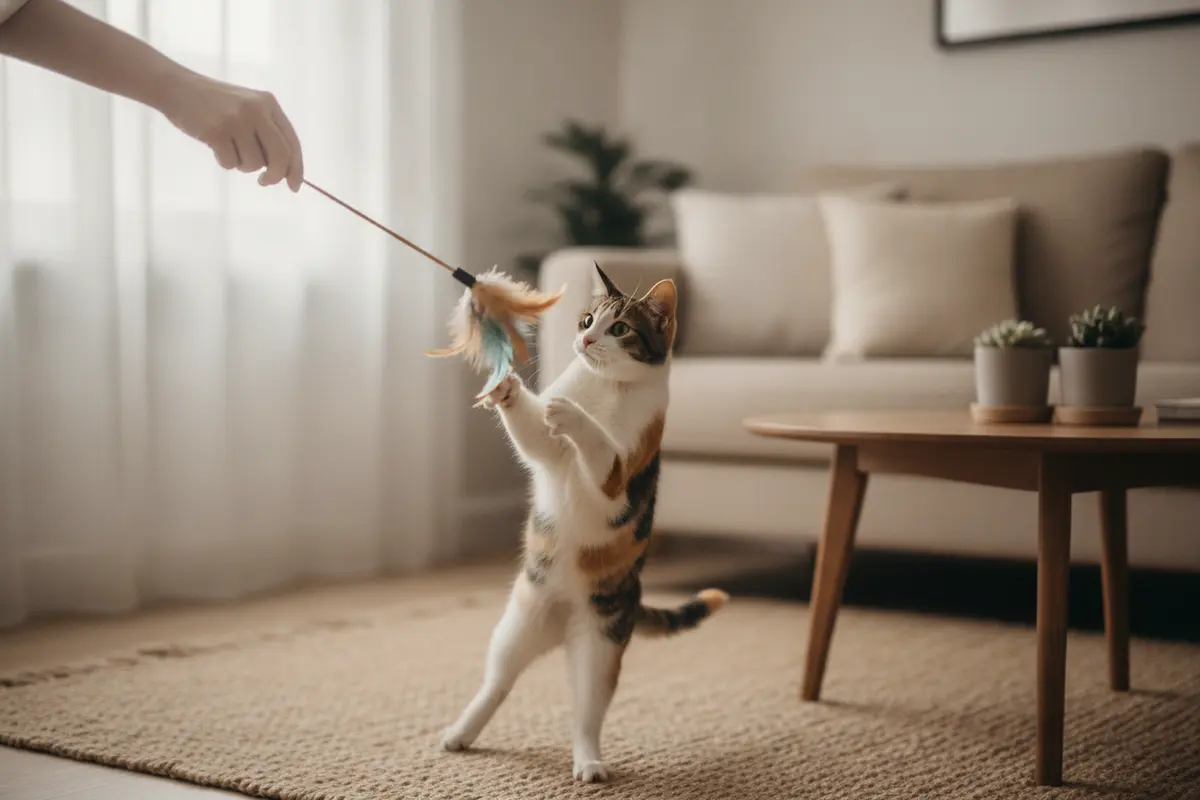
Watch the whole body, not only whether the cat bats at the toy. Voluntary approach, focused watching, and relaxed movement may mean the activity is engaging. Turning away, crouching tensely, hiding, or repeatedly trying to leave are reasons to pause and give space. If your cat becomes highly excited, stop before play turns into rough contact with hands or feet. Direct attention to an appropriate toy instead.
Try a simple routine for a week: offer a brief play invitation at a time your cat is usually awake, then note whether the cat joined in, watched, or walked away. The note can be as simple as “liked floor movement” or “lost interest when toy was overhead.” Use the observation to adjust one thing next time. You do not need to set a strict session length or insist on daily participation.
Shop This Post

Featured in this article
Ducky World Yeowww! 7" Organic Catnip Kicker for Barn Cats
$12.11
Shop Now →
Make food seeking easy before making it challenging
Food-based enrichment can turn a familiar meal into an opportunity to search. Start with a few pieces of the cat’s usual dry food placed close together in an open, quiet area. If your cat finds and eats them comfortably, spread the pieces a little farther apart on another occasion. The first goal is a pleasant, successful search, not a difficult puzzle.
For a food puzzle, make the food visible and easy to reach at first. Demonstrate by placing a piece near an opening, then let the cat investigate without pushing its paws or nose into the device. If the cat becomes frustrated, stops eating, or avoids the puzzle, simplify the setup or offer the food in its usual bowl. Food should not become inaccessible because a puzzle is too hard.
Keep treats and puzzle portions within the cat’s normal feeding plan. If the cat eats a prescribed diet, has a health condition, or needs a specific feeding routine, ask the veterinarian before changing the type or amount of food. A puzzle is an optional way to present food, not a reason to change the diet.
Use a clean, dry space and keep the search away from hazards such as hot appliances, cleaning products, or places where the cat could get trapped. In a home with more than one pet, set up separate opportunities if one animal blocks another from reaching food. Watch each cat to make sure the activity stays calm and accessible.
Set up space for hiding, scratching, climbing, and rest
Look at the room from your cat’s point of view. Can the cat move between a resting place and a preferred viewing spot without crossing a busy area? Is there a place to retreat when visitors arrive? Does a scratching surface stay steady when the cat leans into it? Small layout changes can create useful options without filling the room with equipment.
A cardboard box can serve as a temporary place to explore or hide. Choose one with room to turn around and an entrance that remains open. Remove handles from paper bags, and check boxes for staples, sharp edges, loose tape, or damage. Introduce a new object in a quiet area and let the cat approach at its own pace. Remove it if the cat chews pieces off or appears unsettled.
For a perch, prioritize stability and a safe way to get on and off. A high location is not automatically a good choice if the cat struggles to reach it. Older cats and cats with mobility limits may prefer lower platforms or steps. Keep the route free of slippery gaps, and make sure the perch cannot tip when the cat shifts position.
Scratching preferences differ. Some cats use vertical surfaces, while others prefer a horizontal one. Try a stable option near an area the cat already uses, then notice whether it is approached and used. A surface that slides or tips can discourage use, so secure it or choose another setup. Keep resting areas available too; enrichment includes the ability to settle somewhere quiet.
For a small selection of play options, you can view cat toys and treats and choose an option that suits your cat’s play style. Introduce one item at a time, so it is easier to tell what your cat enjoys.
Use toy rotation to keep a manageable selection
Leaving every toy out all the time can make it harder to notice what gets attention and harder to inspect items. Instead, keep a few safe options available and store the rest. Bring a toy back later, or change how you use it. A familiar toy may attract interest when it moves differently or appears during a calmer part of the day.
- Sort by activity. Group together toys for supervised movement, food seeking, batting, and quiet investigation.
- Inspect before offering. Check seams, cords, feathers, attachments, and surfaces for damage or loose pieces.
- Offer a small selection. Put out one or two options rather than introducing several new objects at once.
- Watch and record. Note what your cat approaches, how long the cat stays interested, and what prompts the cat to stop.
- Store and rotate. Put away interactive toys after use and bring back a different safe option when interest fades.
Rotation does not need a calendar. A short note on your phone can help identify patterns: perhaps your cat favors toys that move across the floor, or prefers food puzzles when the room is quiet. Use those observations to make the next offer more appealing, not to force a particular schedule.
Choose activities for your household and your cat
A plan should work in the home where it will be used. If you have limited floor space, a secure viewing spot and a short play session may be more practical than a large tunnel. If you are away during the day, leave only items that are appropriate for independent use and remove interactive toys that have strings or cords. Do not assume that a toy is safe to leave out simply because it has been used before.
Consider the cat’s age, movement, and play habits. A kitten may investigate quickly and need closer supervision around small parts. A cat that prefers low movement may respond better to a slowly dragged toy than to fast swings. A cat with limited mobility may enjoy accessible food searches or a low hiding box. These are not fixed rules; let comfort and observed interest guide the choice.
In a multi-cat household, provide more than one way to engage. One cat should not have to compete for a toy, food puzzle, or resting area. Offer activities at separate spots if one cat tends to guard resources. If tension rises, end the shared activity and try a calmer setup rather than encouraging competition.
When choosing a new item, read its intended use and inspect it before each session. Follow the product’s instructions, and remove an item if it breaks, frays, or develops a loose attachment. Store cords, string, and wand toys where a cat cannot reach them unattended. If a cat tends to chew or swallow non-food objects, avoid loose parts and seek veterinary guidance about safe activity choices.
Common enrichment mistakes to avoid
- Trying to entertain constantly: Cats need rest as well as activity. Offer opportunities and let the cat choose.
- Making food puzzles too difficult: Start with food in clear view and keep an easier feeding option available.
- Leaving strings out unattended: Supervise string-like and wand toys, then put them away.
- Using hands as toys: Keep play directed to an appropriate object to avoid teaching a cat to pounce on hands or feet.
- Changing many things at once: Introduce one new activity or rearrangement at a time so you can identify what helped.
- Assuming an ignored item is a failure: Try a different time, location, or activity, or simply choose something else.
- Overlooking wear and stability: Check toys, scratching surfaces, boxes, and perches regularly and remove unsafe items.
Troubleshoot when an activity does not work
A first attempt is only a test, not a verdict on what your cat likes. If a new toy gets no response, check the setting before replacing it. Is the room busy? Is the cat tired, hungry, or already focused on something else? Put the item away and offer it at another calm time. Some cats need to watch a new object from a distance before they feel ready to approach.
If your cat sniffs a food puzzle and walks away, make the food easier to see and reach. Place a few pieces beside the puzzle, then put one near an opening. If that still does not interest the cat, serve the meal in the usual way and try a different activity another time. A cat should not have to solve a puzzle to get an appropriate meal.
If a perch or scratching surface is ignored, review its location and stability. A scratcher placed far from the cat’s usual route may go unnoticed, while a surface that shifts under pressure may be unappealing. Move or secure it, then observe without repeatedly guiding the cat to it. For a climbing option, make the route comfortable and accessible instead of assuming the highest spot is automatically best.
When a shared activity leads to competition, separate the cats and offer the same type of opportunity in different locations. If a cat becomes frightened or agitated, stop and allow a quiet retreat. Make one adjustment at a time so you can see whether it improves the experience. If the cat’s response seems tied to pain, illness, or a persistent behavior change, ask a veterinarian rather than continuing to experiment.
Build a simple plan from your observations
Use a flexible weekly outline as a starting point, not a requirement. On one day, offer a short wand session. On another, scatter a few pieces of usual food in an easy search. Keep a box or stable hiding place available for voluntary exploration, and make sure the cat has an undisturbed resting spot every day. Rotate toys when you notice interest fading.
At the end of the week, ask three questions: What did the cat choose? What was easy to fit into the household routine? Did anything cause the cat to avoid the area or become frustrated? Keep the useful parts, simplify anything that did not work, and try one modest change. This approach avoids buying items before you understand what your cat seeks from play and exploration.
Enrichment is not a replacement for veterinary care. A sudden or persistent change in play, appetite, movement, or social behavior can have many causes. If your cat seems unwell, in pain, or markedly different from usual, contact a veterinarian rather than trying to solve the change with toys alone.
Shop interactive cat toys today
Frequently Asked Questions
How much enrichment does an indoor cat need?
There is no single schedule that fits every cat. Offer regular opportunities for movement, exploration, rest, and choice, then adjust based on your cat’s interest, health, age, and household routine. Short invitations can be useful even when a cat chooses not to participate every time.
Can ordinary household items provide enrichment?
Yes. A clean box can invite investigation or provide a hiding spot. Remove bag handles, check for staples and sharp edges, and supervise a new object until you know how your cat uses it. Replace or remove anything that becomes damaged.
Are food puzzles suitable for every cat?
Not necessarily. Many cats can try a simple puzzle, but it should be easy to access and used in a way that fits the cat’s feeding plan. If your cat has a medical diet, a health condition, or difficulty eating, ask your veterinarian before changing how food is offered.
Which toys can I leave out when I am away?
Only leave items that are made for independent use and remain intact after inspection. Put away wand toys, strings, cords, and objects with small detachable parts after supervised play. If your cat chews toys, choose options carefully and ask your veterinarian for individualized advice.
What if my cat ignores a new activity?
Do not force interaction. Give the cat space and try later with a simpler activity, a different location, or a toy that matches the cat’s preferred movement. It is also fine to decide that the option is not a good fit.
Can enrichment help if my cat’s behavior changes suddenly?
Enrichment can add appropriate choices, but it cannot identify the cause of a sudden behavior change. If a change in play, appetite, movement, or social behavior is abrupt or continues, contact your veterinarian for guidance.
Keep the plan safe and flexible, and let your cat’s comfort and curiosity guide what you offer next.


