

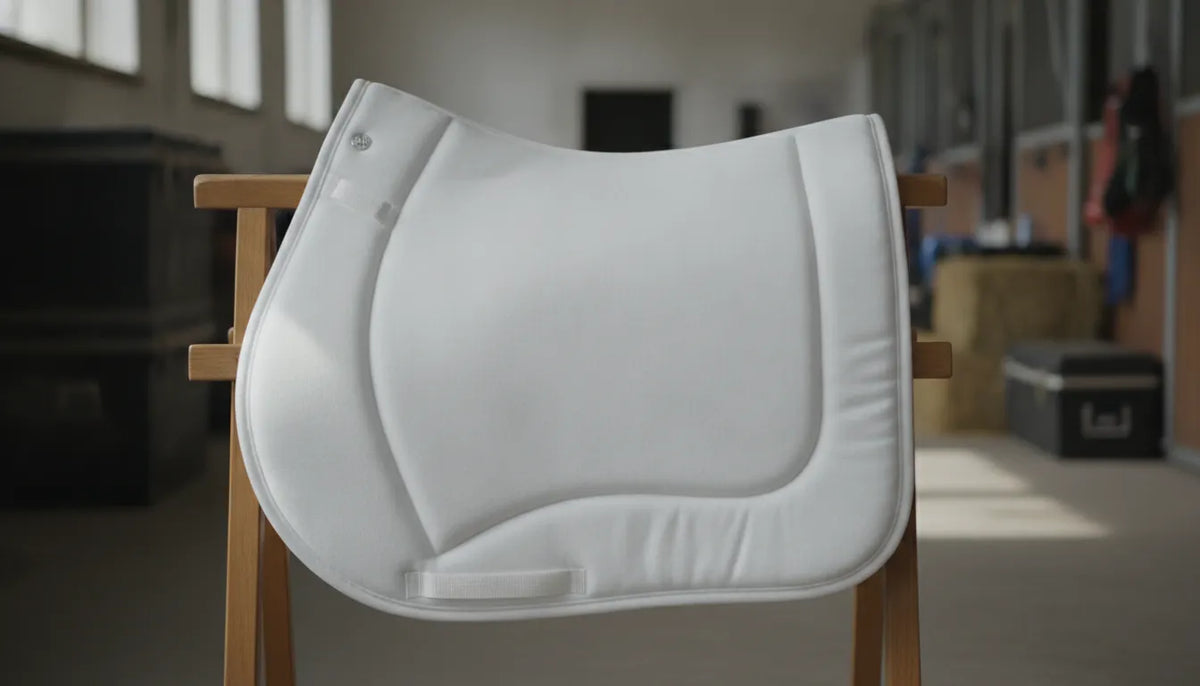
A dressage saddle pad is cut for a long, straight flap and a lifted spine, not for a jumping flap or a Western skirt. Match the drop to the saddle, keep the channel off the spine, and treat the pad as support under a saddle that already fits. If the saddle itself is the question, start with the dressage saddle fit guide, then come back here for the pad.
Hooves and Paws has handpicked horse and pet supplies since 1994, including English pads from Professional's Choice, Toklat, Shires, and Back On Track. Free continental U.S. shipping has no minimum. Unused pads in original packaging carry the 365-day satisfaction guarantee. You get a refund within 30 days, then store credit after that.
What Makes a Dressage Saddle Pad Different?
A dressage saddle uses a deep seat and a long, straight flap so the rider's leg can hang quietly. The pad underneath has to follow that outline. A jumping pad is shorter and shaped farther forward. A square all-purpose pad can leave the lower flap resting on the horse's side, or it can bunch under the knee during a transition.
Look at three measurements before you choose a color or a brand. Each one answers a different part of the fit.
- Spine length. The pad should run a little past the saddle at the front and the back. On Hooves and Paws product pages, the fit note asks for about 2 inches longer and wider than the saddle skirt, with 1 to 2 inches showing front and back.
- Drop. This is how far the pad falls beside the horse. The Professional's Choice Dressage Pad is 24 inches along the spine and 21.5 inches at the drop, which is the coverage a long flap needs.
- Wither lift. A contoured or high-profile spine sits up in the gullet so the pad does not pull down onto the withers.
How Should a Dressage Saddle Pad Sit?
Set the saddle where it belongs before you judge the pad. The live measurement guide walks through the support area, wither tracing, and tree width in how to measure a horse for a saddle. Use those numbers for the saddle. Use the steps below only for the pad.
- Stand the horse square on level ground, with the head and neck straight.
- Place the pad so the raised spine sits in the gullet and the front edge is just behind the shoulder, not on it.
- Set the saddle on the pad. You should still see a little pad past the pommel and past the cantle.
- Check both sides. The drop should cover the flap edge so leather does not rub the side.
- Girth up evenly. A pad that slides back once you walk is too slippery, too thick at the front, or sitting on the shoulder.
- After the ride, look at the sweat. A dry stripe on the spine is normal. A dry spot under one panel, or rubs at the wither, means the pad or the saddle is pressing.
For materials and thickness across English and Western pads, the saddle pad materials guide is the wider reference. This article stays on the dressage cut. It does not repeat Western wool thickness or the five-step saddle fitting method.
What Are the Common Dressage Pad Mistakes?
Most pad problems show up after the first walk, not on the rack. A long flap and a flat pad are a poor match, and the horse tells you before the pad looks worn.
- Using a jumping cut. The front sits too far forward and the drop is too short. The flap edge then rests on the coat.
- Stacking pads to hide a tight tree. Two thick pads can lift the saddle off the back and let it roll. Fix the saddle first.
- Ignoring the spine channel. A pad that lies flat through the gullet presses the withers once you sit.
- Buying by seat size only. An 18 inch seat does not tell you the flap length. Measure the saddle skirt, then read the pad's spine and drop.
- Leaving a wet pad in a bag. The loft packs down, and the next ride starts with a stiff spot under one panel.
If the sweat pattern is even and the pad still covers the flap after the ride, the cut is doing its job. If one side is dry and the other is soaked, look at the saddle balance before you buy a thicker pad.
Which Lining and Shape Should You Choose?
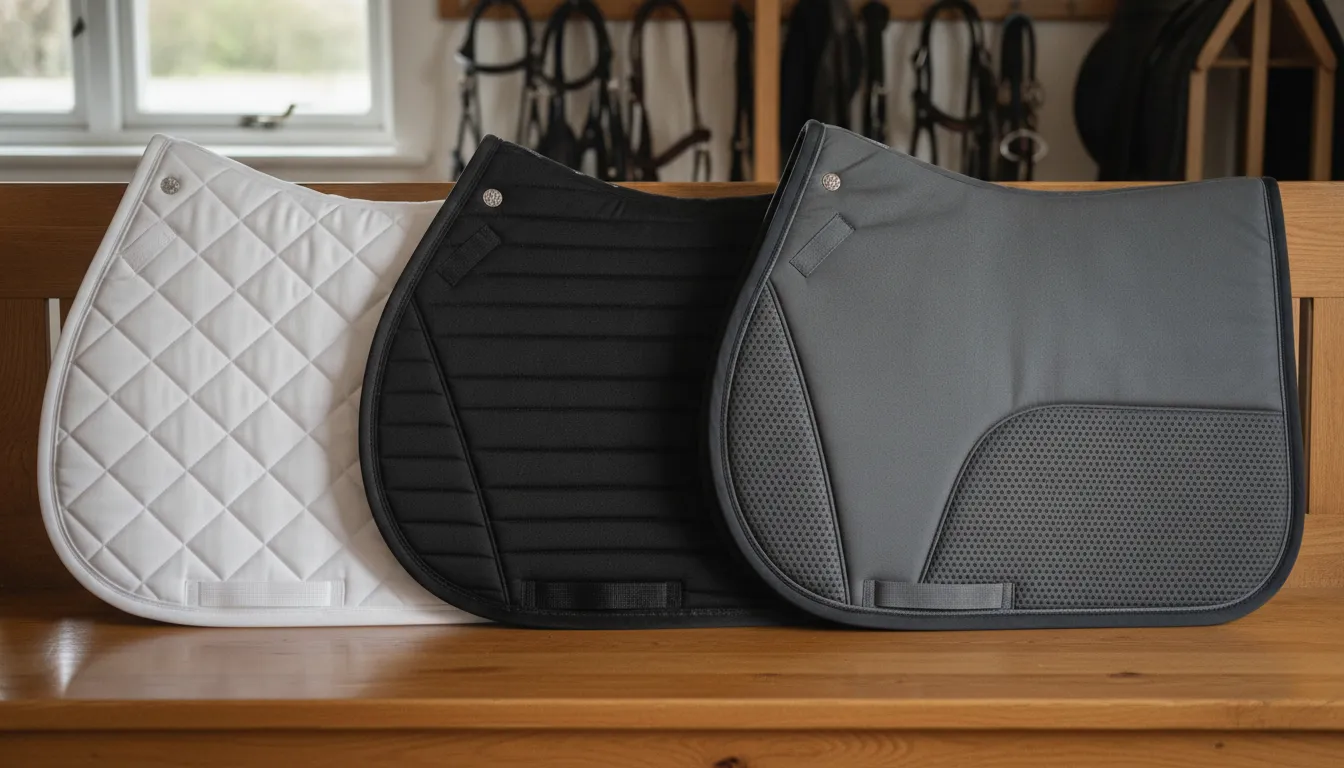
Shape and lining do different jobs. Shape decides clearance. Lining decides heat, grip, and how the pad feels under a long ride. These are live options in the Hooves and Paws dressage pad search, described from the current product pages.
| Pad | Cut and size on the page | What the page says it does | Best starting use |
|---|---|---|---|
| Professional's Choice Dressage Pad | 24 inch spine. 21.5 inch drop. | VenTECH mesh lining. Contoured wither relief. Shock-absorbing core. Reinforced girth loops. | Daily schooling when heat and a long flap are the main issues. |
| Professional's Choice VenTECH Dressage Pad | Universal size. White. Faux shearling lining. | Moisture-wicking mesh. Plush lining. Billet guards. | A white show-style pad that still breathes. |
| Toklat Woof Wear Dressage Pad | Full size. Contoured spine. Long-flap coverage. | Poron XRD foam in the T3 Matrix line. Shimmable pockets. Non-slip underside. | Horses that need wither lift, or a little correction, while the saddle still fits. |
| Back On Track Saddle Pad No1 Dressage | Dressage cut. Quilted padding. | 600 g cotton felt plus 200 g Welltex felt. Built to spread pressure and breathe. | Riders who want a felt dressage pad rather than a thin quilt. |
Shires also lists contoured dressage pads in the same search, including a suede pad with WickAway lining and the Arma Eltar and Deluxe Cotton saddlecloths. Read the size line on the product page before you add one to the cart. A full-size label is not the same as a 24 by 21.5 inch cut.
Can a Pad Fix a Dressage Saddle?
No. A pad can add a little lift, wick sweat, and keep the leather off the coat. It cannot change a tree that is too narrow, too wide, or sitting on the shoulder. The dressage saddle fit guide already recommends checking the saddle on the horse's back without a pad first, and confirming clear space over the withers.
Toklat's T3 Matrix page lists three insert levels: Pro-Impact for a developed topline, Ortho-Impact for conformational challenges such as a swayback, and Lo-Impact for general schooling. Those inserts adjust the pad. They do not rebuild the saddle. If the saddle bridges, rocks, or pinches once the pad is removed, stop and have a saddle fitter look at the tree.
US Equestrian points riders and officials to Dressage Rules DR 120 and DR 121, plus the current rule book, for what is allowed in the arena. The USEF Dressage Attire and Equipment booklet is the illustrated guide those officials use. Schooling at home can be more flexible. For a licensed show, confirm the current pad rule for your level before you rely on a thick corrective pad. The booklet is advisory. The rule book controls.
How Do Schooling and Show Pads Differ?
A schooling pad can be quilted cotton, mesh, or felt, as long as it stays put and clears the spine. A show pad is often white or a solid color, with cleaner binding. The cut still has to match the flap. A short pad under the knee is the wrong pad, even when the color looks right for the ring.
The white Professional's Choice VenTECH pad is listed as a universal size with faux shearling and billet guards. Billet guards keep the girth hardware off the pad edge. That matters on a long dressage flap, where the billets sit farther back than on a close-contact saddle.
Back On Track's Haze Collection dressage pad is another style option in the same search. The page describes corded piping and an anatomical cut with extra space over the spine. Read that page for the current colors. Do not assume a new color is accepted at your show until you check the prize list and the current USEF dressage rules.
Hooves and Paws ships from Apple Valley, California, and also from partner warehouses. If you are packing for a show, read the handling line on the product page. Warehouse items ordered before 1 PM Pacific ship the same business day. Partner items can take 1 to 4 business days, and a few special orders take longer.
When Should You Replace the Pad?
A dressage saddle pad is ready to retire when the shape is gone, not when the color fades. Compressed quilting, a spine channel that no longer lifts, or binding that curls under the flap will change the fit even if the saddle has not changed. Replace it before you add a second pad on top.
Also replace a pad that stays damp after a normal drying day, or that leaves a dirty stripe the brush will not lift. That packed dirt becomes a pressure spot. If the saddle was reflocked or you changed flaps, measure the drop again before you reuse the old pad.
How Do You Care for a Dressage Saddle Pad?
Sweat left in a pad packs down the loft and can rub the next day. Most Toklat product pages describe the pads as machine washable and dryer safe, and the T3 Matrix series asks you to remove the foam inserts before washing. Follow the care label on the pad you bought, because faux shearling and felt do not dry the same way.
- Brush hair and dirt off before the pad goes back on the rack.
- Let a damp pad dry on a rack, not folded in a trunk.
- Wash on the cycle the label allows, and skip fabric softener, which can coat a wicking lining.
- Check girth loops and binding. A torn loop lets the pad shift even when the cut is right.
Orders stocked in the Apple Valley, CA warehouse ship the same business day when they are placed before 1 PM Pacific. Partner-warehouse items take longer, and each product page shows that timing before checkout.
Shop Dressage Saddle Pads Today
Frequently Asked Questions
What size dressage saddle pad do I need?
Match the spine and the drop to your saddle, not to the seat size alone. A common high-performance cut on the Professional's Choice page is 24 inches by 21.5 inches. You still want about 1 to 2 inches of pad showing past the saddle at the front and the back.
Can I use an all-purpose pad under a dressage saddle?
You can for a short school if the drop covers the long flap and the spine stays off the withers. An all-purpose or jumping cut is often too short or too forward for a dressage flap, so the leather edge can rub.
Should a dressage pad be contoured?
Choose a contoured or high-wither cut when the pad pulls down into the gullet. The Toklat page describes a high-profile spine that sits up in the gullet. A flatter pad can be fine on a mutton wither if it still clears the spine.
Does a white pad fit every dressage saddle?
Color does not change the fit. The white Professional's Choice VenTECH pad is a universal-size show-style option with faux shearling. Check the drop and the spine channel the same way you would on a schooling pad.
How often should I wash a dressage saddle pad?
Brush it after every ride and wash it when it is stiff with sweat or smells. Remove foam inserts before washing when the product page says to, and dry the pad fully before the next ride.
Who can help me pick a pad?
Call Hooves and Paws at (760) 247-5523 and have your saddle's spine length and flap drop handy. The team can point you to a current dressage cut in the saddle pad collection. A saddle fitter is still the right person if the saddle itself does not fit.


