


Choosing between a hay bag vs hay net comes down to how your horse eats, where you feed, and how much portability and control you need. Both slow-feeding options can help make forage last longer, but they differ in airflow, opening design, capacity, setup, and everyday handling. The best choice is the feeder that suits your horse's routine and can be used safely and consistently.
Shop Slow-Feed Hay Nets for Your Horse
This guide compares hay bags and hay nets without treating either one as a universal answer. Use the practical differences below to narrow your options, then consider your horse's temperament, feeding environment, and forage plan before choosing a style.
Why Compare a Hay Bag vs Hay Net?
Hay is a horse's primary forage, and many horses do better when it is available in smaller amounts over more of the day. A slow feeder can make a measured portion last longer than a loose pile on the ground, which may support a calmer feeding routine and reduce avoidable waste. It does not replace an appropriate diet, veterinary advice, or regular monitoring, but it can be a useful management tool.
The terms hay bag and hay net are sometimes used interchangeably, yet the construction is not always the same. A hay bag usually combines a fabric body with one or more feeding openings. A hay net is made primarily from knotted or woven mesh, with forage pulled through the openings. Some products blend these designs, so read the product details and inspect the actual opening, seams, and attachment points before buying.
A hay bag and a hay net can both slow forage intake, but the right choice depends on the feeding location, hole size, material, capacity, and how your individual horse interacts with the feeder.
What Is the Difference Between a Hay Bag and a Hay Net?
The central difference is how the feeder presents the forage. A hay bag tends to enclose hay in a more structured container. Its opening may be located on the front, bottom, or side, and its fabric can make the feeder easier to carry from the tack room to the stall, trailer, or paddock. Some bags are designed to sit on the ground, while others are made to hang.
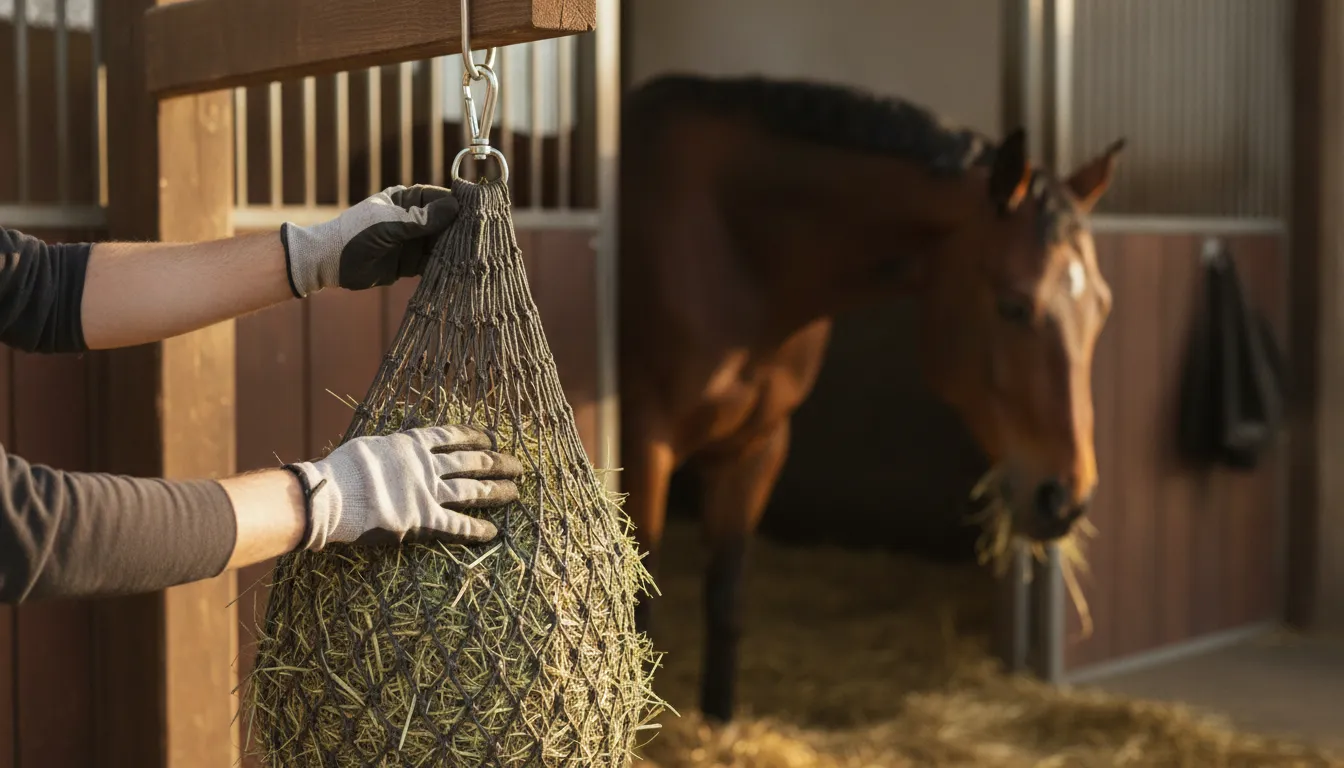
A hay net presents hay through mesh openings across a flexible body. It can be filled with a large quantity of forage and hung from an approved location, making it useful for stall feeding, turnout, and travel. Because the mesh itself creates the feeding surface, hole size and knot construction have a strong effect on how quickly the hay is pulled out.
| Feature | Hay Bag | Hay Net |
|---|---|---|
| Typical structure | Fabric body with a defined opening or feeding panel | Flexible mesh body with forage drawn through openings |
| Portability | Often easy to carry and contain between feedings | Lightweight, but loose mesh may be less convenient to transport when filled |
| Airflow | Depends on the fabric, vents, and opening design | Mesh usually allows substantial airflow around the forage |
| Capacity | Commonly suited to a measured portion or individual feeding | Often available in larger capacities for longer feeding periods |
| Setup | May be placed or hung, depending on construction | Usually filled and securely hung or anchored |
| Best starting question | Do I need a contained, portable feeder for a specific portion? | Do I need flexible capacity and a mesh feeding surface? |
These are general patterns, not guarantees. A reinforced hay bag may be more durable than a lightweight net, while a heavy-duty net may outlast a poorly made bag. Compare individual products by material, stitching, hardware, opening size, and intended use.
Hay Bag Strengths and Limitations
A hay bag can be a practical choice when you want a tidy, contained portion that is easy to carry. The fabric body may help keep loose hay from spreading through a stall, trailer, or feeding area. If you routinely move hay between a barn, show grounds, and trailer, a bag with a reinforced handle or dependable attachment points may simplify the process.
Hay bags can also work well when you want to offer a defined amount of forage at a particular time. A smaller opening may slow access, while a larger opening can make it easier for a horse to eat. The correct design depends on the horse and the feeding goal. A horse that becomes frustrated or paws aggressively at a feeder may need a different opening, a different placement, or a gradual introduction.
Limitations matter too. A bag's airflow depends on its materials and construction. A tightly woven or overfilled bag may not ventilate like an open mesh net. Moisture, dust, and heat can also become concerns if damp hay is packed into a feeder and left in a warm, poorly ventilated location. Empty and clean the bag on a regular schedule, and make sure the forage is appropriate for the planned feeding period.
Some hay bags are designed for ground use, but that does not make every ground-feeding setup safe for every horse. Check the product instructions, look for loose straps or hardware, and inspect the bag after use. A bag that has torn seams or a stretched opening should be removed from service until it is repaired or replaced.
Hay Net Strengths and Limitations
Hay nets are popular because they are flexible, lightweight, and available in many sizes and mesh openings. A net can hold a generous portion of forage without requiring a rigid container, and its shape can adapt to the amount of hay inside. This makes it useful for a stall, paddock, trailer, or other approved feeding area when it is filled and secured correctly.
Open mesh can provide good airflow around dry hay, and the visible mesh makes it easier to monitor wear. However, airflow still depends on how tightly the net is packed and where it is placed. A net pressed against a wet wall, buried in bedding, or stuffed beyond its capacity is not the same as a properly filled and ventilated net.
The main limitations are handling and entanglement risk. A full net can be awkward to move, and a loose or damaged net can create hazards if it is placed where a horse can catch a hoof, shoe, halter, or leg. Hanging height, attachment method, and surrounding space deserve as much attention as the mesh opening. A hay net should never be treated as a set-and-forget item.
Some horses pull hard at the mesh, so inspect knots, seams, rings, and straps often. If your horse destroys feeders, gets anxious around mesh, or has a history of entanglement, discuss a safer feeding arrangement with your veterinarian or equine professional before using a net.
Which Feeder Fits Your Horse's Daily Routine?
Start with the feeding location. For a trailer or a short, contained feeding period, a portable hay bag may be convenient. For a stall or turnout area where a larger quantity needs to be offered, a hay net may provide the capacity and flexibility you need. The physical environment matters: identify safe attachment points, remove sharp edges, and leave enough clearance for the horse to move normally.
Next, consider your horse's eating behavior. A determined, rough feeder may need reinforced construction and a design that does not expose loose hardware. A patient horse may do well with a smaller opening, while a horse that becomes agitated when forage is difficult to reach may need a more generous opening or a slower transition. Watch the first several uses rather than assuming the feeder is suitable because another horse uses the same style.
Finally, consider your management routine. Can you fill, hang, empty, and inspect the feeder consistently? Will you be able to keep it clean and dry? A slightly less sophisticated design that you use correctly may be better for your horse than a feature-heavy design that is difficult to maintain.
Choose based on the whole routine: feeding site, horse behavior, portion size, cleaning, inspection, and how securely the feeder can be positioned. Convenience is part of safety because a feeder must be maintained to work well.
Hole Size, Airflow, and Eating Pace
Hole size is one of the most important factors in a slow feeder. Smaller openings generally make it harder to pull hay out quickly, while larger openings allow easier access. That does not mean the smallest available mesh is automatically best. A change that is too difficult for a particular horse can lead to frustration, aggressive pulling, damaged teeth or gums, or reduced forage intake.
Introduce a new opening gradually when possible. Measure or observe how much hay remains after a normal feeding period, watch whether the horse is eating comfortably, and adjust the plan with your veterinarian or nutrition professional if intake changes unexpectedly. Horses with dental problems, a choke history, or a special forage requirement need individual guidance.
Airflow protects forage quality, but it is not a substitute for good storage. Use clean, dry hay that is appropriate for your horse, avoid overfilling, and do not leave wet forage trapped in a closed bag. A breathable mesh net may offer strong airflow, but placement and fill level still matter. A hay bag with vented or open sections may also work well when it is not packed tightly.
Durability, Portability, and Setup
Evaluate durability at the points that receive the most stress. Look for reinforced seams, securely finished edges, strong webbing, and hardware that is appropriate for the intended use. Mesh should not have unexplained gaps, pulled knots, or sharp exposed ends. On a hay bag, examine the feeding opening and handles. On a hay net, examine the top ring, drawstring, knots, and any hanging straps.
Portability is more than product weight. Consider how the feeder feels when filled, whether it keeps hay contained in transit, and whether it can be cleaned without special equipment. A hay bag often suits a routine that involves frequent carrying. A hay net may be easier to store when empty and can offer more capacity, but moving a full net may be less convenient.
Setup should follow the manufacturer's directions. Do not improvise a hanging point on a weak board, a movable gate, or hardware that can detach. Keep the feeder away from sharp edges, narrow corners, and objects that can trap a hoof or leg. If a feeder is used in a trailer, verify that it cannot swing into the horse or become caught during loading and unloading.
How Can You Set Up Either Feeder Safely?
Safety starts with a supervised introduction. Fill the feeder with a normal portion, place it in the intended area, and observe how your horse approaches, pulls, paws, and moves around it. Watch for rubbing, broken hardware, trapped limbs, frantic behavior, or a sudden refusal to eat. Remove the feeder immediately if you see a hazard.
- Read the product instructions and use only the intended attachment points.
- Inspect seams, mesh, straps, rings, snaps, and knots before every use.
- Keep the feeder clear of sharp edges, loose wire, and narrow spaces.
- Prevent the feeder from hanging where a hoof or shoe can become caught.
- Use a secure closure that cannot create a long, loose loop.
- Keep the hay dry and remove damp or spoiled forage promptly.
- Clean the feeder on a schedule suited to the material and environment.
- Monitor the horse's intake, comfort, body condition, and behavior after a change.
Hanging height requires judgment. A location that is safe for one horse and one feeder may not be safe for another. Follow the product's directions, consider the horse's size and movement, and avoid any setup that lets the feeder swing into the horse or sit where legs can reach it. When in doubt, choose a different placement and ask an equine professional to review the arrangement.
The feeder itself is only one part of the safety equation. A secure attachment, clear space, regular inspections, suitable hay, and supervised first use are essential for both hay bags and hay nets.
A Practical Hay Bag vs Hay Net Decision Guide
Use this quick framework when two products look similar:
- Choose a hay bag first when portability, contained portions, and a defined feeding opening are your main priorities. Confirm that the bag's material provides suitable ventilation and that the intended placement is safe.
- Choose a hay net first when you want flexible capacity, an open mesh feeding surface, or a feeder that can be securely hung in an appropriate stall or turnout location. Match the opening to your horse's needs.
- Compare either style carefully when your horse is a rough feeder, has dental concerns, has a history of entanglement, or needs a closely managed forage plan. A veterinarian or equine nutrition professional can help determine whether a design fits.
- Test before relying on the feeder for a long period. Observe the horse, inspect the feeder after use, and adjust the setup if the horse cannot eat comfortably or the equipment shows damage.
For additional options, browse the Hooves and Paws slow-feed hay net collection. Compare product dimensions, opening size, materials, and attachment details rather than choosing by appearance alone. A well-matched feeder should fit both your horse and the way you actually manage forage each day.
Frequently Asked Questions
Is a hay bag or hay net better for every horse?
No. The better option depends on the horse, forage plan, feeding location, feeder design, and daily supervision. Compare the opening, materials, capacity, airflow, and attachment method, then observe how your horse uses it.
Does a hay net slow a horse down more than a hay bag?
Not automatically. Eating pace is influenced by the opening size, the amount and type of hay, how tightly the feeder is filled, and the horse's behavior. A small-opening bag can slow access more than a large-opening net, while a small-hole net may be slower than a generously sized bag.
What hole size should I choose for a slow feeder?
Choose an opening that slows access without preventing comfortable forage intake. Start with the product guidance, consider your horse's size and eating behavior, and monitor intake. Seek professional advice for dental issues, choke concerns, or special dietary requirements.
Can I leave a hay bag or hay net outside?
Only if the product is intended for that setting and the location is safe. Weather, moisture, ultraviolet exposure, mud, and rough turnout behavior can shorten the life of a feeder. Inspect it more frequently outdoors and remove wet or damaged equipment.
How often should I inspect a hay net or hay bag?
Inspect it before every use, paying close attention to seams, mesh, straps, closures, rings, and knots. Stop using it if you find a tear, pulled knot, sharp edge, loose hardware, or any change that could create an entanglement risk.
Can a hay net or hay bag reduce hay waste?
It may reduce waste by keeping more forage contained, but results vary with the feeder, hay type, opening, placement, and horse. Measure or observe waste in your own setup and keep the feeder clean, dry, and correctly filled.
What should I do if my horse becomes frustrated with a slow feeder?
Check the opening, fill level, placement, and condition of the feeder. A transition may need to be gradual, or the design may not suit that horse. If the horse stops eating, shows pain, damages the feeder, or behaves dangerously, remove it and consult your veterinarian or equine professional.


