


Learning how to tie / hang a hay net safely starts with more than securing a full bag to the nearest fence rail. The attachment point, hanging height, knot or clip, hay-net design, and your horse's shoes and habits all affect the setup. A thoughtful installation can slow rushed eating, keep hay cleaner, and reduce waste without creating an avoidable entanglement hazard.
This guide covers a practical way to hang a hay net in a stall, shelter, trailer, or turnout area. It is general horse-care information, not veterinary or manufacturer-specific instruction. Always follow the net maker's directions, consider your horse's individual health and behavior, and ask your veterinarian or qualified equine professional about special feeding or mobility concerns.
Quick answer: How should you hang a hay net?
Choose a sturdy attachment point, keep the net off the ground and clear of corners or hardware, secure the top so it cannot open, and place the lowest part where your horse can eat comfortably without putting a hoof or shoe into the net. Check the height while the net is full and again as it empties.
For many average-sized horses, a starting point is a bottom height around 3 feet from the ground, adjusted for the horse, the net's dimensions, and the manufacturer's instructions. The goal is not one universal measurement. The goal is a stable setup that encourages a comfortable, slightly downward head position while keeping the net and its loops well away from the horse's feet.
Observe the horse eating before leaving the setup unattended. If the horse struggles to reach the hay, pulls the net down, paws at it, catches a blanket or halter, or shows unusual frustration, stop and adjust the setup. A net that is technically tied but unsafe for that individual horse is not a safe installation.
What equipment do you need before hanging a hay net?
Gather the net, the hay ration, and a secure attachment method before you fill the bag. A simple setup may include a designated tie ring, a heavy-duty quick-release snap, and the net's own top rope. Avoid improvised attachment points that can bend, splinter, loosen, or release sharp edges.
- A sound hay net: Look for intact mesh, strong seams, secure rings, and no stretched openings or broken strands.
- A fixed attachment point: Use a purpose-installed stall ring, sturdy fence post, trailer tie point, or another anchor rated for the location. Do not tie to a gate latch, loose board, or movable object.
- A safe connector: A suitable quick-release snap can make removal easier, but it must be compatible with the net and anchor. Keep the release mechanism away from areas where a horse can rub or catch tack.
- Appropriate hay: Fill the net with the amount recommended for the design. An overfilled net can become heavy, distort its openings, and pull harder on the attachment point.
- A way to inspect the setup: Keep a flashlight, spare connector, and repair-safe replacement net available so a damaged net does not stay in service.
If the net is new, read its instructions before tying it. Designs vary. Some are intended for a particular bale size, some are designed for ground-level use only under supervision, and others include special closures or attachment straps. General guidance should never override the product's safety instructions.
How do you tie a hay net safely?
The safest knotting method is the one that keeps the filled net closed, prevents the rope from slipping through the rings, and can still be released by an adult in an emergency. Do not leave long loose rope tails where a horse could catch a leg, shoe, blanket, halter, or muzzle.
- Inspect the net before filling it. Check the mesh, top rings, seams, rope, and connector. Remove any net with a broken strand, sharp hardware, or opening that has stretched beyond its intended size.
- Fill it on the ground in a clear area. Place the hay inside without standing where a horse could crowd you. Keep the top opening gathered as the net fills so the hay stays contained.
- Close the top completely. Gather the rings or closure according to the design. If the net uses a drawstring, pull it snug without crushing the rope or forcing the rings apart.
- Secure the closure. Tie the rope using the manufacturer's recommended method or attach it to the approved connector. A quick-release method is preferable when the location and hardware are designed for it. Avoid a knot that can tighten into a permanent jam.
- Attach the net to the fixed anchor. Clip or tie the closed top to the tie ring. The anchor should carry the load without flexing or pulling out of the wall, post, or fence.
- Manage the rope tail. Keep excess rope short, secured, and outside the horse's reach. Never leave a long loop hanging below the net.
- Test the connection by hand. Apply a firm downward and sideways pull before the horse enters. The net should not open, slide, or swing into a wall or corner.
Never tie the net directly to a horse. Do not place a filled net where a horse can push it beneath a feeder, catch it on a latch, or drag it into a corner. If you use a snap, make sure the snap gate is fully closed and cannot be opened by rubbing against the anchor.
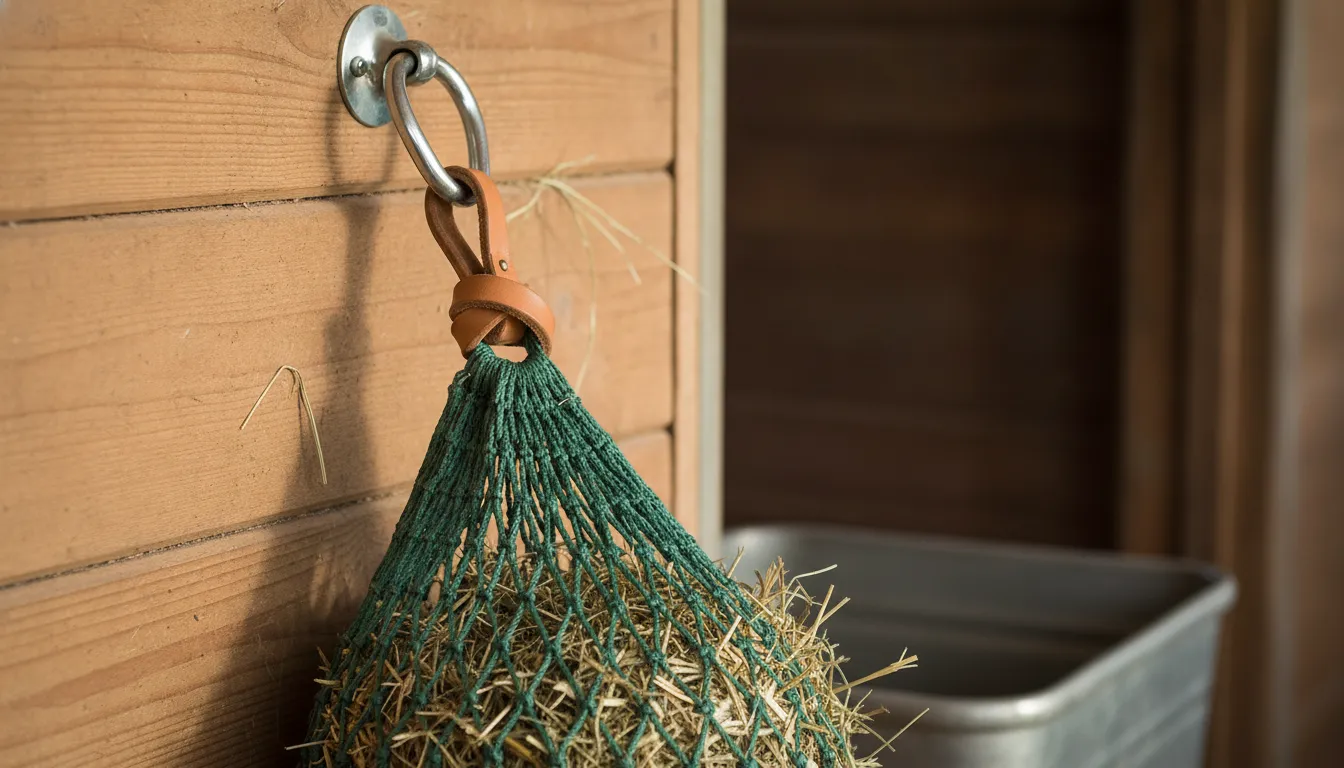
Where is the safest height for a hay net?
Hang the net high enough to keep the lowest part and loose loops away from hooves, but not so high that the horse must stretch upward or eat with its head held high. Measure a full net, then recheck it when nearly empty.
Height is one of the most important parts of a safe hay-net setup, and it cannot be chosen from the empty bag alone. A full net may hang lower, while an empty net can swing, twist, or expose loops that were not obvious at feeding time. Consider your horse's height, posture, shoes, blankets, and ability to reach the hay without strain.
For an average horse, many owners begin with the bottom of the net around 3 feet from the ground, then adjust based on observation and product guidance. Some sources and manufacturers use different reference points, such as the withers or the tie ring, so use the measurement as a starting point rather than a guarantee. The bottom should not rest on the ground or hang low enough for a hoof to enter the mesh.
- The horse should be able to pull hay without repeatedly reaching sharply upward.
- The net should remain clear of the horse's feet when full and nearly empty.
- The bag should not swing into a wall, bucket, feeder, gate, or corner.
- Blanket straps, halters, and other equipment should not be able to catch on the net or rope.
- There should be enough clearance for the horse to step away without becoming trapped between the net and a surface.
Horses with dental, neck, back, respiratory, mobility, or hoof concerns may need a different feeding arrangement. Ask your veterinarian or equine care professional to help determine whether a suspended net is appropriate. If your horse wears shoes, take extra care to keep every part of the net and its loops above hoof level.
How should a hay net be used in a stall?
A stall gives you a controlled environment, but walls, corners, buckets, mats, doors, and bedding can create new snag points. Select an anchor on a strong wall or approved tie area, not on a removable partition or a weak board. Keep the net away from the stall door so the horse cannot pin it against the opening or catch it while entering.
Before turning the horse loose, remove nearby items that can interact with the net. A hanging bucket, hay rack, blanket bar, or exposed hook can catch a rope or mesh. Look at the setup from the horse's eye level, then from the floor, because a safe-looking attachment can expose a loop when the net drops.
Introduce a new net when you can observe the horse. Some horses understand the feeding method immediately, while others paw, toss, or pull at the bag. Start with an opening size the horse can manage rather than beginning with an extremely restrictive net simply because it slows feeding more. Monitor intake and behavior, and make changes gradually.
Do not assume a stall makes a low net safe. A shod horse can still catch a shoe in loose mesh, especially while rolling or pawing. If the net becomes wet, damaged, or contaminated with bedding or manure, remove it and replace or clean it according to the manufacturer's instructions.
What changes when you hang a hay net for turnout?
Turnout adds wind, rain, mud, gates, fencing, other horses, and more room for a net to swing or become dragged. Choose a location that keeps the hay protected while preventing the bag from contacting wire, sharp posts, electric-fence hardware, or a gate that moves. A shelter or designated feeding station can offer better control than an exposed fence line.
For group turnout, consider whether one horse can guard the net or pull it away from another horse. Each horse may need its own feeding point with enough spacing to prevent crowding. Do not place a net where horses can become trapped between the bag and a fence or where one horse can pull another horse's net down.
Outdoor hardware should be weather-appropriate and checked for rust, sharp edges, and loosened fasteners. Wind can turn a secure net into a moving object, and rain can add weight. Recheck the anchor after bad weather, and remove the net if conditions make the location unpredictable.
Some horses can safely use hay nets during turnout, while others need a different feeder or closer supervision. Observe the actual horse in the actual pasture. If the horse has a history of pawing, pulling, climbing, aggressive resource guarding, or getting caught in equipment, ask a qualified professional to help plan the feeding arrangement.
How often should you inspect a hay net?
Inspect the net before every use and perform a closer inspection regularly. Replace a net when damage, stretched openings, sharp hardware, or an unreliable closure creates a risk you cannot correct safely.
A hay net is a piece of feeding equipment, not a set-and-forget fixture. Check it before filling, after the horse has eaten, and after any unusual event such as a pulled anchor, storm, entanglement, or aggressive tugging.
- Look for broken strands, frayed rope, torn seams, and stretched or enlarged openings.
- Check every ring, snap, buckle, and tie point for sharp edges, cracks, bending, or corrosion.
- Confirm the anchor has not loosened from the wall, post, fence, or trailer.
- Make sure the net still hangs at the intended height when full and nearly empty.
- Check for manure, urine, mud, mold, or wet hay and clean or replace the net as appropriate.
- Watch for new behavior, including pawing, pulling, rubbing, head tossing, or refusal to eat.
Keep a damaged net out of service until it is repaired with a manufacturer-approved method, if repair is permitted. Tying a temporary patch over a weak area may create smaller loops or a new snag point. When in doubt, replace the net rather than trying to extend its service life.
What safety mistakes should you avoid?
Most hay-net problems come from a mismatch between the net, the horse, and the location. Avoid these common mistakes:
- Hanging the net too low: A hoof, shoe, blanket clasp, or leg can enter the mesh or catch a loose loop.
- Hanging it too high: The horse may stretch upward, pull harder, or eat in an uncomfortable posture. Elevated feeding can also be a poor fit for some respiratory or neck concerns.
- Using a weak anchor: A loose board, gate latch, or light hook may fail under the weight of wet hay and a pulling horse.
- Leaving long rope tails: Loose rope can catch on a leg, shoe, halter, or stall hardware.
- Starting with an overly restrictive opening: A frustrated horse may paw, strike, or pull aggressively at the net.
- Skipping observation: A setup that seems safe while empty may become unsafe once it is full, partly empty, wet, or moved by wind.
- Ignoring the manufacturer's instructions: Product designs and intended uses differ, especially for bale nets, trailer nets, and outdoor feeders.
If an incident occurs, remove the horse from the area only when it is safe to do so, address any immediate injury, and contact your veterinarian when needed. Do not resume use until you understand what caused the entanglement or failure.
How do you choose the right hay net for safe feeding?
Safe hanging begins with choosing a net that matches your horse and feeding routine. Consider the opening size, capacity, material, closure, location, and whether the net is intended for a stall, pasture, trailer, or bale. A durable net with a manageable opening is more useful than a restrictive design your horse cannot use calmly.
If your horse is new to hay nets, a moderate opening can make the transition easier. Once the horse eats calmly and you have observed the setup, you can discuss whether a smaller opening is appropriate for your feeding goals. The amount and type of hay still matter. A slow feeder does not replace a balanced ration or professional nutrition advice.
Hooves and Paws carries carefully selected horse supplies for everyday care and feeding routines. Browse slow-feed hay nets to compare options, then follow each product's instructions for filling, closing, hanging, cleaning, and inspection.
How to hang a hay net safely: final checklist
Before you leave the horse with a suspended hay net, confirm each item below:
- The net is intact, clean, and appropriate for the horse and feeding location.
- The hay amount fits the net without overloading its seams, rings, or anchor.
- The top is fully closed and the knot, snap, or connector is secure.
- The attachment point is strong, stable, and free from sharp edges.
- Loose rope and hardware are short, controlled, and outside the horse's reach.
- The lowest part of the net stays above hoof level when full and nearly empty.
- The horse can eat with a comfortable posture without pulling the net into a hazard.
- Nearby gates, buckets, blankets, hooks, fencing, and corners cannot catch the net.
- You have observed the horse using this setup and know how to remove it quickly.
A safe hay-net routine is built through observation. Check the setup, watch the horse, and adjust the height or location when the conditions change.
Shop Safe Slow-Feed Hay Nets Today
Frequently Asked Questions
How high should a hay net be off the ground?
For many average-sized horses, owners begin with the bottom of the net around 3 feet from the ground, then adjust for the horse, net design, shoes, and manufacturer instructions. The net should stay above hoof level without forcing the horse to reach upward.
Can a horse wear shoes while eating from a hay net?
A shod horse may be able to use a hay net, but the setup requires extra care. Keep the net and loose loops well above hoof level, observe the horse closely, and ask a qualified professional for help if the horse paws, rolls near the net, or has a history of entanglement.
What is the safest knot for a hay net?
The safest closure is the manufacturer's recommended method or an approved quick-release attachment that keeps the net closed but can be released by an adult. Avoid long rope loops and knots that become impossible to untie under load.
Should a hay net touch the ground?
Do not let a suspended hay net rest on the ground for unattended feeding. Ground-level netting can create a hoof or shoe entanglement risk. If a product is specifically designed for supervised ground use, follow its instructions and monitor the horse.
Can you hang a hay net in a stall?
Yes, many hay nets are used in stalls when attached to a strong fixed point and positioned away from doors, corners, buckets, hooks, and other snag hazards. Check the height with the net full and nearly empty, and observe the horse during introduction.
Can you hang a hay net outside in turnout?
You can use a hay net outdoors when the feeder, anchor, and location are designed for the conditions. Protect it from sharp fencing, moving gates, wind, mud, and crowding. In group turnout, provide enough space to prevent one horse from guarding or pulling down another horse's net.
How often should you replace a hay net?
Replace a hay net when the mesh, seams, rope, closure, or hardware is damaged or unreliable. Inspect it before each use and after pulling, storms, entanglement, or other unusual events. A temporary repair is not safe if it creates a sharp edge or small snag loop.


