

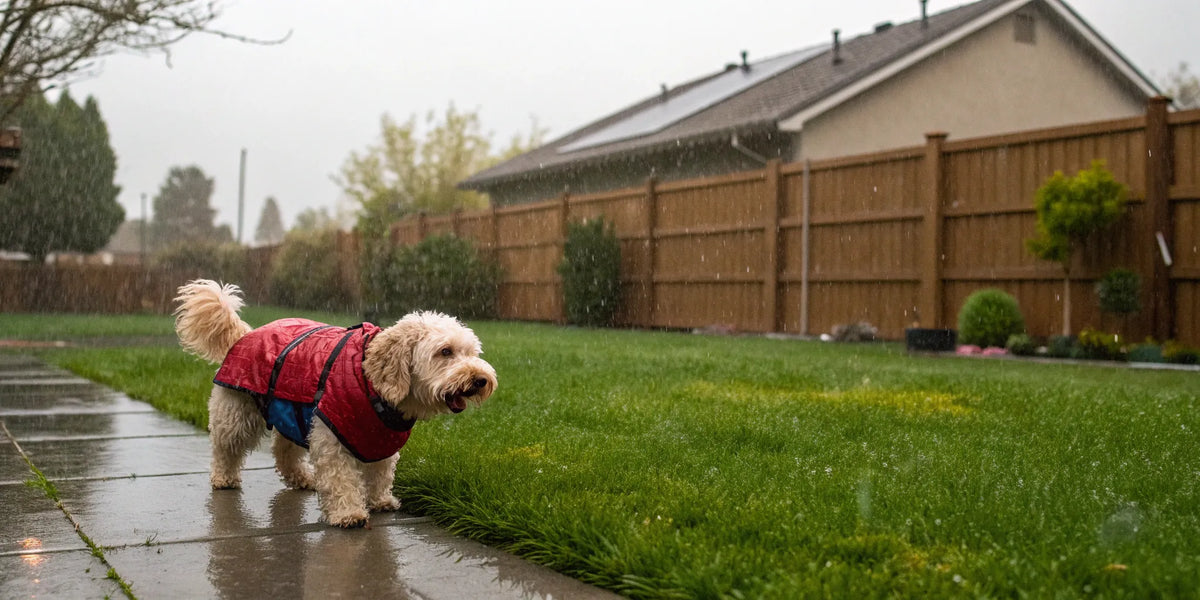
The best waterproof coat for a small dog is one that fits your dog's measurements on the maker's own size chart, covers the back and chest (and the belly for low-slung dogs), fastens securely without rubbing, and works with your harness. Choose a light shell for mild rain and an insulated coat for cold, wet days.
A rainy day can feel like a huge obstacle when you have a small dog. A light drizzle can leave a little dog soaked, and a long-coated one can come home carrying half the puddle. A good small dog coat isn't just an accessory; it can turn a dreaded wet walk into a comfortable one. But finding the right one can be tricky. This guide explains what waterproof ratings mean, which features matter, how to measure for a snug fit, and ten coats worth a look, so you can pick with confidence.
Key Takeaways
- Fit comes first: Measure your dog's neck, chest and back length before you shop, then check them against the maker's own size chart. Makers size differently, so a "small" in one brand is not a "small" in another.
- Look at function, not just looks: Check whether the maker calls the coat waterproof or water-resistant, whether the seams are taped, how much of the belly it covers, and whether it has reflective details for gloomy days.
- Match the coat to how you'll use it: A light shell suits quick walks in mild rain, an insulated coat suits cold, wet weather, and a coverall or snowsuit suits dogs that come home covered in mud.
How to Choose the Best Small Dog Raincoat
Finding the right raincoat for your small dog is about more than style. It's about keeping them dry and comfortable, and happy to head outside even when the weather isn't cooperating. A good coat can turn a rainy-day potty break into a manageable walk. With so many options it's easy to feel a little lost, so focus on three things: the material, the fit, and the amount of coverage your dog actually needs.
A coat that keeps the rain out saves you from endless towel-drying sessions. Just as important, a well-fitting jacket won't rub, chafe or get in the way when your dog wants to trot along. When you find a coat that checks the right boxes, it quickly becomes one of your most-used pieces of dog gear. You can browse the coats, jackets and accessories we carry in our Dog Apparel & Accessories collection.
Does Your Dog Need a Coat?
Not every dog needs one. The American Veterinary Medical Association's cold weather safety advice says that if your dog has a short coat or seems bothered by cold, you can consider a sweater or dog coat. The AVMA also suggests shortening walks in very cold weather, wiping or washing your dog's feet, legs and belly after winter walks to remove snow, ice, salt and de-icing chemicals, and talking to your veterinarian about your own pet's risks in cold weather. If your dog is shivering or very lethargic after being out in the cold, the AVMA says to contact your vet.
A raincoat is a slightly different question. Plenty of dogs with thick coats don't feel the cold, but their owners still like a shell that keeps the coat clean and cuts down on drying time. For short-coated or small dogs that dislike the cold, an insulated waterproof coat does both jobs at once.
What Do Waterproof Ratings Actually Mean?
When a tag says "waterproof," it helps to know what's behind the word. Some makers publish a waterproof rating in millimeters (mm), sometimes called the water column or hydrostatic head. The higher the number, the more water pressure the fabric holds back before it starts to leak. Not every maker publishes one, so compare like with like.
Here's how a few makers describe their raincoats:
- Ruffwear lists its Sun Shower Dog Raincoat shell at a 3,000 mm waterproof rating.
- Hurtta lists the Mudventure Coat at a water column of over 10,000 mm, with all seams taped.
- Non-stop dogwear lists the Fjord Raincoat 2.0 at a 20,000 mm water column.
Two other things matter as much as the number. First, the seams: water can find its way through stitching holes, which is why makers point out when the seams are taped. Second, the wording: some coats are sold as water-resistant rather than waterproof. Kurgo describes its Loft Dog Jacket as water-resistant, and Canada Pooch describes its Torrential Tracker as water-resistant and suited to moderate rain. A water-resistant coat can be a fine choice for a short walk in a shower, but if you walk in steady rain, look for a coat the maker calls waterproof.
Must-Have Features for a Comfy Fit
A raincoat can have the best rating in the world, but if it doesn't fit well, your dog won't want to wear it. Comfort is everything. Look for adjustable straps, especially around the chest and belly, to create a snug fit that doesn't restrict movement. This matters most for small dogs with distinctive body shapes, like long-bodied Dachshunds or barrel-chested French Bulldogs.
Also consider how easy the coat is to put on. A design that slips over the head and fastens at the chest or belly is often easier to manage than one with leg holes and several clasps, especially when your dog is excited to get out the door. Leg straps or leg loops, which several makers use, help keep the back of the coat from flapping or lifting in wind.
Full Belly or Back-Only: Which Coverage Is Best?
Next, decide how much coverage your dog needs. Many raincoats offer back-only coverage with a chest panel, which works like a cape to protect your dog from rain falling from above. This is often enough for quick potty breaks or for dogs with short coats.
If you have a long-haired dog or one that's low to the ground, like a Corgi or Dachshund, more belly coverage helps. A coat with a deeper belly panel, or a full coverall, protects the underside from splashes and mud, which means a cleaner dog when you get back home. The right choice depends on your dog's build and how much mess you're willing to clean up after a walk.
Understanding Different Coat Styles
Once you've figured out the material and fit, choose a style. Dog raincoats come in a few common designs, each offering a different level of coverage. The best one for your dog depends on their build, their own coat and how much protection they need. A dog who needs a quick shield for a potty break has different needs than a dog who splashes through puddles on a long walk. Thinking about your daily routine will help you decide whether a simple vest, a versatile jacket or full coveralls is right.
Vests
Vests cover the chest and back while leaving the legs completely free. That makes them a good choice for active dogs who need their full range of motion, and a gentle starting point for dogs who aren't used to wearing clothes, because the light, less restrictive feel can make the adjustment easier. Ruffwear, for example, sells its Sun Shower raincoat as a vest style with an extended back that covers the hips and thighs.
Jackets
A jacket is the most common style. It usually offers more coverage than a vest, often runs further down the back, and may include a high collar for neck protection. A good jacket lets your dog walk, trot and explore comfortably while staying dry. Many jackets add insulation or reflective trim, which makes them practical across a range of weather.
Coveralls
For the most coverage, a coverall or snowsuit covers the back, chest, belly and legs. Coveralls are helpful for dogs that are low to the ground, since they keep the underside from getting soaked with mud and puddle splashes, and for long-haired dogs whose coats pick up dirt. They take a little more time to put on, but the trade-off is a cleaner, drier dog after a wet walk. Ruffwear sells a coverall version of its Sun Shower, and Doggie Design calls its fleece-lined Ruffin It a snowsuit.
Additional Features to Look For
Beyond the basic style, a few features make a raincoat more convenient and comfortable. These are the details that turn a good coat into a great one. When you compare options, think about what would make your routine easier, such as how you attach a leash or whether the coat adds warmth, especially when you're trying to get out the door on a gloomy day.
Harness Compatibility and Leash Openings
If your dog walks in a harness, check how the coat works with it. Makers handle this differently. Shires says its Digby & Fox Waterproof Dog Coat is designed to be worn with a harness. Ruffwear puts a leash portal on the back of the Sun Shower so it can be worn over most harnesses. Hurtta's Mudventure has a harness opening that closes with snap buttons to keep water off the back. Kurgo's Loft jacket uses a two-way zipper to reach the harness or collar. Doggie Design describes a covered D-ring access hole on its Alpine All-Weather Coat. A good opening means you can clip on the leash without fussing with the coat, and without leaving a gap for rain.
Fleece Lining and Hoods
On rainy days that also come with a chill, a coat with a soft lining or insulation adds warmth. Doggie Design describes its Alpine All-Weather Coat as having a fiber fill and a warm fleece lining, and its Ruffin It snowsuit as lined with soft, thick Sherpa fleece. Some coats also come with a hood. Not every dog is comfortable in one, which is why a removable hood, like the zip-off hood on the Ruffin It, lets you decide. A high collar is another way to keep the neck dry; Ruffwear's Sun Shower has an oversized storm collar, and Hurtta's Mudventure has an inner collar that tightens behind the ears.
Reversible Designs
A reversible coat gives you two looks in one, often a solid color on one side and a pattern or a second color on the other. Kurgo sells its Loft Dog Jacket as reversible. Beyond the look, a reversible design can be handy if one side gets a little dirty on a walk: you can flip it for the trip home.
Recycled Materials and Finishes
Many owners now ask what a coat is made from. Some makers publish this. Hurtta says the Mudventure's surface fabric is 100% recycled polyester with a fluorocarbon-free water-repellent finish. Non-stop dogwear lists the Fjord Raincoat 2.0 fabric as about 46% recycled polyester. Ruffwear lists a nonfluorinated DWR (durable water repellent) finish on the Sun Shower. If materials matter to you, read the maker's product page, where these details are usually listed.
Shop This Post

Featured in this article
Doggie Design Alpine All Weather Dog Parka - Waterproof Fleece Lined Reflective - Multiple Sizes
$25.00
Shop Now →
Finding the Perfect Fit for Your Small Dog
A waterproof coat that doesn't fit properly is a recipe for a miserable walk. A coat that's too tight can chafe and restrict movement, while one that's too loose can slip, twist or leave gaps where the rain gets in. Getting the fit right keeps your dog comfortable and dry.
The good news is that finding the right size isn't complicated. It takes a few minutes and a soft measuring tape. Since dog coat sizes are not standard, a "small" from one brand can fit very differently from another. That's why you should measure your dog before you buy a new coat, even if you think you know their size.
How to Measure Your Dog
Grab a soft, flexible measuring tape and some treats to keep your dog patient. Have your dog stand on a flat surface, then take three measurements:
- Neck: Measure around the base of the neck, where the collar usually sits.
- Chest (girth): Measure around the widest part of the chest, usually just behind the front legs.
- Back length: Measure from the base of the neck, between the shoulder blades, along the back to the base of the tail.
Write the numbers down in inches and centimeters, because makers use both. Our step-by-step guide on how to measure your dog for a coat walks through each measurement in more detail.
How to Read a Sizing Chart
Once you have your dog's measurements, compare them with the chart for the exact coat you're looking at. Don't guess from breed or weight alone. Makers size coats by different measurements:
- Back length: Shires sizes its Digby & Fox Waterproof and Equi-Flector dog coats by back length. Hurtta sizes the Mudventure by back length in centimeters, from 25 to 65.
- Chest girth: Ruffwear sizes the Sun Shower by chest girth; its smallest size, XXS, fits a 13 to 17 inch chest.
- Neck and chest: Kurgo says to measure the neck and chest for the Loft jacket, and that those matter more than back length.
For example, here is the start of Shires' size chart for its Waterproof, Equi-Flector and several other dog coats, covering the sizes most small dogs wear:
| Shires size | Back length | Chest depth |
|---|---|---|
| XXXXS | 25 cm / 10 in | 5 cm / 2 in |
| XXXS | 30 cm / 12 in | 6 cm / 2.25 in |
| XXS | 35 cm / 14 in | 6.5 cm / 2.5 in |
| XS | 40 cm / 16 in | 7 cm / 2.75 in |
| S | 45 cm / 18 in | 8 cm / 3 in |
If your dog falls between two sizes, follow the maker's own advice, because it differs. Ruffwear suggests sizing up for a relaxed fit or down for a snug fit, while Hurtta says to choose the larger size. Check the sizing chart for every coat you consider; it's the single best way to avoid a poor fit.
Why Adjustable Straps Are a Must-Have
Look for coats with adjustable straps, especially around the chest and belly. Small breeds come in all sorts of shapes: some are long and lean, while others are short and stocky. Adjustable straps let you snug the coat for a secure fit without making it restrictive.
Adjustability also gives you some flexibility if your dog has a thick winter undercoat or you sometimes add a thin layer underneath. Hurtta, for instance, lists four adjustment points on the Mudventure, at the neckline, collar, waist belt and back length, and Non-stop dogwear lists cinch cords at the head, neck and tail plus an adjustable chest strap on the Fjord Raincoat 2.0. Straps like these help the coat stay put while your dog moves.
Sizing for Extra-Small or Uniquely Shaped Dogs
Finding the right fit for very small dogs like Chihuahuas, or for dogs with distinctive shapes like Dachshunds and French Bulldogs, can be a challenge. Standard sizing often doesn't suit them because their proportions don't match the typical mold. A coat that fits a Dachshund's chest might be far too short in the back, while one sized for a barrel-chested Frenchie's length could be tight around the ribs.
For these dogs, multiple adjustment points around the neck, chest and belly are especially useful. When comparing size charts, check every measurement the maker lists, then use the straps to fine-tune the rest. A wide size range helps too: Shires' chart starts at a 10 inch back length, Hurtta's at 25 cm, and Non-stop dogwear offers the Fjord Raincoat 2.0 in 14 sizes. Taking the time to find a coat that suits your dog's shape means they can move freely without chafing or slipping.
10 Waterproof and Rain Coats Worth a Look for Small Dogs
Below are ten coats to compare. The first five are coats we carry; the second five are well-known coats from other makers that we don't carry, included so you can compare features. Every detail below comes from the maker's own description, and some of these coats are water-resistant rather than waterproof, which we've noted.
Coats We Carry
1. Digby & Fox Lite Waterproof Dog Coat
The Digby & Fox Lite Waterproof Dog Coat is the lighter option in Shires' Digby & Fox range. Shires lists it as 100% polyester with a waterproof rating of 3,000 mm, a breathability rating of 3,000 g/m², a DWR finish that makes water bead and run off, and taped seams. It has touch-close fastenings at the chest and belly, elasticated leg straps, a rubber slot so a harness can be used while keeping rain out, and reflective strips on both sides. Shires says it's machine washable. It's a practical everyday raincoat for wet walks.
2. Digby & Fox Waterproof Insulated Dog Coat
For cold, wet days, the Digby & Fox Waterproof Insulated Dog Coat adds warmth. Shires describes it as having a waterproof outer, an insulated breathable lining with 200gsm fill, taped seams, touch-and-close fastenings at the chest and belly, elasticated leg straps, reflective side strips and contrast trims, and says it's designed to be worn with a harness. Shires sizes it by back length, with the smallest size at a 10 inch back.
3. Shires Equi-Flector Dog Coat
If you walk near roads or at dusk, visibility matters. The Shires Equi-Flector High-Visibility Reflective Barn Dog Coat uses Shires' bright Equi-Flector fabric with reflective side strips. Shires lists a waterproof outer, an insulated breathable lining with 200gsm fill, taped seams, touch-and-close chest and belly fastenings, elasticated leg straps, and says the coat is harness compatible. It's a natural match for owners who already use Equi-Flector gear when they ride.
4. Doggie Design Alpine All-Weather Dog Parka
The Doggie Design Alpine All Weather Dog Parka is a warmer, plaid parka for cold, wet weather. Doggie Design describes a tough, waterproof outer shell, extra fiber fill for warmth, a warm fleece lining, a fur-lined collar with a neck cinch, adjustable straps, a covered D-ring access hole for the leash, and reflective straps and trim for night walks. It's a good fit for small dogs that feel the cold.
5. Doggie Design Ruffin It Snow Suit
The Doggie Design Ruffin It Snow Suit is a snowsuit rather than a raincoat. Doggie Design describes its shell as a soft, flexible, water-repellent polyester and nylon blend, lined with soft, thick Sherpa fleece, with a zip-off hood you can leave on or take off. Note that the maker calls it water-repellent, not waterproof, so think of it as a warm suit for cold, damp or snowy outings rather than a coat for steady rain.
Other Coats to Compare (We Don't Carry These)
6. Ruffwear Sun Shower Dog Raincoat
Ruffwear describes the Sun Shower as a waterproof, windproof raincoat with a nylon ripstop shell rated at 3,000 mm and a nonfluorinated DWR finish. It has an oversized storm collar, reflective accents, a light loop, a leash portal on the back so it can be worn over most harnesses, side-release buckles, an extended back that covers the hips and thighs, and leg loops for windy days. It comes as a vest or a coverall, sized by chest girth. We don't carry Ruffwear.
7. Hurtta Mudventure Coat
Hurtta's Mudventure is an unlined raincoat with a smooth waterproof laminate instead of a fabric lining. Hurtta lists a water column of over 10,000 mm with all seams taped, a 100% recycled polyester stretch surface fabric, four adjustment points, a harness opening that closes with snap buttons, an inner collar that tightens behind the ears, rear leg loops and reflective strips at the front and back. Sizes run from 25 to 65 cm back length. We don't carry Hurtta.
8. Non-stop dogwear Fjord Raincoat 2.0
If you've struggled to find a size that fits, the Fjord Raincoat 2.0 comes in 14 sizes, according to Non-stop dogwear. The maker lists a three-layer fabric with a 20,000 mm water column, drainage holes on the chest piece so water doesn't gather underneath, a leash opening for a half harness, reflective print, cinch cords at the head, neck and tail, an adjustable chest strap and leg straps. We don't carry Non-stop dogwear.
9. Kurgo Loft Dog Jacket
Kurgo describes the Loft as an insulated, reversible jacket with polytech fill and a water-resistant (not waterproof) shell. A two-way zipper gives access to the harness or collar, and it has reflective accents. Kurgo says to measure the neck and chest, and to aim for a fit that's snug but not restrictive. It's a cozy choice for cold, damp days rather than heavy rain. We don't carry Kurgo.
10. Canada Pooch Torrential Tracker
If your dog is low to the ground, belly coverage helps. Canada Pooch describes the Torrential Tracker as having full belly coverage and a water-resistant polyester shell suited to moderate rain, with a polyester and cotton lining, a dual hook-and-loop closure and reflective trims. Canada Pooch says the smaller sizes include sleeves. We don't carry Canada Pooch.
Matching the Coat to How You'll Use It
Dog raincoats range from simple shells to technical coats that rival your own outdoor gear. So what's the right choice? The honest answer is that it depends on your dog, your climate and your routine. A dog who needs a quick cover for potty breaks in mild rain has very different needs from a dog who joins you on long walks in all weather. The key is to match the coat's features to how you'll actually use it.
Quick Walks in Light Rain
For casual walks and quick trips outside, a light, simple coat is often enough. Look for a coat the maker calls waterproof, an easy on-and-off design, and enough coverage across the back and chest. A lightweight shell like the Digby & Fox Lite is designed for exactly this kind of everyday wet walk. These coats are usually light and flexible so your dog can move freely, though they may not cover the belly fully.
Regular Walks in All Weather
If you and your dog are out every day, rain or shine, it's worth looking more closely at construction. Taped seams, a published waterproof rating, a secure harness opening, and machine-washable fabric all make a difference for muddy walks. The fit is usually more adjustable, which helps keep a small, active dog comfortable and covered. If your days are cold as well as wet, an insulated coat such as the Digby & Fox Waterproof Insulated coat or the Doggie Design Alpine parka saves you from layering.
Hiking and Rough Weather
If you and your dog head out in all kinds of weather, technical details matter more. Look for tough fabrics such as ripstop that resist snags on rough trails, a high published waterproof rating, a windproof shell, a storm collar and straps that keep the coat from lifting in wind. Just as with good horse tack, a well-made coat is built to withstand regular hard use. Check the maker's description for each of these features rather than relying on a product's name.
Common Raincoat Problems (and How to Avoid Them)
Finding a great raincoat is a good first step, but a few common issues can turn a walk into a soggy disappointment. Most of them are avoidable if you know what to look for before you buy. From a poor fit to stiff fabric, here are the most frequent problems and how to sidestep them.
What to Do When the Fit Isn't Right
A coat that's too tight in the chest, or so loose it slides around your dog's back, doesn't just look sloppy. It can restrict movement, rub and fail to keep the rain off. The best way to avoid this is to measure your dog correctly before you shop, paying close attention to back length, chest girth and neck size. For small dogs with distinctive builds, like long-bodied Dachshunds or barrel-chested Pugs, adjustable straps make a big difference because they let you create a snug, secure fit. Just like choosing the right dog collar, a good fit is all about security and comfort.
After the first few walks, check for rubbing behind the front legs and around the neck, and make sure the belly panel or straps sit clear of where your dog relieves themselves. If something rubs, adjust the straps or try a different size.
How to Avoid Stiff, Uncomfortable Coats
Some dogs freeze in place the first time they wear a coat. A stiff or unfamiliar fabric can make a dog hesitant to move. A coat should move with your dog, not against them, so look for flexible fabric and a cut that leaves the shoulders free. Some makers point this out; Hurtta, for example, describes the Mudventure's surface fabric as mechanical stretch and its laminate as soft and smooth.
It also helps to introduce the coat gradually. Let your dog sniff it, drape it over their back for a moment with treats, then fasten it for short sessions indoors before you head outside. Our coat sizing guide covers this step by step.
What to Do When a Coat Loses Its Water Repellency
Over time, you might notice rain no longer beads on your dog's coat the way it used to. Many coats rely on a durable water repellent (DWR) finish on the outer fabric; Shires lists one on the Digby & Fox Lite, and Ruffwear lists one on the Sun Shower. Finishes like this can wear with use and washing. Following the maker's care instructions helps the coat last, and if water stops beading, check the maker's guidance before you use a wash-in or spray-on reproofer.
Beyond the Rain: Features for All-Weather Wear
Keeping your dog dry is the main goal, but temperature, activity level and even the time of day play a role in choosing the right gear. A versatile coat should handle a cool drizzle, a chilly downpour or a gloomy evening walk and keep your dog comfortable either way. Here are a few features that make a coat all-weather ready.
Why Breathability Matters for Active Dogs
If your small dog loves to trot and play on rainy days, breathability matters as well as waterproofing. A coat that keeps rain out but traps warmth and moisture inside can leave an active dog damp and warm underneath. Some makers publish a breathability figure alongside the waterproof rating: Shires lists 3,000 g/m² for the Digby & Fox Lite, and Non-stop dogwear lists 20,000 g/m²/24hr for the Fjord Raincoat 2.0. If your dog is very active, a breathable shell is worth looking for.
How to Layer for Colder Weather
When the temperature drops and the rain turns icy, you'll want your dog to stay warm. Your first instinct might be to put a sweater under the raincoat, but piling on layers can be bulky and restrict movement, and the coat may no longer fit properly. Often it's simpler to choose a single coat designed for the cold. An insulated waterproof coat provides warmth and rain protection in one layer, which gives your dog the freedom to move naturally. If you do layer, measure your dog with the layer on and check that the coat still fastens without pulling.
Why Reflective Details Matter
Rainy days are often dark and dreary, which can make it hard for drivers and cyclists to see a small dog. Reflective strips, piping or logos catch light from headlights and streetlights and make your dog easier to see in low light. Nine of the ten coats on our list have reflective details listed by their makers, and the Shires Equi-Flector coat adds bright high-visibility fabric. For extra visibility on dark roads, you can pair the coat with a reflective collar or a clip-on light.
Gear for All Seasons
A great raincoat is essential, but your dog's comfort doesn't depend only on staying dry. Your walks likely take you through all four seasons, from hot summer afternoons to crisp winter mornings. Thinking about your dog's gear year-round means they're ready for whatever the weather brings, just as you switch your own wardrobe with the seasons.
Cooling Coats for Hot Weather
In summer, the job flips from keeping your dog warm and dry to helping them stay cool. Cooling coats are built for that. The Back On Track Cool on Track Evaporative Cooling Dog Coat works through evaporation: the product page says to saturate it with tap water, squeeze out the excess and rewet it when it starts to dry, and it adjusts with hook-and-loop around the belly and neck. A cooling coat is a help on warm days, not a substitute for shade, water and avoiding the hottest part of the day; if you're worried about your dog in the heat, talk to your vet.
Coats for Hiking and Snow
For owners who love the trails, a basic raincoat might not be enough. Hiking and winter outings call for a coat that's waterproof, tough and, in the cold, warm. Look for rugged, tear-resistant fabric that stands up to branches and rough ground. An insulated coat like the Digby & Fox Waterproof Insulated keeps the rain off and adds warmth, and a fleece-lined snowsuit like the Ruffin It suits cold, snowy days. For more on cold-weather options, see our guide on how to choose the perfect dog winter coat.
Fit and Comfort Checks Before You Buy
Product details only tell you so much. Before you settle on a coat, run through a few quick checks that tend to separate a coat your dog will happily wear from one that ends up in a drawer.
Features That Make Daily Use Easier
The coats owners reach for most are usually the ones that are easy to put on, stay in place, and keep the rain off the parts of the dog that matter most. Good coverage keeps more of your dog dry, which means less drying time and less dirt in long coats. Easy fastenings matter on a busy morning, and machine-washable fabric is a plus after a muddy walk. Check the maker's care instructions before you buy if washing matters to you.
Red Flags to Watch For
A few things are worth checking carefully:
- Hoods: Some dogs accept a hood and some don't. If you're unsure, choose a coat with a removable hood or a high collar instead.
- Leg holes and fastenings: Some coats require you to lift each leg through a hole. If your dog dislikes having their legs handled, a coat that slips over the head and fastens at the chest and belly may be easier.
- Belly panels: For male dogs, check that the belly panel or straps sit clear of where they urinate.
- Stiff fabric: A stiff fabric can make a dog move awkwardly. Look for flexible materials that let your dog walk and run freely.
- "Waterproof" vs. "water-resistant": Read the maker's own wording, since several popular coats are sold as water-resistant.
How to Care for Your Dog's Raincoat
You've found the right raincoat, and it's keeping your small dog dry on drizzly days. A little care will help it last through years of walks. Keeping waterproof fabric in good shape is simple, but it often calls for a slightly different approach than washing a standard dog sweater.
How to Wash a Raincoat Without Ruining It
When your dog's raincoat gets muddy, your first instinct might be to toss it in a hot wash, but the care label should always come first, because makers' instructions differ. A few examples from the makers on our list:
- Ruffwear says to wash the Sun Shower cold on a gentle cycle with mild detergent, secure the fasteners, and hang it to dry, with no bleach, ironing or dry cleaning.
- Hurtta says to machine wash the Mudventure cold or at 30°C on a mild cycle, with no fabric softener and no tumble drying.
- Non-stop dogwear says to fasten the buckle and loosen the cinch cords, wash the Fjord Raincoat 2.0 gently in a laundry bag at no more than 30°C, then tumble dry on low.
- Kurgo says to machine wash the Loft on gentle or hand wash it, then air dry.
- Canada Pooch says to spot clean the Torrential Tracker or machine wash it inside out on a gentle, cold cycle, then hang it to dry.
As you can see, one coat's instructions allow a low tumble dry while another's rule it out, so check the label on your own coat. Fasten any hook-and-loop closures before washing so they don't snag other fabric, and make sure the coat is completely dry before your dog wears it again.
How to Store Your Coat to Make It Last
How you store the raincoat matters as much as how you clean it. Putting a damp coat into a closet is a recipe for mildew and can degrade the material over time. Before you put it away, make sure the coat is completely dry, inside and out.
Store it in a cool, well-ventilated place where it won't be squashed. Hanging it is a great option, but you can also fold it loosely and keep it in a drawer. Avoid cramming it into a tight space, which can leave hard creases. Proper storage keeps the coat fresh and ready to grab the moment storm clouds roll in.
Tips for Shopping Online
Shopping online gives you a huge selection of dog raincoats, but scrolling through endless options can feel overwhelming. The trick is to shop smarter, not harder. By using the tools on retail websites and paying close attention to the details, you can quickly narrow down the right coat for your dog.
Using Filters to Narrow Your Search
Think of filters as your personal shopping assistant. Instead of looking at every coat, filter the results to the most relevant options. Start with your dog's size, the most important factor. From there, narrow by brand if you have a favorite, or by features such as insulation or belly coverage. Taking a minute to apply filters makes it much easier to compare the best choices without getting lost in a sea of products.
Checking the Sizing Guide
Before you add a coat to your cart, find the sizing guide for that specific coat and compare it with the measurements you took. Since sizes vary between brands, this step is essential for avoiding a poor fit. Check which measurement the maker sizes by (back length, chest girth or both), and read the maker's advice for dogs between sizes.
Frequently Asked Questions
What's the single most important thing to get right when choosing a raincoat?
The fit. You can buy a coat with excellent waterproofing, but if it's too tight, too loose or restricts your dog's movement, they won't want to wear it. Measure your dog's neck, chest and back length, compare them with the maker's own size chart, and use the straps to fine-tune the fit.
My dog's measurements are between two sizes. Should I size up or down?
Follow the maker's guidance for that coat, because it varies. Ruffwear suggests sizing up for a relaxed fit or down for a snug fit, while Hurtta says to choose the larger size. If you plan to wear a harness under the coat, measure with the harness on.
Is a water-resistant coat good enough?
For short walks in light or moderate rain, a water-resistant coat can be enough. If you walk in steady rain, choose a coat the maker calls waterproof, ideally with taped seams. Some makers also publish a waterproof rating in millimeters, where a higher number means the fabric holds back more water pressure.
Should I get a raincoat with a hood for my dog?
It depends on your dog. Some dogs are happy in a hood and others aren't. A removable hood, like the zip-off hood on the Doggie Design Ruffin It, lets you try it both ways, and a coat with a high or storm collar is another way to keep the neck dry.


