

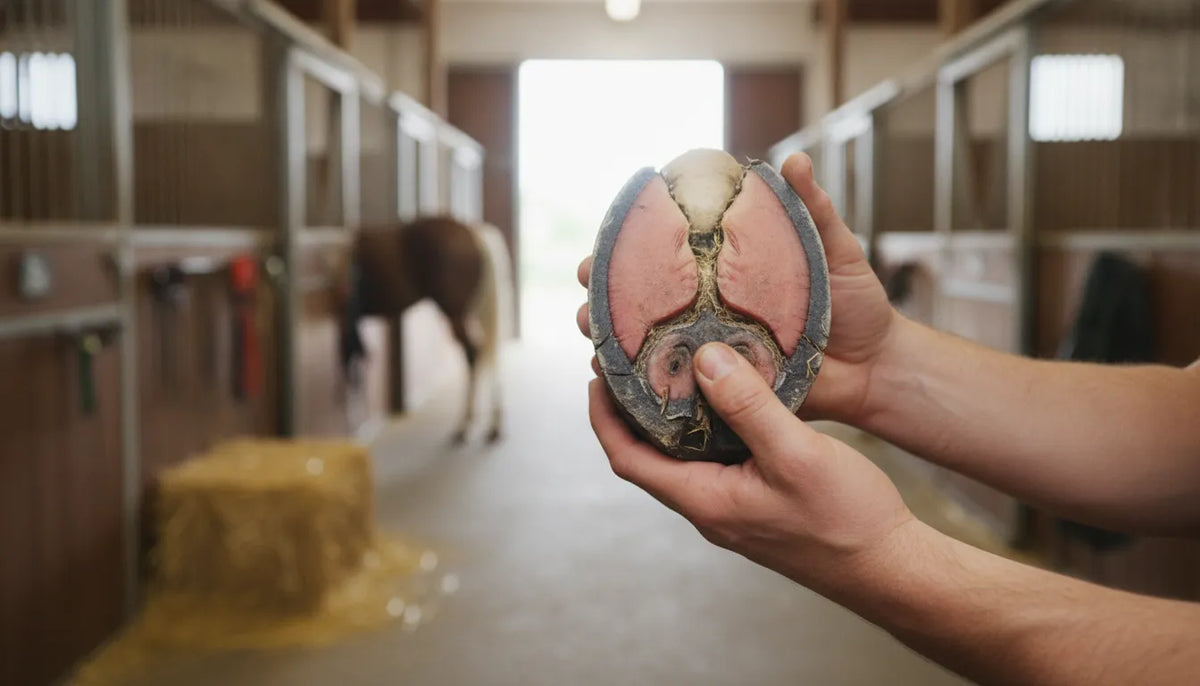
Horse hoof problems often start as a small change you can see or smell before the horse looks lame. A black, soft frog points to thrush, while a sudden refusal to bear weight points to an abscess until a veterinarian says otherwise. A hot hoof, or a crack that reaches the hairline, is a separate clue that needs its own plan. Some of these changes need a farrier within the week, and a few need a veterinarian the same day. This guide sorts the common problems by what you can check in the stall. It also covers what you should not open yourself, and when a stall-rest boot is the right protection after a vet or farrier has already treated the foot.
What do horse hoof problems look like at the daily check?
Pick each foot every day, even when the horse is sound, because packed mud hides thrush, a bruise, and the start of a crack. Compare all four feet, because a problem usually shows on one foot first. You may feel more heat, a stronger pulse at the fetlock, or a smell that is not just dirty bedding. The horse may land toe-first, or it may refuse to stand square in the stall.
Look at four places on the picked-out foot. The wall should be even, without a split that climbs toward the coronet. The sole should be firm rather than flaky or purple, and the frog should be rubbery, with a shallow central cleft instead of a deep black slit. The white line, where wall meets sole, should stay tight rather than turning into a crumbly groove full of dirt.
Key Takeaway: A daily pick is the screening test. Heat plus a strong pulse plus sudden severe lameness is an abscess or a worse foot problem until a veterinarian says otherwise. A bad smell with a soft frog and no lameness is usually thrush, and it still should not wait.
Write down what you see before the details fade. A note such as "left front, hot, stronger pulse, will not stand on it" beats "he is off." If the horse was fine at breakfast and is three-legged by afternoon, treat that as urgent. Do not file that change under ordinary stiffness from a hard workout.
Which horse hoof problem matches the sign you see?
Owners often use one word, "hoof problem," for five different conditions. The American College of Veterinary Surgeons calls a hoof abscess a very common cause of sudden lameness. Most cases are handled by a veterinarian who opens the abscess for drainage, then soaks, medicates, and bandages the foot.
Thrush is a different condition. The Merck Veterinary Manual describes it as a degenerative condition of the frog. Anaerobic bacteria are thought to play a key role, often starting in the central sulcus. A crack, a bruise, and white line disease sit between those two extremes.
| Problem | What you notice | Who should see it |
|---|---|---|
| Hoof abscess | The horse is suddenly very lame, and the hoof feels hot with a stronger pulse. | Call a veterinarian or farrier the same day, and do not open the sole yourself. |
| Thrush | The frog is black, soft, and smelly, and the horse may still be sound. | Ask the farrier to see it soon, and call a veterinarian if the horse is lame. |
| Sole bruise | The stride shortens after rocky ground, and the sole is tender to pressure. | Ask the farrier if it lingers, and call a veterinarian if heat or a strong pulse appears. |
| Hoof crack | The wall has a split, and the split is more serious when it reaches the coronet. | Ask the farrier to balance the foot, and call a veterinarian if the horse is lame. |
| White line disease | The white line is crumbly, and dirt packs into the seam between wall and sole. | Ask the farrier to remove damaged horn, and call a veterinarian if the horse is lame. |
Quick Summary: Match the sign before you match a product. Smell and a soft frog point to thrush. Sudden three-legged lameness points to an abscess until proven otherwise. A split wall is a crack. A chalky seam is white line disease. A tender sole after rocks is often a bruise.
Our thrush treatment guide covers the daily cleaning routine once you know the problem is thrush. Our hoof crack guide covers crack types and home care after the farrier has a plan. This page stays with the sorting step, so you do not treat a crack like an abscess or mistake an abscess for ordinary dry hoof.
When is a horse hoof problem an emergency?
Severity depends on whether sensitive tissue is involved. A superficial change in the frog can wait for a farrier appointment, but infection beneath the sole, a penetrating puncture, or inflammation of the laminae cannot. Those situations need a veterinary examination rather than another day of observation.
Call your veterinarian the same day if the horse will not bear weight. Also call if the coronet is swollen or you see drainage. Call if you see blood, or if the horse has a fever or will not eat. A nail or a sharp rock in the sole or frog is also a same-day call. Do not soak a puncture and hope. The American College of Veterinary Surgeons lists hoof testers, a careful opening of the sole, and radiographs as veterinary tools. Those are clinic tools, not stall tools.
Call the same day, and say it may be laminitis, if more than one foot is hot. Do the same if the horse rocks back onto the heels. A known founder risk that is suddenly sore on hard ground belongs in that call too. Founder is neither a thrush problem nor a boot problem, and it needs a veterinarian before you choose any product.
A farrier visit can wait until the next scheduled stop only in a narrow case. The horse is sound, the frog is only mildly dirty, and any crack is shallow and clear of live tissue. If you are unsure, send a photo of the picked-out sole and a short video of the horse walking. Most vets would rather see a false alarm than a hoof opened with a dirty knife.
Key Takeaway: Same-day veterinary care: non-weight-bearing lameness, a puncture, blood or pus, swelling at the coronet, or more than one hot foot. Farrier this week: sound horse, smelly frog, or a shallow crack. Never cut into a sole to "let it drain."
How should you protect a hoof after the vet or farrier treats it?
Once a veterinarian or farrier has drained an abscess or packed a bruise, the next failure is usually dirt. A cotton wrap that slips puts the opening back in manure. So does a duct-tape pad full of shavings, or a boot that falls off in the stall. A medicine boot is a stall-only cover. It keeps a poultice or bandage clean for a short recovery. It is neither a trail boot nor a turnout boot.
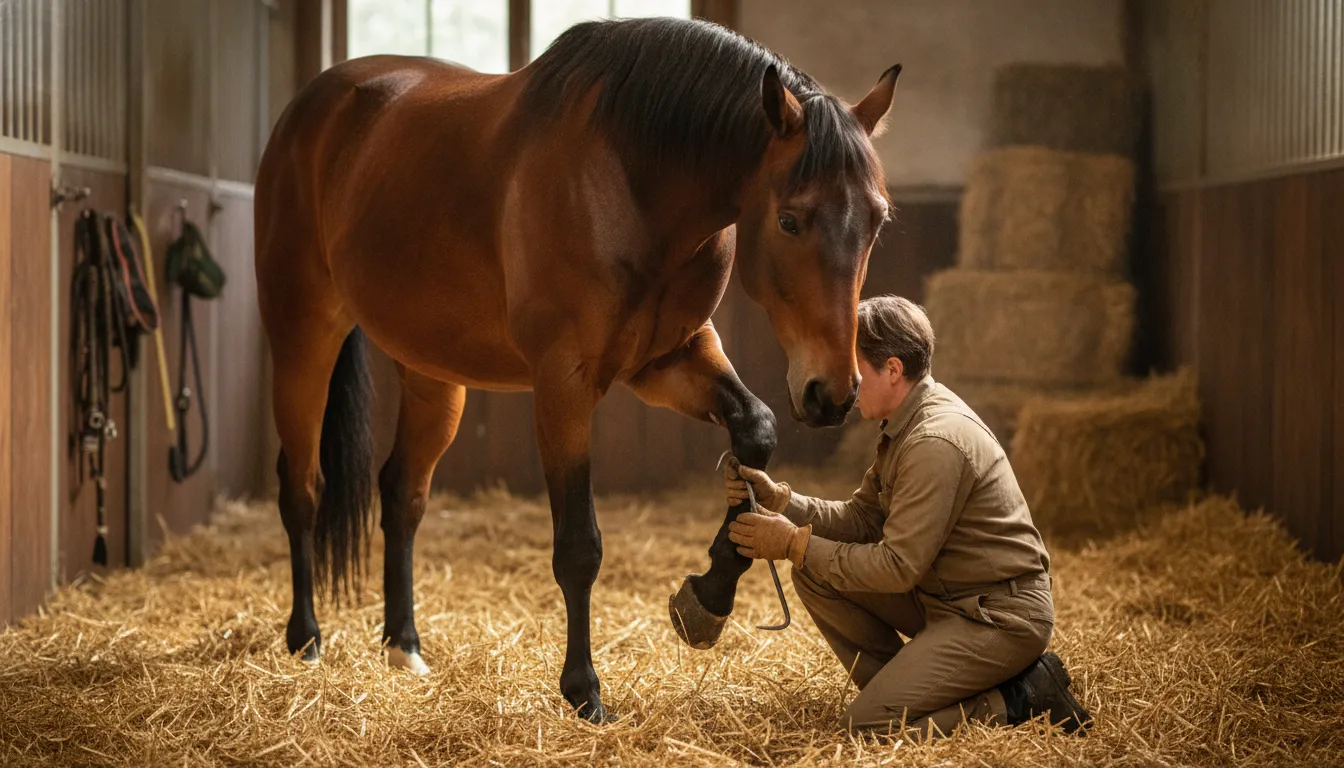
The Classic Equine Medicine Hoof Boot is built for that stall-rest window. The Hooves and Paws product page lists it for abscesses, bruised soles, puncture wounds, and poultice protection.
- The page describes a heavy-duty zipper and a textured rubber tread for stall mats or concrete aisles.
- Sizes are 00, 0, 1, and 2. It can go over a bare hoof, a shod hoof, or a bandage.
- The maker rates it for about two to three weeks of stall rest. The page says it is stall use only, not for riding, turnout, or pasture.
- Boots are sold one at a time, so you order the foot that is hurt rather than a pair by default.
Measure the hoof at its widest point, and size up if a thick bandage has to fit under the zipper. Confirm the size you need on the product page before you order, because fit is what decides the boot.
Use the boot only the way your veterinarian or farrier describes. A common pattern is a drained abscess, a poultice or drawing pad, then the boot in a clean stall, removed once a day for inspection. If the horse is more lame the next day, the coronet swells, or the discharge smells worse, take the boot off and call. A boot can hide a worsening foot just as easily as it hides shavings from the stall.
For the wider shelf of oils, dressings, hardeners, and conditioners, use our hoof care products guide and the hoof care collection. Those pages help you choose a topical, but they do not replace a diagnosis from your veterinarian or farrier. Trail boots and barefoot boots are a separate buying question, and they are covered in our hoof boots guide.
What can you do at home while you wait, and what should you skip?
- Pick the foot and note heat, pulse, smell, and whether the horse will bear weight.
- Stall the horse on clean, dry bedding if it is lame.
- Photograph the picked-out sole and send a short walking video to your vet or farrier.
- Soak only if that person has already told you to soak.
- After they drain or pack the foot, cover the dressing with a stall-only medicine boot and recheck it daily.
While you wait for the farrier or vet, pick the foot and stand the horse on clean, dry bedding. Keep a lame horse in a stall or a small dry pen. A brief warm-water soak in a clean bucket is reasonable for a suspected abscess only if your vet or farrier has already said to soak. Do not add household bleach, peroxide, or an unlabeled thrush remedy to an open sole.
Skip the shortcuts that make a hoof problem worse:
- Do not pare the sole or frog with a knife to look for an abscess.
- Do not turn a non-weight-bearing horse out in the hope that work will walk the lameness off.
- Do not pack a dirty cleft with ointment and then leave that horse standing in a wet stall.
- Do not start a hoof hardener on a soft, infected frog, because hardener is meant for weak wall rather than for thrush.
- Do not ride in a medicine boot, because the Classic Equine page limits this model to stall use only.
Thrush prevention is mostly housing. The Merck manual still lists wet, dirty footing and infrequent picking as common predisposing factors. It also notes that thrush can show up in well-kept horses. Dry the stall, pick the feet daily, and give the frog a chance to see air. If the central cleft is a deep split that pinches, that is a farrier and vet problem, not a spray-and-forget problem.
Cracks need balance more than oil. A hardener or dressing can support a dry wall only after the farrier decides the crack is stable. Hoof oil will not close a crack that moves, bleeds, or starts at the coronet. Send that foot to the farrier and read the crack guide before you buy a second jar.
Key Takeaway: Home care is clean, dry, and hands-off until a professional opens or balances the foot. Products from the hoof care shelf support that plan. They do not diagnose it.
How do you keep the next horse hoof problem from starting?
Conformational faults such as long toes, sheared heels, or a medial to lateral imbalance also produce chronic foot pain. Correcting those faults takes a veterinarian and a farrier working from the same plan. Trimming alone does not treat an underlying disease, and medication alone does not balance the hoof.
Most repeat hoof problems are schedule problems. Book the farrier before the toes get long, rather than after a crack appears, and keep picking the feet every day. Keep the stall drier than the run-in if the frog is already soft. Pull a loose shoe before the clinches open a path for dirt and moisture. On rocky trails, ask whether the horse needs a trail boot or a pad, which is a different product from a stall-only medicine boot.
Feed and general health still matter, but do not invent a supplement plan from a single hoof photo. A horse with repeated abscesses, a cresty neck, or a history of founder needs the veterinarian's plan before any supplement. Biotin, a hoof supplement, or a richer diet belongs in a conversation with that veterinarian, not as a substitute for drainage.
Hooves and Paws is a family-owned retailer in Apple Valley, California. We have sold horse, dog, and cat supplies since 1994, with a 365-day satisfaction guarantee. The hoof care collection is the shelf we use for this topic: picks, topical hoof care, and medical boots. Free ground shipping in the continental U.S. has no minimum. If you are choosing a size for a bandaged hoof, call the shop at +1 (760) 247-5523 before you order. A boot that will not zip over the wrap is the wrong size, not a defective boot.
Keep a small stall kit where you pick feet. Include a hoof pick, a clean bucket, and one medicine boot in the size your horse actually wears. Add vet wrap only if your vet has shown you how to use it. The horse health and first aid collection is the wider barn kit. For this problem, start with the foot you can see today.
Shop hoof protection options today
Frequently Asked Questions
What are the most common horse hoof problems?
The problems owners meet most often are abscesses, thrush, sole bruises, hoof wall cracks, and white line disease. An abscess usually means sudden severe lameness. Thrush shows up as a soft, black, smelly frog. Bruises follow hard or rocky ground. Cracks and white line disease change the wall or the white line and may or may not make the horse lame right away.
How can I tell an abscess from thrush?
Thrush is mainly a frog problem: black, soft tissue and a rotten smell. The horse is often still usable. An abscess is infection under the sole or at the white line. The horse is often suddenly very lame, with heat and a stronger pulse. When lameness is severe, call a veterinarian or farrier instead of treating it as thrush.
Can I drain a hoof abscess myself?
No, you should not. Opening the sole can drive dirt into live tissue or miss the abscess entirely. The American College of Veterinary Surgeons describes abscess care as a veterinarian opening the sole for drainage, then soaking, medicating, and bandaging the foot. Your job is to keep the horse stalled and pick the foot. Get professional help the same day rather than waiting overnight.
When should a medicine boot be used?
Use a medicine boot after a vet or farrier has drained, packed, or bandaged the hoof and wants that dressing kept clean during stall rest. The Classic Equine Medicine Hoof Boot is sold for that short recovery, about two to three weeks. The product page limits it to stall use, so it is not a riding boot or a turnout boot.
Does a smelly frog always mean the horse needs a vet today?
Not always, because a mildly smelly frog on a sound horse is a farrier and hygiene problem. Pick daily, dry the stall, and treat as your farrier directs. Call a veterinarian if the horse is lame or the cleft is deep. Call if you see blood or proud flesh, or if more than one foot is suddenly hot.
What should a healthy hoof look like between farrier visits?
Between visits, the wall stays intact, the sole stays firm, and the frog stays rubbery with a shallow central cleft. The white line is tight. The horse stands square and walks without a head bob. Any new heat, pulse, smell, or crack that grows between visits is worth a photo to your farrier before the next scheduled appointment.


