


A slow feeder dog bowl can turn a meal that disappears in seconds into a calmer, more controlled routine. By placing ridges, channels, or other obstacles between your dog and the food, it encourages smaller bites and more deliberate eating. The right design can also add light mental enrichment, but it should never frustrate your dog or be treated as a substitute for veterinary care.
Shop Dog Feeding and Health Essentials
Why Do Some Dogs Eat So Quickly?
Fast eating can come from habit, competition, excitement, a highly food-motivated personality, or an underlying health concern. A slow feeder changes the mechanics of the meal, but it does not explain why a particular dog is unusually hungry.
Dogs may gulp food because they learned to compete with littermates, share a home with other pets, become highly excited at mealtime, or simply have a strong appetite. Some dogs also eat faster when their food is especially easy to scoop, such as a shallow pile of dry kibble in a wide bowl. In a multi-dog home, feeding dogs in separate spaces can help when competition is part of the pattern.
Fast eating can involve large bites and swallowed air. Some dogs then burp, regurgitate, vomit, or seem uncomfortable after the meal. Those signs deserve attention, especially when they are new, persistent, or accompanied by changes in weight, thirst, stool, or energy. A bowl can be a useful management tool, but it is not a diagnostic test.
Before shopping, observe the behavior. Does your dog finish dry food quickly but take longer with wet food? Do they chew the bowl or try to flip it? Do they guard food from other pets? Does the pace change when the meal is divided into smaller portions? These details will guide the design and difficulty level better than breed labels alone.
How Does a Slow Feeder Dog Bowl Work?
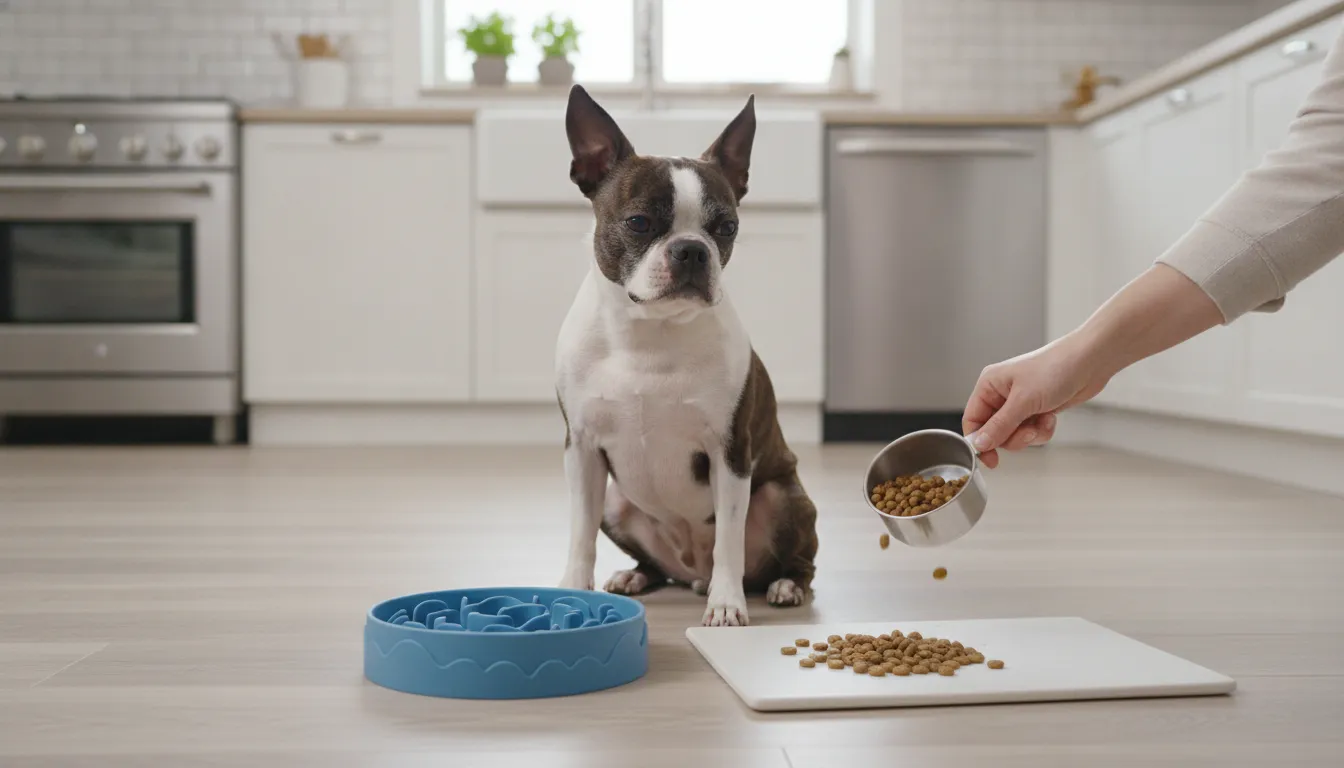
A slow feeder dog bowl uses physical barriers to make the easy scoop and swallow motion harder. Your dog has to move the tongue and nose around the pattern, which usually extends mealtime and encourages smaller bites.
Most slow feeders use raised sections, grooves, channels, or a center obstacle. Instead of taking a large mouthful from an open surface, your dog works around the pattern to reach individual pieces of food. The effect is simple: the meal takes longer and the dog has more opportunities to pause.
Research on go-slow feeders has found that dogs can eat more slowly from them than from standard bowls, although dogs may become more efficient with practice. That means a slow feeder is a management aid, not a permanent guarantee that eating will remain slow. Rotating between appropriate designs, dividing meals, and supervising the routine may help preserve its usefulness.
Some dogs find the extra effort satisfying, while others find a difficult maze stressful. If your dog paws at the bowl, barks, abandons the meal, or becomes tense around it, the design is asking for too much. Reduce the challenge or try a different feeding method.
Types of Slow Feeder Bowls and Feeding Tools
There is no single best pattern for every dog. Start with the food, facial shape, chewing habits, and space where the meal will be served.
| Type | Best fit | Watch for |
|---|---|---|
| Maze or ridge bowl | Most dry-food eaters who need a clear pace change | Deep, tight channels can frustrate short-snouted dogs |
| Raised-center or flower pattern | Dogs who need a mild challenge and easy access between meals | High projections may not suit every muzzle |
| Stainless steel slow feeder | Chewers or households that prefer a durable, nonporous surface | Check that the shape is stable and the edges are smooth |
| Food-grade silicone mat or bowl | Wet food, soft food, travel, or dogs who need a flexible shallow surface | Inspect for chewing damage and confirm it stays in place |
| Food-dispensing toy | Dogs who enjoy rolling, nudging, and working for small portions | It may be too stimulating or noisy for some routines |
Snuffle mats and lick mats are related enrichment tools rather than traditional bowls. They can extend a meal or part of a meal, but they require their own cleaning routine and should be used on a clean surface. For a dog who eats wet food, a textured lick surface may be more practical than a deep kibble maze.
What Should You Look for When Choosing One?
The safest choice matches your dog's muzzle, meal size, chewing behavior, and tolerance for challenge. A simple, stable feeder that your dog uses comfortably is more useful than a complicated design that sits untouched.
1. Match the pattern to your dog's face
A long-snouted dog may handle a deeper maze than a short-snouted dog, but individual fit matters more than a breed label. Flat-faced dogs often need a shallow pattern with open spaces so they can reach food without pressing the face into deep channels. A puppy or senior dog may also need an easier layout, even if the same dog could manage a harder puzzle at another life stage.
2. Choose a difficulty your dog can solve
Look for a feeder that slows the meal without turning it into a contest. Begin with broad channels or a few low obstacles. You can add challenge later if your dog finishes comfortably and shows interest. Avoid designs with small removable pieces for dogs who chew or carry their bowls.
3. Consider food texture and portion size
Dry kibble may work well in a maze with rounded channels. Wet food can pack into narrow grooves and become difficult to remove, so a shallow textured surface may be easier to use and clean. If your dog receives a large meal, choose a surface with enough room to spread the portion without stacking food into one inaccessible pocket. Never reduce a prescribed daily ration simply because a feeder makes the meal last longer.
4. Prioritize stability and safe materials
A non-slip base, wide footprint, or suction feature can reduce sliding and flipping. Stainless steel is nonporous and durable. Food-grade silicone is flexible and useful for shallow patterns. Plastic can be practical when it is sturdy and free from cracks, but inspect it regularly. Ceramic can be heavy and stable, yet chips and cracks should be treated as reasons to replace it.
5. Make cleaning realistic
Every ridge and channel is a place where food residue can collect. A feeder that is technically effective but difficult to wash may become a hygiene problem. Check the manufacturer's care instructions, confirm whether it is dishwasher safe, and make sure you can reach all surfaces with a brush or sponge. Wash bowls regularly, and clean them promptly after wet or fresh food.
For more help thinking through a dog's daily meals, compare this guide with Hooves and Paws' dog food selection guide. The food itself, portion, and feeding schedule matter as much as the bowl.
Is a Slow Feeder Safe for Puppies and Flat-Faced Dogs?
Puppies and flat-faced dogs can use an appropriately fitted slow feeder, but they need an easy starting pattern, close supervision, and a design that does not force the face into deep or narrow spaces.
Age, facial shape, and behavior should guide the choice. For a puppy, use a stable feeder with a simple pattern and watch the first several meals. Puppies may chew, paw, or carry new objects, so remove the feeder if pieces break off or the puppy treats it as a toy. Ask your veterinarian how a feeding change fits with the puppy's growth plan and food portions.
For brachycephalic dogs, look for shallow grooves, low ridges, and a broad eating surface. The dog should be able to breathe normally and reach food without repeatedly burying the nose or pressing the face against the bowl. If the dog struggles, a shallow silicone mat, hand-feeding during training, or another veterinarian-approved option may be a better fit.
Supervise any new feeder, especially when the dog is a powerful chewer or when the bowl contains wet food. Stop using it if you see broken material, sharp edges, coughing, repeated gagging, or escalating frustration.
How Do You Introduce a Slow Feeder?
Make the first experience easy. Put a small portion of the normal meal in the new feeder and leave enough food near the most accessible areas that your dog can succeed immediately. Praise calm exploration, but do not crowd the dog or take the feeder away while they are eating.
- Start with a simple, shallow pattern.
- Use the dog's familiar food rather than changing the diet and bowl at the same time.
- Watch the first several meals for chewing, coughing, frustration, or bowl flipping.
- Keep the difficulty steady until the dog eats comfortably.
- Increase challenge only when the dog remains relaxed and finishes the meal.
- Try a different style if the dog repeatedly abandons food or becomes tense.
If several dogs eat together, use separate feeding areas before assuming the bowl itself is the whole solution. Reducing competition can be as important as adding obstacles. A calm, predictable routine also helps dogs that become overstimulated when food appears.
Find Dog Health and Feeding Essentials
Cleaning and Daily Care
Clean the feeder as carefully as you would a standard food bowl. Empty leftover food after the meal, separate any removable parts, and wash the channels, underside, and non-slip base. Follow the manufacturer's temperature and detergent instructions if the feeder is dishwasher safe. Otherwise, use warm water and dish soap with a brush that reaches the narrowest areas.
Inspect the bowl during washing. Replace it if the surface is cracked, deeply scratched, peeling, or damaged by chewing. A rough or broken surface can trap residue and make reliable cleaning difficult. Keep a second clean bowl available if the feeder needs to dry before the next meal.
When a dog eats wet or fresh food, clean the feeder after every use. Dry kibble still leaves oils and crumbs behind, so regular washing remains important. For additional food-handling guidance, see the fresh dog food storage guide.
Can a Slow Feeder Prevent Bloat?
A slow feeder may reduce rapid gulping for some dogs, but it cannot guarantee prevention of bloat or gastric dilatation-volvulus, commonly called GDV. Research on the relationship between eating speed and GDV is mixed, and a bowl does not remove other risk factors. Treat it as one practical feeding adjustment, not as medical protection.
Learn the warning signs of an emergency: repeated unproductive retching, a swollen or painful abdomen, sudden restlessness, heavy drooling, weakness, rapid breathing, or collapse. If these signs appear, contact an emergency veterinarian immediately rather than trying to solve the problem with a feeder. The MSD Veterinary Manual overview of GDV explains why rapid veterinary treatment matters.
Contact your regular veterinarian when fast eating is new or extreme, when your dog is losing weight despite eating well, or when meals are followed by repeated vomiting, regurgitation, diarrhea, pain, or unusual thirst. A vet can help separate a feeding habit from a health concern and advise on portions, meal frequency, and other changes.
Shop Slow Feeding Essentials for Dogs Today
Frequently Asked Questions
Do slow feeder dog bowls really work?
They often extend mealtime by making it harder to scoop and swallow large mouthfuls. Results vary by pattern, food, and dog. Dogs can become more efficient with practice, so the bowl works best as part of a calm, supervised feeding routine.
What is the best slow feeder dog bowl for a fast eater?
The best option is stable, easy to clean, and challenging enough to slow eating without causing frustration. Start with a simple maze or low ridge pattern, then consider your dog's muzzle shape, meal texture, chewing habits, and portion size.
Can a puppy use a slow feeder dog bowl?
Many puppies can use one when the pattern is shallow and easy to solve. Supervise the first meals, watch for chewing or frustration, and ask your veterinarian about portions and feeding changes during growth.
Are slow feeder bowls good for flat-faced dogs?
They can be, but flat-faced dogs usually need a broad, shallow design with open access to the food. Avoid deep mazes that force the nose into narrow spaces. Stop if the dog struggles to breathe, reach food, or remain comfortable.
How often should you clean a slow feeder bowl?
Wash it after every wet or fresh-food meal and on a regular schedule for dry kibble. Clean every channel and the underside, follow the manufacturer's instructions, and replace the feeder if it becomes cracked, rough, or damaged.
Can a slow feeder stop a dog from getting bloat?
No. A slow feeder may help reduce rapid eating, but it cannot guarantee prevention of bloat or GDV. Learn the emergency warning signs and seek immediate veterinary care for retching, abdominal swelling, pain, weakness, or collapse.


