


A feeding amount that looks reasonable in a bowl is not necessarily the right amount for every dog. Weight, life stage, activity, body condition, and whether a dog is spayed or neutered can all change the daily estimate. Treats and other extras count too.
A dog calorie calculator provides a starting estimate of daily energy needs, not a guaranteed prescription. Most tools use body weight and additional details to approximate resting needs, then apply a factor for the dog's circumstances. For context, Ohio State's nutrition service gives an example of about 400 Calories per day for a healthy-weight, 22-pound adult neutered dog at rest, while noting that individual needs can vary substantially. Review the Ohio State formula and guidance.
Use the result as a measured starting point, compare it with the food label, and watch your dog's body condition over time. The next step is understanding what the number represents, and what it leaves out.
What Does a Dog Calorie Calculator Actually Estimate?
A dog calorie calculator estimates how much energy your dog may need in a day. It is not measuring calories burned in real time, and it cannot account perfectly for every dog's metabolism, health, activity, or body condition. Think of the result as a practical starting point for discussing portions and monitoring your dog's weight, not as a fixed prescription.
On food labels, energy is usually listed as kilocalories, abbreviated kcal. In everyday nutrition language, one kilocalorie is commonly called one Calorie. Your dog's daily estimate describes energy intake, not the amount of food by volume. The same number of calories can come from different amounts of kibble, canned food or treats, so the food's kcal information matters when you convert an estimate into portions.
RER and MER in plain language
Resting energy requirement, or RER, is an estimate of the energy a dog needs for basic body functions while resting. A common Ohio State formula is RER = 70 x body weight in kilograms raised to the 0.75 power. For example, Ohio State illustrates that a 10-kilogram dog, about 22 pounds, has an RER of approximately 400 Calories per day.
Maintenance energy requirement, or MER, goes beyond resting needs. A calculator applies a factor to RER to account for circumstances such as life stage, activity, and reproductive status. That adjusted figure is intended to estimate total daily energy needs, not guarantee the exact amount your dog should eat. Ohio State's companion-animal nutrition guidance notes that these calculations are starting points and that individual needs can vary substantially.
Key Takeaway
Use the calculator to establish a reasonable starting estimate, then watch body condition and discuss meaningful feeding changes with your veterinarian. A calculator is educational support, not veterinary advice.
Which Details Should You Enter in a Dog Calorie Calculator?
A calculator can only be as useful as the information you enter. Before accepting its daily estimate, gather your dog's current weight, target or ideal weight, body condition, reproductive status, age, activity level, and feeding goal. These details help the tool distinguish a healthy adult maintaining weight from a growing puppy, an active working dog, or a dog that needs professional weight-management support.
Use an accurately measured weight, identify whether it is current or ideal, and select the closest body condition, life stage, activity, and goal options. Treat the result as a starting estimate, not a fixed prescription.
Weight and body condition
Enter your dog's current weight in the unit the calculator requests, preferably from a recent, reliable measurement. Then check whether the tool asks for current weight or ideal weight. If your dog is overweight, using current weight for a maintenance calculation may preserve the very weight you are trying to change. Some tools instead use a lower target weight for certain goals, so read the instructions carefully rather than substituting a guess.
Body condition score, or BCS, adds context that the scale cannot provide. A common system runs from 1, severely underweight, to 9, clinically obese, with 5 representing ideal weight in the Purina Institute's reference scale. Ideal BCS can vary by breed, so ask your veterinary team if you are unsure how to score your dog. The Pet Obesity Prevention calculator defines its healthy-body-condition use case as BCS 4 to 5 out of 9 confirmed by a veterinary team. Sources: Purina Institute's MER calculator and the Pet Obesity Prevention calculator.
Life stage, activity, and goal
Select whether your dog is still growing, a healthy adult, senior, pregnant or nursing, or has a health or feeding concern. Puppies have different nutritional needs during rapid growth. Senior status also depends partly on size: Purina Institute lists toy and small breeds at 8 years or older, medium breeds at 7 or older, and large or giant breeds at 6 or older. Choose an activity level based on your dog's consistent routine, not an occasional long walk.
Finally, state the goal: maintain current weight, reach or maintain an ideal weight, or support a weight-change plan. Maintenance estimates are not automatically weight-loss plans. If your dog's BCS is 7/9 or higher, or weight is changing unexpectedly, involve your veterinary team before reducing food. The Pet Nutrition Alliance explains that its calculator is designed to support veterinary nutritional assessment, and recommendations may need adjustment as progress is monitored: read its calculator guidance.
Shop This Post

Featured in this article
Zymox Otic Pet Ear Care with 0.5% Hydrocortisone - Enzymatic Ear Solution for Dogs & Cats - 1.25 oz
$22.49
Shop Now →


How Accurate Are Dog Calorie Calculator Results?
A dog calorie calculator is useful for establishing a reasonable starting point, but it cannot measure your dog's exact daily energy requirement. Ohio State's veterinary nutrition service notes that individual needs can vary by as much as 50% from calculated values. Its calculations are therefore best treated as crude, changeable estimates rather than fixed feeding instructions.
That variability can reflect activity, age, body condition, reproductive status, metabolism, health, and ordinary differences between individual dogs. Even a carefully entered calculation may be too high or too low for one specific animal. The right question is not whether the number is perfect on day one, but whether it provides a sensible baseline that you can evaluate safely over time.
A calculator result is guidance only. Use it as a starting estimate, then monitor body condition and discuss meaningful feeding changes with your veterinarian.
| Approach | What it can tell you | Important limitation |
|---|---|---|
| Calculator estimate | Provides a daily calorie starting point from inputs such as weight, life stage, activity, and reproductive status. | It uses general factors and may differ substantially from your dog's actual needs, including variation of up to 50%. |
| At-home monitoring | Shows how your dog responds to the starting amount through body weight, visible shape, and body condition over time. | Home observations can be inconsistent, and sudden changes may indicate a health issue rather than a simple portion problem. |
| Veterinary plan | Combines examination, health history, body condition assessment, and progress to create individualized guidance. | It still may require follow-up adjustments as your dog's health, activity, or circumstances change. |
For at-home monitoring, pay attention to body condition rather than relying only on the scale. Look for changes in the waist, abdominal tuck, and the amount of fat covering the ribs. A body condition score helps make that assessment more consistent, but your veterinarian can confirm the score and explain what is appropriate for your dog's breed and build.
Ohio State advises adjusting feeding amounts up or down as needed to maintain a healthy body condition score. The Ohio State nutrition guidance also emphasizes that calculated values are starting points. Similarly, the WSAVA calorie guidance applies to average healthy adult dogs in ideal body condition and states that its recommendations are for guidance only. If weight changes unexpectedly, body condition is difficult to assess, or your dog has a medical condition, ask your veterinary team to review the estimate before changing portions substantially.
How Should Calories Change by Life Stage and Activity?
A dog's calorie estimate should change as growth, metabolism, exercise, and reproductive demands change. Life stage matters because a growing puppy is building tissue, while an older dog may move less and burn energy more slowly. A dog calorie calculator can provide a starting point, but it cannot account for every individual health factor.
Use life stage and activity as estimate inputs, then monitor body condition and discuss major feeding changes with your veterinarian. Puppies, pregnant or nursing dogs, seniors, and dogs with health concerns need extra caution.
Puppies and growing dogs
Early growth brings higher nutrient needs because puppies develop rapidly during their first months. Their requirements also change as they approach adult size, so a puppy's estimate should not be treated as a fixed daily target. Recheck portions as weight, body condition, breed size, and growth progress change. The Pet Obesity Prevention calculator separates dogs that are still growing from healthy, fully grown adults for this reason.
Adults, seniors, and activity levels
Healthy adult dogs may need different amounts depending on whether they are inactive, moderately active, or participating in sustained work, sport, or strenuous exercise. Count regular exercise honestly, but avoid labeling a dog highly active based on occasional bursts of play. Senior status also varies by size. Purina Institute lists toy and small breeds as senior at 8 years or older, medium breeds at 7 or older, and large or giant breeds at 6 or older. Seniors often have slower metabolism and less activity, although disease or changing mobility can alter the picture. Review portions when routine, exercise, or body condition changes.
Pregnancy, nursing, and health concerns
Pregnancy and nursing can substantially change nutritional demands, while medical conditions may affect appetite, digestion, mobility, or metabolism. Do not use a general calculator to set a feeding plan for a pregnant or nursing dog, a puppy with poor growth, or a dog with an illness. The Pet Obesity Prevention tool specifically distinguishes pregnant or nursing dogs and dogs with health or feeding concerns from its healthy-adult use case. Ask your veterinary team for an individualized target, especially if weight changes unexpectedly.
For all life stages, treat the result as a starting estimate. Ohio State notes that nutritional needs vary by life stage and that food amounts should be adjusted to maintain a healthy body condition.
How Do You Turn Daily Calories Into Food Portions?
A daily calorie estimate becomes a portion only after you match it to the calorie information for the food you are feeding. Start with the total daily kcal from your dog calorie calculator, then divide that number by the food's kcal per measurable unit. Keep the unit consistent so a cup, can, pouch, or gram does not get confused with another.
- Find the food's calorie statement. Check the package or manufacturer's feeding information for kcal per cup, can, pouch, 100 g, or gram. These are different bases. If the label says 400 kcal per cup, use cups in your calculation. If it says 120 kcal per 100 g, weigh the food in grams and convert from that basis. The Pet Obesity Prevention calculator specifically identifies these label formats as inputs, so record the unit before measuring. Review the calculator's portion guidance for the label details.
- Divide daily calories by calories per unit. Use this simple formula: daily portion = daily kcal target divided by kcal per unit. For example, a 600 kcal daily target divided by 400 kcal per cup equals 1.5 cups per day. That is the full day's amount, not the amount for each meal.
- Split the daily amount into meals. If your dog's routine includes two meals, divide the daily portion between them. Measuring each meal consistently is more reliable than estimating with a scoop that may be overfilled. For wet food, apply the same process to cans or pouches, and account for partial containers according to their stated kcal value.
- Include treats and extras in the total. Treats, chews, toppers, table food, and other extras are not calories to add on top of the daily target. General guidance is to keep treats and extras at 10% or less of daily calories. If extras are part of the routine, reserve that allowance and reduce the main food portion accordingly. Compare dog food calorie information before changing formulas, and portion fresh dog food safely when using a fresh format.
- Measure, observe, and reassess. Treat the result as a starting portion, not a guaranteed requirement. Reference factors are not minimum or maximum safe intakes, and portions may need review as your dog's body condition, activity, or health changes. Ask your veterinary team before making significant feeding changes.
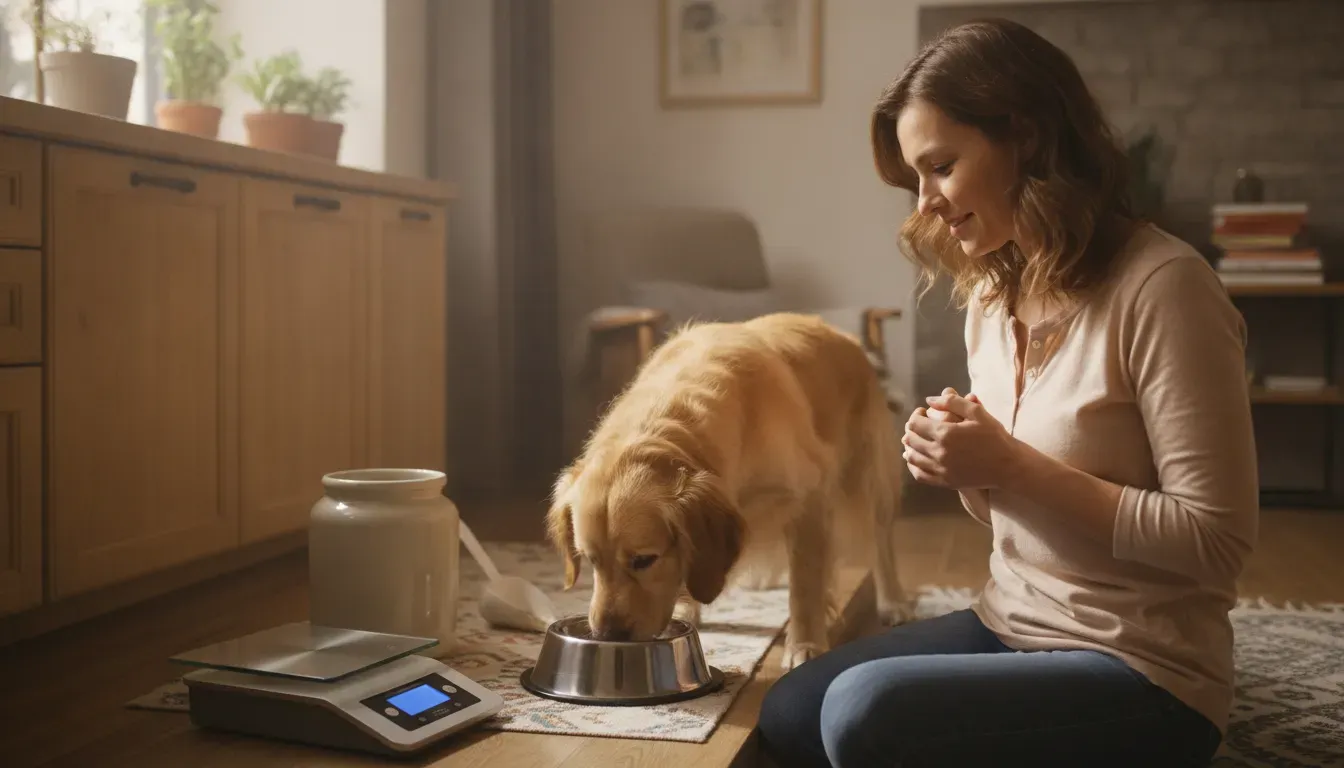
Convert calories into portions by dividing the daily kcal target by the food's kcal per cup, can, pouch, 100 g, or gram. Count treats and extras within that daily total, generally keeping them at 10% or less.
Because individual needs vary, monitor your dog's body condition rather than relying on the calculator alone. The calculator source describes its figures as starting estimates, so a veterinarian can help interpret the result when weight, appetite, or health concerns are involved. See the source guidance.
When Should a Veterinarian Review the Estimate?
A dog calorie calculator is a useful starting point, not a diagnosis or a complete feeding plan. Ask your veterinarian to review the estimate before making major changes if your dog is losing or gaining weight unexpectedly. Veterinary review is also important when your dog has a body condition score (BCS) far from ideal or a medical condition that may affect appetite, digestion, metabolism, or nutrient needs.
Weight changes and body condition concerns
Contact your veterinary team if your dog's weight changes without an intentional feeding or activity change. A calculator may also be the wrong tool for deciding how to manage obesity or marked thinness. BCS is commonly scored from 1 to 9, but breed and body type can affect how an individual dog should look. Have your veterinarian confirm the score and identify an appropriate goal weight rather than relying on an online number.
The Pet Nutrition Alliance advises that pets with obesity at BCS 7/9 or higher follow a weight-loss program under the direct guidance of the veterinary health care team. Its calculator is designed to support veterinary nutritional assessment, and recommendations may need adjustment as progress is monitored. Review the Pet Nutrition Alliance guidance with your veterinarian.
Life stage, illness, and feeding changes
Use extra caution with puppies, pregnant dogs, and nursing dogs. Growth and reproduction create nutritional demands that a general maintenance estimate may not capture. A veterinary review is also appropriate for seniors, dogs with chronic disease, dogs taking medication, or any dog whose appetite, thirst, stool, energy, or eating habits have changed.
If digestive symptoms accompany a feeding change, discuss the pattern before switching foods or restricting calories. Our guide to digestive support dog food options can provide background for that conversation. If itching, recurring ear problems, vomiting, or suspected food sensitivity is part of the concern, use our guide to choose dog food for allergies as an educational resource, not as a substitute for diagnosis.
Choosing Practical Dog Wellness Supplies After You Calculate
Once you have a reasonable calorie estimate, organize the rest of your dog's routine around accurate portions, regular observation, and supplies that make daily care easier. A calculator can help you think through feeding needs, but it does not determine whether an individual supplement, toy, collar, or other product is appropriate for your dog.
Use the calorie result as a starting point for feeding decisions. Dog wellness supplies can support an organized care routine, but they do not replace veterinary guidance or provide a personalized calorie plan.
Hooves and Paws serves dog owners and multi-pet households with a catalog that includes dog health and wellness products alongside equestrian and cat supplies. Depending on your routine, that category may help you find practical items such as health supplements, toys, collars, CBD products, or outdoor gear in one place. Choose based on your dog's age, needs, environment, and your veterinarian's recommendations when health concerns are involved.
Keep the boundaries clear: the retailer's available information does not provide dog calorie formulas, feeding recommendations, product calorie values, or evidence that a particular product supports weight management. Do not treat a wellness product as a substitute for changing portions, monitoring body condition, or getting professional advice. If your dog is losing or gaining weight unexpectedly, ask your veterinary team to review the full feeding plan before making significant changes.
For a practical starting point, browse dog wellness supplies that fit your care routine, then keep the calculator's estimate, food label details, treats, activity, and body-condition observations together in your notes. That record gives you and your veterinarian a clearer basis for deciding what should change.
Shop Dog Wellness Supplies Today
Frequently Asked Questions
How do I calculate how many calories my dog needs?
Use your dog's weight, life stage, activity, reproductive status, body condition, and feeding goal in a calculator. A common starting point estimates resting energy needs, then applies a factor for daily activity and circumstances. Treat the result as a starting estimate, not a fixed prescription. The Ohio State veterinary nutrition guidance explains the underlying formula and why portions may need adjustment.
Can I use a dog calorie calculator for a puppy?
Yes, but puppy results require extra caution because nutritional needs change quickly during growth. Enter the correct life stage and use a diet appropriate for growth rather than applying an adult estimate without review. Ask your veterinarian to confirm portions, especially for large-breed puppies, rapid growth, poor weight gain, or any health concern.
Are dog calorie calculator results accurate for every dog?
No. Calculators provide useful starting points, but individual needs can vary substantially with body condition, activity, health, and metabolism. The WSAVA calorie guidance notes that recommendations are for guidance only. Monitor weight and body condition, then make gradual changes with veterinary input when needed.
How many treats can my dog have each day?
Include treats, chews, table food, and supplements in the daily calorie total. The Pet Nutrition Alliance recommends keeping treats to no more than 10% of total daily Calories. Check package kcal information when available, measure portions consistently, and reduce the main food if extras are a regular part of the routine.
When should a veterinarian review my dog's calorie estimate?
Ask for veterinary guidance if your dog needs intentional weight loss, has a body condition score of 7/9 or higher. Is pregnant or nursing, has a medical condition, or gains or loses weight unexpectedly. The Pet Nutrition Alliance recommends direct veterinary-team guidance for obese pets and adjustments based on progress.
Ready to Support Your Dog's Everyday Wellness?
Once you have a practical calorie estimate, keep your dog's broader care routine organized around trusted, thoughtfully selected supplies. Hooves and Paws makes it easier to explore options for everyday dog health and wellness while keeping your dog's individual needs in mind. Shop dog health and wellness supplies at Hooves and Paws.


