

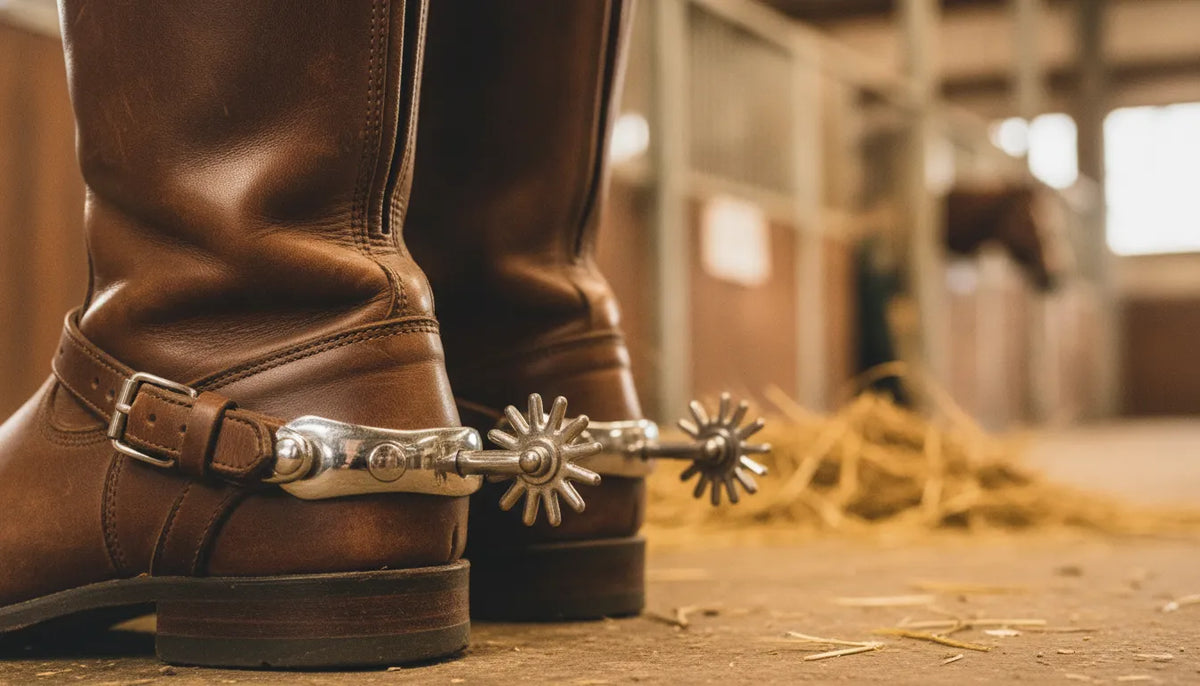
Horse spurs are small metal aids worn on the rider's boot heel to make a leg cue more precise, not stronger. Choose by discipline and experience: short necks and rounded, ball or roller ends for beginners and sensitive horses, longer shanks or rowels only for riders with a quiet, independent leg, and always within your show rules.
When you watch an experienced rider cue a horse with a subtle flick of the heel, you are watching years of practice in action. That small movement often comes from a spur tucked behind the boot. Far from the cruel device shown in movies, a properly fitted spur is a refined communication aid that lets a rider whisper cues rather than shout them. Whether you ride Western or English, understanding spur types, shank lengths, rowel designs and ethical use is essential before you strap one on. This guide covers how to choose the right spurs for your discipline, fit them correctly and use them as a tool for better horsemanship.
Horse Spurs Guide: What Are Horse Spurs and Why Are They Used?
Horse spurs are small aids designed to make a rider's leg cue more precise. They do not replace a balanced seat, quiet leg, or thoughtful training. Used correctly, a spur helps a horse understand a refined signal that may be difficult to communicate with the calf alone. It should never be used to punish, frighten, or force a horse forward.
Key takeaway: A spur is a communication tool, not a shortcut to control. Riders should earn the ability to use one through an independent seat, a stable lower leg, and consistent understanding of basic aids.
From Ancient Tools to Modern Riding Equipment
Spurs have a long history in mounted riding, and while their construction, decoration and mechanics have changed, the central purpose has stayed much the same: help the rider deliver a distinct leg aid without increasing overall force. Today you will find them in shaped stainless steel, German silver and blackened steel, in styles built around Western and English boots and leg positions.
That history does not make every spur appropriate for every horse or rider. The useful question is not whether a spur looks traditional or advanced, but whether it supports a clear, humane training conversation. A rider's balance, leg stability, the horse's education, and the intended discipline all matter when selecting equipment.
Why Precision Matters More Than Pressure
A well-timed spur can amplify a light cue for a specific response, such as moving away from the leg or improving lateral work. It should not be used simply to make a reluctant horse go faster. The leg aid comes first, and the spur is reserved for situations where a more exact signal is appropriate. The instant the horse responds, the rider should soften the aid.
AQHA judge guidance on using spurs makes the same point. A spur should never stand in for a weak leg or be a rider's first reaction; the cue starts with the seat, travels down the leg and reaches the spur last. As a rider's feel improves, the leg needs to move less.
For riders ready to compare styles, shanks, and straps, view our full selection of spurs and spur straps. Choose equipment that matches your training, not equipment that asks your horse to tolerate an unsteady leg.
Types of Horse Spurs by Riding Discipline
Spur design follows the rider's discipline, boot, leg position, and intended aid. Western and English spurs share the same basic anatomy: a band or yoke around the heel, a shank or neck extending toward the horse, and sometimes a rowel at the end. Their proportions and ornamentation, however, reflect different riding traditions and methods of communication.
| Discipline or style | Typical design | Common examples | Best suited to |
|---|---|---|---|
| English, general | Narrower bands, shorter necks, blunt or rounded ends | Prince of Wales, Tom Thumb, ball and roller spurs | Close-contact riding and riders who need a precise, restrained leg aid |
| Dressage | Metal, English style, no longer than 2 inches including any rowel under USEF DR120.4 (2026) | Plain blunt, swan neck, Impuls and smooth free-turning rowel spurs | Refining leg cues without creating unnecessary movement or leverage |
| Hunter and jumper | Smooth metal or plastic with rounded edges; no serrated rowels (USEF HU106.6, JP111.3) | Prince of Wales, hammer, Impuls and dummy spurs | Clear aids while maintaining a quiet leg |
| Western, general | Wider bands, longer shanks, larger or more decorative rowels | Cloverleaf, rosebud and multi-point rowels; bumper spurs | Western seats, Western boots and discipline-specific leg placement |
| Western ranch and show | Ornate construction with a prominent rowel and substantial heel band | Engraved and silver-trimmed Western styles | Riders who want a traditional look alongside an appropriate aid |
Western spurs commonly have longer shanks and wider bands because they are designed around Western boots and a different leg position. The larger rowels often carry decorative detail, but appearance should never be confused with severity. The shank length, rowel shape, rider's leg stability, and contact technique all affect how a spur communicates.
English spurs tend to be smaller and more streamlined. In dressage, a plain blunt spur, an Impuls spur or a swan neck can help a rider reach the horse cleanly while keeping the leg quiet. Spur maker Sprenger recommends a swan neck when there is a large gap between the rider's leg and the horse's belly, but it still requires an independent seat and thoughtful application. In hunter and jumper work, the Prince of Wales is a familiar choice because it gives a direct aid without a bulky profile; the Toklat Women's English Canted Tom Thumb Spurs are a short-necked version with rubber boot protection.
If you are new to spurs, begin with a short shank and a rounded or ball end rather than choosing a design for its decoration. The Shires Roller Ball Spurs, with a stainless steel ball that rolls freely along the horse's side, are one gentle option. A mild, well-fitted spur gives you room to develop consistent leg control. For a broader look at Western-specific options, see our Western Spurs: A Complete Beginner's Guide, then select a style that matches your discipline, boot and current level of experience.
Common Spur End Styles at a Glance
Most of the names you see on a spur wall describe the end of the shank, the part that meets the horse:
- Prince of Wales and Tom Thumb: a flat, blunt end on a short neck, common in English rings; a very short neck is usually called a Tom Thumb. Our guide to English spurs covers each English style.
- Hammer or hammerhead: another blunt English end; the 2026 USEF jumper rules list hammer spurs by name as permitted (JP111.3). Our comparison of Prince of Wales and hammerhead spurs explains the difference.
- Ball and knob: a smooth, rounded end. Sprenger recommends that beginners start with rounded or ball-shaped spurs with a short spike, and says rounded versions also suit sensitive horses. In Western styles, Weaver Leather describes its Men's 21st Century Ball Spurs as stainless steel with a 1-inch shank and a knob/ball end.
- Roller ball and disc: an end that turns as it touches the horse. Sprenger describes its roller wheel as one that "rolls gently when it touches the horse's belly, preventing friction in sensitive areas." Our roller ball spurs guide covers rolling ends in detail.
- Swan neck: a shank that curves upward to close a large gap between the leg and the horse, per Sprenger; USEF dressage permits swan necks even though other curved shanks must point down (DR120.4.1).
- Impuls and dummy: as the 2026 USEF rules describe them, Impuls (impulse) spurs have a round knob of hard plastic or metal on the shank, and dummy spurs have no shank at all. Both are permitted in dressage (DR120.4.1) and jumper classes (JP111.3).
- Rowel: a wheel that spins, from smooth discs to cloverleaf, rosebud and multi-point rowels; see the rowel section below.
- Bumper: a short, blunt Western end with no rowel, so the cue is a bump rather than a roll; the Professional's Choice Floral Bumper Spurs have a 1 1/4-inch shank and a 3/4-inch heel band.
Shop This Post

Featured in this article
Professional's Choice Floral Copper Dot Ladies Spurs, 8-Point Rowel
$135.99
Shop Now →
Understanding Spur Shank Length, Angle, and Rowel Types
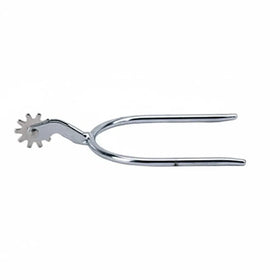
Spur design determines how precisely a rider's leg aid reaches the horse. The right combination should suit the rider's experience, discipline, leg position, and the horse's build. A longer shank or sharper rowel is not automatically better. It simply changes the timing, leverage, and feel of the aid.
How does shank length change leverage?
The shank, sometimes called the neck, is the projection from the spur's heel band toward the horse. Short necks give a mild, close-contact aid and suit disciplines where the leg stays close to the horse's side. Sprenger says its best-selling English spurs have a neck of roughly 2 to 3.5 cm (about 3/4 to 1 3/8 inches) with a slightly rounded end, and the Toklat Women's English Canted Tom Thumb Spurs go shorter still, with a 1/2-inch neck.
Western shanks generally run longer. The Weaver Leather Women's 21st Century Stainless Steel Spurs have a 1-inch shank, many of the everyday Western spurs we carry sit between 1 1/2 and 2 1/4 inches, and show and ranch styles such as the Professional's Choice Cowhand Floral Filigree Spurs reach 3 inches. A longer shank gives more reach and leverage, so it should be reserved for experienced riders with a quiet, independent leg. Sprenger's guidance also notes that riders with short legs usually need shorter spurs and riders with long legs longer ones, so the distance between your leg and the horse's barrel matters (Sprenger's spur-selection guidance).
Show rules can cap the length, too. In the 2026 USEF rulebook, dressage spurs may be no longer than 2 inches (5.08 cm) including the rowel, and FEI Pony and Children tests allow only blunt spurs no longer than 3.5 cm (DR120.4.3). The 2026 eventing rules set a 4 cm limit for the dressage phase (Subchapter EV-9).
Which shank angle fits the horse's shape?
A straight shank delivers the rowel directly from the heel. A curved or dropped shank changes the point of contact and can help the rider reach the horse without turning the toe sharply inward. A swan neck curves upward, shortening the distance between the spur and the horse's barrel. This shape can be useful for a large-barrel horse or a rider whose leg naturally sits farther from the horse's side.
Choose the shape that supports a balanced leg rather than one that compensates for an unstable position. The spur should refine an existing aid, not make up for inconsistent lower-leg control.
How do rowel types affect the feel?
The rowel is the rotating contact piece at the end of the shank. Disc rowels and rollers are among the softest options, and Sprenger recommends disc-rowel spurs for sensitive horses. Thicker, rounder rowels feel softer, while serrated rowels feel stronger, and every rowel must spin freely, so clean them regularly. The Shires Humane Rowel Spurs take the roller idea further, with four brass rollers set horizontally so they glide along the horse's side. Among Western designs, cloverleaf and rosebud rowels such as those on the Weaver Leather Men's Stainless Steel Roping Spurs are common mild choices.
Show rules draw firm lines here. The 2026 USEF hunter, jumper and hunter seat equitation chapters do not permit rowels with serrated edges (HU106.6, JP111.3, EQ106.3), and dressage rowels must be blunt or smooth and free to rotate (DR120.4.1). Beyond the rules, rowel choice should reflect the rider's skill and the horse's responsiveness.
What are spurs made of?
Most spurs are stainless steel. Sprenger says its spurs are made of high-quality stainless steel or German silver and have no sharp edges that could injure the horse or damage the leather of the boot. Western pairs also come in black, raw, copper-plated and chrome-plated steel, often with engraving or German silver trim, as on the Weaver Leather Men's Engraved Stainless Steel Spurs, and Shires makes a plastic roller ball spur for English riders. Material matters for showing: USEF dressage requires metal spurs (DR120.4), although Impuls spurs may carry hard plastic knobs, while the hunter and jumper rules allow smooth metal or plastic (HU106.6, JP111.3).
The spurs and straps we carry come from Weaver Leather, Professional's Choice, Shires and Toklat. We don't carry Herm Sprenger or Stübben spurs; Sprenger is quoted here only from its own published guidance.
What do Western and rodeo rules say?
Western rules focus more on how spurs are used than on their design. In the 2026 USEF Western Division, spurs are listed as optional attire (WS104.2), and several ranch classes penalize spurring in front of the cinch, including Ranch Trail (WS142.5) and Ranch Reining (WS143.4). Rodeo associations set their own equipment rules: the National Intercollegiate Rodeo Association's 2026-2027 animal welfare rules say spurs must be dulled and that no locked rowels, rowels that will lock, or sharpened spurs may be used on bareback horses or saddle broncs. Breed associations, 4-H, Pony Club and local shows publish their own rules, which can be stricter, so check the current rulebook for the organization running your event.
How to Fit and Wear Spurs Properly
Correct placement keeps a spur stable, predictable, and comfortable for both rider and horse. Take a moment to fit each spur before mounting, then check the position again once your feet are in the stirrups.
- Put the buckle on the outside. Hold the spur with the neck, or shank, pointing away from the boot and the buckle side facing out. AQHA judge guidance for English spurs is buckles on the outside of the boot with the strap tails pointing down. This keeps the spur aligned with the rider's leg and places the neck where it can be used deliberately.
- Position the band on the boot heel. Set the band, sometimes called the yoke, around the heel of the boot rather than beneath it. The neck should angle downward. If it points upward, the spur is incorrectly positioned; AQHA judge guidance is blunt that spurs should not be turned up.
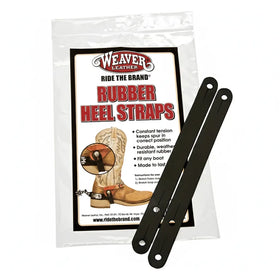
- Thread the strap through both slots. Run the spur strap through the slots on each side of the spur and over the instep of the boot, then fasten it on the outside. Keep the strap flat as you fasten it. A twisted strap can create pressure points and may allow the spur to rotate.
- Adjust for a secure, controlled fit. Tighten the strap until the band sits securely on the boot heel. The spur may move slightly up or down, but it should not slide down onto the base of the heel or swing freely from side to side. If it shifts excessively, stop and refit it before riding.
- Test the position with your stirrup length. Mount only after checking that your stirrups allow your lower leg to rest naturally. Ride at a walk and confirm that the spur stays in place when your heel is down and your ankle remains relaxed. If your leg position changes the spur's contact point, adjust the fit or stirrup length rather than forcing the aid.
Boot shape matters. A well-constructed pair of riding boots gives the spur band a more consistent surface than a loose or heavily rounded heel. Before your next ride, view our full selection of spurs and spur straps to find a combination suited to your discipline and boot style. For Western spurs, wide leather straps such as the Weaver Leather Horizons Spur Straps help the spur stay put and protect the top of the foot.
Spurs come in ladies', men's and children's or youth sizes. Shires makes its roller ball spurs in Gents and Ladies sizes, and Western youth pairs such as the Professional's Choice Equisential Youth Spurs drop to a 1/2-inch band. Go by how the band fits your boot rather than the size label.
Caring for your spurs
A little care keeps a spur working the way it should. Shires' care instruction for its stainless steel spurs is simply "wipe clean," so wipe off sweat, dirt and arena dust after each ride and dry the spurs before you put them away. Sprenger adds that hair and dirt should be cleaned from all spurs with rowels, especially when horses are changing their coats, so the rowel can always spin freely. Check the straps for cracks or stretching at the same time. Retire a pair that is bent or cracked, has a rowel that no longer turns freely, or no longer sits securely on your boot, because a worn spur cannot give the clear cue you intend.
Ethical Spur Use: Guidelines for Responsible Riders
Spurs should refine an established aid, not replace it. They are an extension of the rider's leg and a way to make communication more precise, not a go-faster button or a punishment device. AQHA judge guidance on spurs frames them the same way: a refinement used last, after seat and leg, never a rider's first reaction.
Establish the leg aid before adding the spur
Start with your normal leg aid and give the horse a fair opportunity to respond. If the horse understands the cue but does not respond, a light, deliberate spur touch may reinforce the request. Use the smallest effective aid, then remove the pressure as soon as the horse responds. That release is part of the conversation. Holding pressure after the desired response can confuse the horse and dull the meaning of the aid. Our guide on how to use equestrian spurs walks through the stages of pressure.
In practice, spurs should support accuracy, such as encouraging a horse to move laterally away from the leg, rather than being used simply to create more forward speed. Basic voice and leg responses should come first, with spurs helping refine communication afterward.
A stable leg is a safety requirement
Responsible spur use depends on a quiet, independent lower leg. A rider who is still gripping, bouncing, or losing balance may make accidental contact, even with a mild spur. Build an independent seat before riding in spurs, and practice keeping the leg stable at the walk, trot, and canter. Stay aware of your leg position throughout the ride so the signal remains consistent rather than intermittent or startling.
If you are still learning basic aids, seek instruction without spurs until your seat and leg are sufficiently independent. Choosing equipment should account for both horse and rider training level, along with the horse's sensitivity and body shape, rather than following a trend or selecting the most prominent design. The Sprenger spur-selection guide highlights these factors, and recommends softer spurs for young horses that are still learning the plain leg aid.
Know when spurs are inappropriate
Do not introduce spurs to a green or young horse that is still learning basic responses to voice and leg commands. The horse needs time to understand those aids clearly before an additional signal is added. A young horse may also react defensively if the rider's leg is not yet stable. The same principle applies to an inexperienced rider: independent balance and reliable leg control come before spur use.
During or after a ride, pay attention to signs that the equipment or its use needs reassessment. Spur rubs, repeated flinching, tail swishing, tension, or a horse that becomes less willing to move forward deserve an immediate pause. Remove the spur, check the fit and placement, review the aid with a qualified instructor, and consider whether the horse may be uncomfortable. For practical care resources, keep appropriate horse health and first aid supplies available, but do not treat visible irritation as something to ride through. For what the research says about spur marks, see Do Spurs Hurt Horses?
Use spurs as refinement, never force
Every good spur choice leads back to the same standard: use the mildest effective tool, apply it with a stable leg and release promptly. If a horse repeatedly ignores an aid, investigate training, tack, fit, comfort and understanding before increasing pressure. Ethical riding is not about making a stronger correction. It is about making the clearest request possible and listening carefully to the response.
Choosing Your Next Pair
Match the spur to your horse
Start with the horse in front of you. Sprenger says softer spurs or spurs with a wide rowel should be used for particularly sensitive and delicate horses, that blunt or lazy horses often need clearer signals, and that spurs should be avoided with young horses at the beginning so they can gain confidence in the plain leg aid. For a sensitive, forward horse, a ball, roller or very short neck is usually enough, and some horses need no spur at all. For a laid-back horse that has learned to ignore the leg, check training, tack and comfort first; a flat Prince of Wales gives a more distinct signal than a ball without anything sharp. If this is your first pair, our beginner's guide Horse Spur 101 walks through the basics.
The right spur supports clearer communication when it matches your discipline, your boot and your riding experience. Hooves and Paws has supplied riders since 1994, and you can compare styles, shank lengths and straps side by side in our Spurs & Spur Straps collection.
Frequently Asked Questions
When should you use spurs on a horse?
Use spurs only after your horse understands basic voice and leg aids and responds consistently. A spur should refine a quiet, precise aid, often to encourage lateral movement, rather than replace training or create more speed. Apply a light touch, then release as soon as the horse responds. Spurs are not a go-faster button: if a horse seems lazy or unresponsive to your leg, check training, tack and comfort first, and ask your vet if a once-responsive horse turns dull.
Are spurs cruel to horses?
Spurs are not inherently cruel when an experienced rider uses them as a controlled communication aid, with a stable leg and appropriate equipment. They can cause discomfort or injury when used to jab, punish or compensate for an unsteady leg. Humane use means watching the horse's responses and releasing as soon as it answers; AQHA judge guidance lists tail wringing, pinned ears and kicking out as signs a horse is objecting.
Can beginners use horse spurs?
Most beginners should wait until they have an independent seat, steady lower leg and reliable basic aids. Starting with rounded or ball spurs and a short shank may be appropriate with qualified instruction, but a rider who cannot keep the leg quiet can give accidental signals. Young or green horses should first master voice and leg responses before spurs are introduced. Sprenger's selection guidance supports matching equipment to rider and horse training level.
How do I fit horse spurs properly?
Set the band snugly on the spur rest of the boot heel so it does not slide down onto the heel base, with the buckle on the outside and the neck angled down, never up. Bring the boots you ride in when you choose spurs, since the heel and sole shape change the fit. Check the fit before riding, then confirm your leg position stays consistent to prevent accidental contact.
Can I use the same spurs for English and Western riding?
It is usually better not to. English spurs have narrower bands and short necks made for English boots and a close leg, while Western spurs have wider bands and longer shanks made for Western boots and leg position. The rules differ as well: USEF dressage allows only metal, English-style spurs (DR120.4), and hunter and jumper rules bar serrated rowels (HU106.6, JP111.3). Choose a pair that fits the boot you ride in and the rules of the class you enter.


